
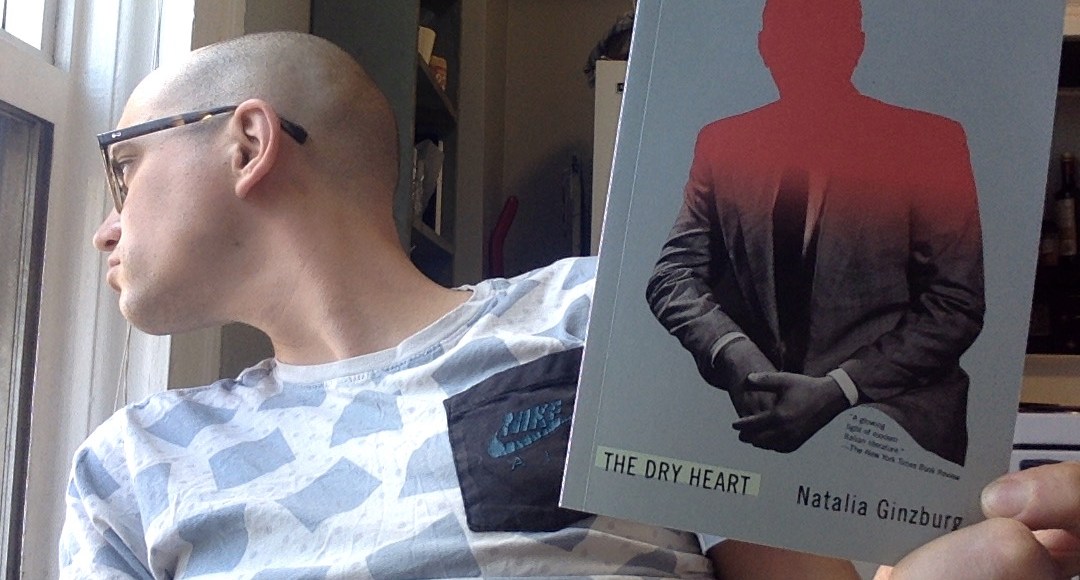

The Dry Heart is a gorgeous Italian novella from 1947, written by Natalia Ginzburg and published in a beautiful fresh edition by New Directions. It’s not a new translation, though, it’s the same translation that has been used in English renditions of this book since the 1950s (by Frances Frenaye). It doesn’t need to be redone, though, as it’s a clear, crisp, evocation of a clear, crisp narrative and it works very very fucking well.
The Dry Heart is about a shit marriage and it opens and closes with the wife murdering her cheating spouse. So, I suppose it’s not just a shit marriage, it’s more like a proper fucking terrible marriage. Open, disapproved-of, adultery and spousal murder, ino, make for a marriage terrible. Yes.
The Dry Heart is a beautiful, haunting, deeply emotive novella about child mortality, about sexual (and romantic) repression, about recklessness and selfishness and about people’s urges and desires leading them in the worst possible directions.
The Dry Heart is about the need for propriety that was a ubiquitous staple of many societies for a long time in the previous century and still is for small-minded losers now.
The Dry Heart is about people who stay in unhappy relationships and how the distractions from these relationships often cause more harm.
The central relationship in the life of Alberto, the unnamed (I think!) narrator’s husband, is not the one with his wife, it is the one with Giovanna, the woman he has been in love with for decades.
Alberto is in his mid-forties and having an on-off relationship with an age-appropriate, but married, woman, with whom he has phenomenal sexual chemistry. He distracts himself from this by spending time with a young, naive, schoolteacher who is flattered (and confused) by the attentions of this handsome, older, affluent, man.
The narrator projects romance and desire onto the weird friendship she develops with this older man (a friend of her mentor), who is way out of her league. Alberto is surprised and kinda hurt when the narrator reveals her attraction and intentions to him.
The narrator proposes to him, with no prior romantic action or conversation: Alberto never kissed her or made a subtle move because he doesn’t/didn’t want her, and he doesn’t/didn’t need to want her: Alberto already has spellbinding sex and romance in his life, but because his lover, the woman he loves, has a husband and a child he decides to try and make her jealous by having the same things right back at her.
Alberto’s wife is a tool, a foil: he enters the marriage for completely the wrong reasons, as does she.
The narrator wants a husband, she wants stability, she wants to have a husband that she “knows exactly where he is” at all times. She wants an all-consuming marriage, she wants to control and be controlled, but she doesn’t do anything to make this happen, she doesn’t look for lovers, she doesn’t go on dates or do anything except entertain a man who wants to be seen around with a young woman but has no real interest in her at all.
Our once-naive narrator misread Alberto’s slow conversation as intense listening, as real and profound romantic involvement and excitement, which it never was. She’s also scared of sex and doesn’t know what she wants: they are a terrible match.
The Dry Heart is about desire, it is about not knowing how to express it, how to feel it or how to recognise it.
The narrator wants to be wanted, she wants to want, but she doesn’t want Alberto, or his (nicer) friend, Augusto, who also used to be a lover of Giovanna. Eventually, the narrator meets Giovanna, and – of course – Giovanna is kind and compassionate to a woman who she knows isn’t her rival. Giovanna understands the situation better than the narrator does and she pities her. Obviously, the narrator doesn’t enjoy being pitied by her husband’s lover, but what can she do to stop this? Kill ‘im, I suppose.
The Dry Heart touches on ideas of expected behaviours, how a person should be, particularly who a woman should be.
It’s a freshly post-war novel but makes no mention of this explicitly. Perhaps it is implied by the sexual liberation of Francesca, the narrator’s cousin, who is – like everyone in this novel to some extent – bored and unexcited by life. Francesca seeks adventure and romance and alcohol and glamour, while her unnamed cousin seeks stability and a husband and a baby but it all falls to dust because she does so for all the wrong reasons.
Convention is a dangerous thing and should be abjured.
A great book. Recommended, and I’ll read more Ginzburg soon…
MY GLASGOW INTERNATIONAL COMEDY FESTIVAL WIP SHOW IS ON 12TH MARCH! TICKET LINK HERE!

Thank you so much for reading TriumphoftheNow.com! If you like what you’ve read, please subscribe, share and order one of my books. If you love what you’ve read, why not order me something frivolous and noisy from this Amazon wishlist or make a quick donation via my ko-fi page?
I’m currently focusing on parenting and creative practice, so small donations are appreciated now more than ever!
scott manley hadley aka SOLID BALD live
Here’s a video of me recently performing at the prestigious (it has a Wikipedia page) comedy night, Quantum Leopard. Listen to how much fun the crowd is having. You could have that much fun, too!
Forthcoming gigs include the following – there may/will be others:
12th March 2026: BALD PERSONALITY DISORDER 30 MIN WIP at Glasgow International Comedy Festival
26th March 2026, 7.30pm: Comedy @ Cosmic, Plymouth
Various Dates and Times, May 2026: BALD PERSONALITY DISORDER FULL LENGTH WIP at the BRIGHTON FRINGE
27th June 2026: Twinkles Cabaret, London
Discover more from Triumph Of The Now
Subscribe to get the latest posts sent to your email.

 Triumph Of The Now
Pingback: Valentino and Sagittarius by Natalia Ginzburg – Triumph Of The Now