
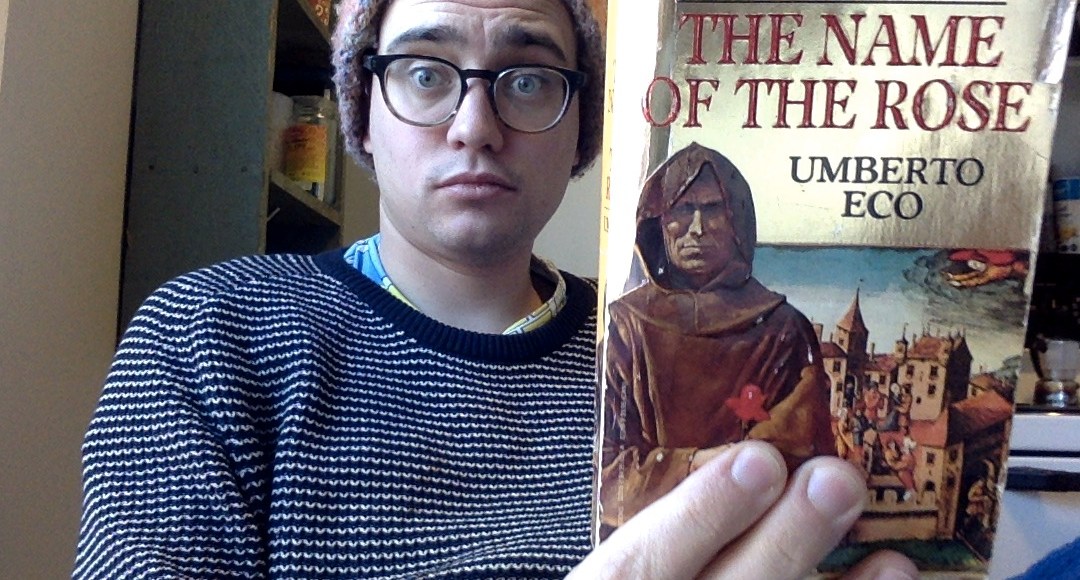

This is one of those books that every middle class person I know read when a teenager because every adult then living and reading literature bought a copy of this at some point in the eighties or nineties.
The Name of the Rose is a big deal kinda book.
It’s a canonical[ish] novel, a famous novel: there’s apparently a big budget film of it with Sean Connery in, which I’d never heard of until I was reading this and someone told me about it, which I’m now excited to watch lol.
I don’t know why The Name of the Rose is a bestseller, as it’s the kind of book that literary nerds like me enjoy because it’s – given its status – surprisingly dense and discursive.
Though there is, yes, some great mysterious, suspicious, bloody violence that results in a compelling murder mystery that runs through the novel’s centre, demanding explanation like a wayward horny monk demanding Flesh, what the book is much more about is different interpretations of Christianity.
The Name of the Rose is punctuated by long scenes of debate-y dialogue that contrasts oppositional ways of engaging with holy texts and different ways of looking to the (then) future of the church.
The Name of the Rose is set in the middle of the fourteenth century and involves a respected ageing monk, William, arriving at a remote monastery in the Italian Alps to oversee a meeting between two factions of a schism in the Catholic church.
The Emperor is in Rome, but the Pope is in Avignon, and they send delegations to meet halfway to try and find a way forwards, but when William (and Adso, his secretary/intern/novice/whatever) arrive at this mountaintop abbey they discover that the place is in disarray, because a monk was found suspiciously dead the night before.
The abbot asks William – a former inquisitor – to investigate, and just as they are getting ready to dive into the exploration of Truth, another monk’s dead body is found in even more suspicious and bloody and horrible circumstances and it’s a race against time to get everything cleared up before this international summit happens.
This, then, becomes the pattern of the book: just as a murder is about to be solved, another one happens that erodes the likelihood of the nearly-reached solution. There is a huge, forbidden, library that takes up an entire floor of the abbey’s massive castle; the library is built like a labyrinth, and William soon realises that the truth is to be found somewhere in that terrifying structure.
There’s loads of murder, a bit of torture, a surprising amount of sex, some big druggy hallucinations, some big dream sequences, the threats of execution by fire, there are heretics and there’s religious debate and there is sinister, creepy, awful violence perpetrated with a clear conscience and a creepy religious zeal. It’s great.
Actually, I retract my comment about not understanding why it was a bestseller: of course it was a bestseller, it’s an easy sell, innit?
The Name of the Rose is a clever book and it feels like a clever book, it’s also much more complicated and complex and literary in its writing than most of the “literary” bestsellers of recent years, eg The Goldfinch, which is a very genrey thriller, not a literary text.
The Name of the Rose uses the tropes of historical fiction and murder mystery to prop up scenes of conversation and dialogue that are often very long set pieces exploring the different attitudes various Catholic sects had, in the fourteenth century, to things as disparate as – the two that recur – poverty and laughter.
It is, though, very homosocial and v male gazey: it reminded me of John Fowles, and I mean that as both critique and compliment.
///
Sorry, had to do some work for a while.
But, yeah, it’s a good novel.
My only disappointment with it rests in the narrative of the narrator, who is Adso, William’s teenage protege. Adso is writing his memories of this wild time in his youth when he is a very old man, a very old monk.
This means that all the personal development Adso goes through in the body of the novel came to naught: though he sees the hypocrisy and corruption and greed and cruelty of the Church in a clear and undeniable manner, he still dedicates his life to it and does nothing to reform the institution of which he is a part..
There’s a sadness to this overarching structure, I suppose. I imagine this is self-conscious from Eco, evoking that nostalgia, that destructive backwards look.
This was translated by William Weaver, so I don’t know if other editions make it more readable or more literary in English.
Not too much to say about this one, teehee.

Thank you so much for reading TriumphoftheNow.com! If you like what you’ve read, please subscribe, share and order one of my books. If you love what you’ve read, why not order me something frivolous and noisy from this Amazon wishlist or make a quick donation via my ko-fi page?
I’m currently focusing on parenting and creative practice, so small donations are appreciated now more than ever!
scott manley hadley aka SOLID BALD live
Here’s a video of me recently performing at the prestigious (it has a Wikipedia page) comedy night, Quantum Leopard. Listen to how much fun the crowd is having. You could have that much fun, too!
Forthcoming gigs include the following – there may/will be others:
17th March 2026, 7pm: Slap & Giggle @ Coin Laundry, Clerkenwell
24th March 2026, 7.30pm: Lolipops, Southwark
26th March 2026, 7.30pm: Comedy @ Cosmic, Plymouth
9th April 2026, 7pm: Sunset Comedy, Chalk Farm
15th April 2026, time tbd: BALD PERSONALITY DISORDER 40min-ish WIP at Shirker’s Rest, New Cross (more details soon!)
27th June 2026: Twinkles Cabaret, London
9th August – 14th August: BALD PERSONALITY DISORDER at The Street, Edinburgh, part of PBH’s Free Fringe
Discover more from Triumph Of The Now
Subscribe to get the latest posts sent to your email.

 Triumph Of The Now
Pingback: LOTE by Shola von Reinhold – Triumph Of The Now
Pingback: A Small Town In Germany by John Le Carré – Triumph Of The Now
Pingback: A Canticle for Leibowitz by Walter M. Miller Jr. – Triumph Of The Now
Pingback: The Rose Field by Philip Pullman (The Book of Dust Volume 3) – Triumph Of The Now