
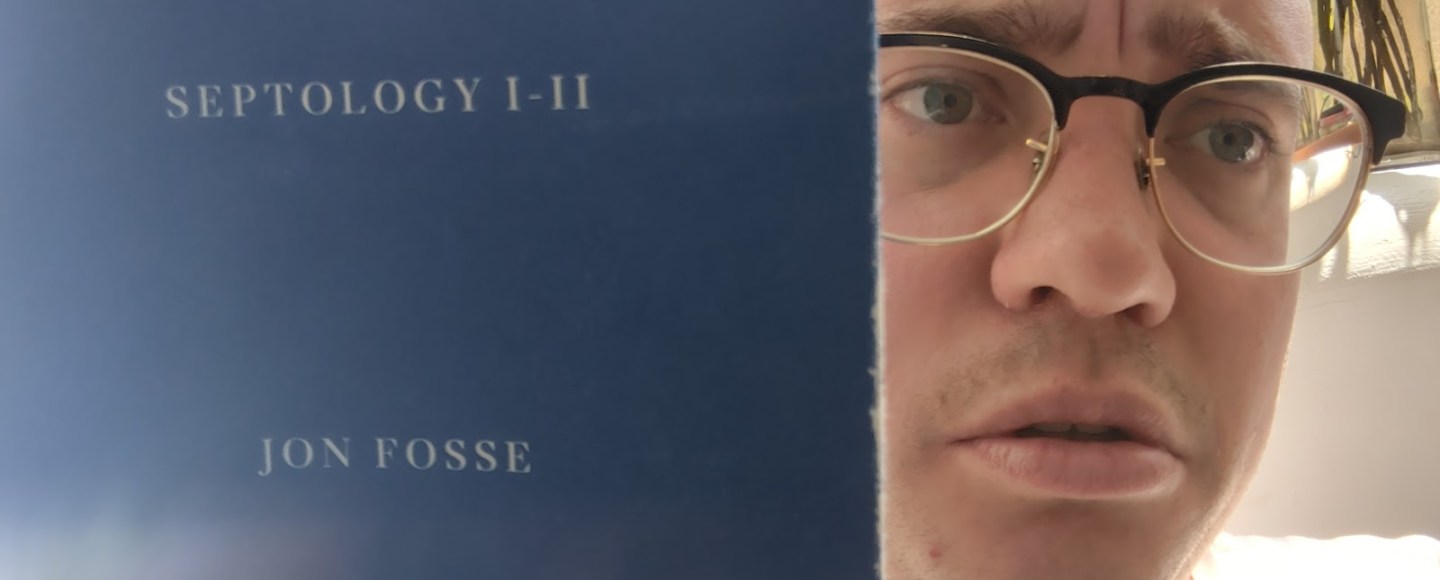

July 5th, 2022, Tottenham
Jon Fosse is a Norwegian writer and this book – The Other Name (Fitzcarraldo Editions 2019, translated by Damion Searls, original Norwegian also 2019 I believe) – is the first part of a trilogy of novels (or the first two parts of a “Septology”) that has been recently published and lauded by critics as a masterpiece.
Is it a masterpiece?
That’s not for me to say, as I’ve only read the first third, but if I were to treat this as a singular totality, I could see myself being a little unimpressed.
The Other Name is somehow very beautiful, very serious, very moving, very literary, very readable, but alongside all of this, it is also – somehow – more than a little dull.
This is the story of Asle and (possibly?) Asle, two (or possibly one) past-their-prime Norwegian painters (as in visual artists rather than decorators) living in the countryside one early Winter.
This novel is a first person stream of consciousness from [an] Asle, a depressed childless teetotal Catholic widower, preparing for his annual commercial art show. He chats to his neighbour, a single and uneducated farmer who does odd jobs for the artist (and has a sister who he clearly wants to set up Asle with), he reminisces about falling in love with Ales (his dead wife) and he heads into the nearest city to check on the other Asle, who he’s worried about.
(The other Asle is both an alternative Asle and the same Asle)
Asle finds Asle unconscious in the snow in the street and takes him to a local hospital, then collects Asle’s dog from his apartment and runs into a flirty divorcée-type (who seems to be a city-based double for the farmer’s sister (the way city-based Asle is a double for rural Asle)) who he doesn’t recognise but she claims they used to fuck regularly back in Asle’s drinking days, and because he did use to have drinking days (tho a long time ago) he doesn’t make any firm denials.
The Asle who lives in the city, and is unconscious for the majority of this novel, tho, is also an artist and described, physically, as identical to narrator-Asle but with numerous key differences in terms of life experiences and personality.
City-based Asle is a depressed alcoholic drinking himself to death.
City-based Asle was divorced multiple times and has numerous estranged children scattered across Norway and seems to be as much of a social recluse as narrator-Asle, save for occasional trips to buy (and drink) alcohol, and also because he lives with a dog (a state of living which I highly recommend). This Asle also lacks the comfort found by the narrator in his Catholicism.
What this ends up being is a gentle, slow, text, full of thoughts about the meanings and expectations of life, as well as the power and the potency of creativity and self-expression.
Narrator-Asle explores his own experiences from his past and narrates his thoughts as he wanders through the present; he considers which paintings to exhibit for sale and which to keep for himself, he considers how he will spend the upcoming Christmas, he talks about food he likes to eat and the meat and fish products his neighbour produces at a very high quality. He thinks about driving, about ageing, about why he doesn’t drink and why he doesn’t smoke and how he was able to make these healthier life changes: his faith and his stable marriage, both of which the other Asle lacks.
The stream of consciousness is what keeps the book compelling, the reader is within one sentence as it evolves from one idea, one thought, to another, we see the processes and the passage from present to memory to alternative present to – in the final pages of Septology II – a harrowing flashback to an experience of childhood sexual abuse that reconfigures the ways in which Asle (either of them, both of them?) have responded to later events.
I think it is this very structure that made me feel the book was somewhat boring, an impression that hasn’t really stuck with me since I put it down a little over an hour ago: by not really giving a reader a signposted place to stop reading (i.e. the end of a section/chapter/paragraph even!) I found myself reading more Fosse each time I picked it up than I really wanted to – 30 minutes before bed became 60 minutes, 10 minutes on public transport turned to 15 as I loitered at my destination to continue reading: the stream of consciousness device compelled me to read more of this writing – and read it faster – than I really wanted to.
I was reading Fosse because I wanted to get to the end of the sentiment, the idea, so that I could transition into a different activity (e.g. sleeping, buying a lightbulb, putting away my laundry etc), rather than reading Fosse because I wanted to be reading Fosse at that moment.
It’s strange, because it’s beautifully written (well, beautifully translated by Damion Searls, I cannot speak to Fosse’s prose!) but its form kept reeling me in when its content – philosophical memorialising/explorative prose – felt much better suited to a slower ingestion.
The stream of consciousness device can be used to phenomenal effect, but – in my arrogant (I haven’t been humble since I was quoted in the New Yorker) opinion – it is better suited to narratives with urgency within the content, y’know – Mathias Enard’s Zone, the last bit of fucking Ulysses, fuckin’ On The Road – not this (tbf gorgeous) discursive look at the slower end of life.
I dunno, obviously Fosse is highly acclaimed and obviously this is an excellent novel, but I feel that I would have enjoyed The Other Name more if I’d been able to sip it over a week, rather than down it in a day, which was what the relentless of its single-sentence structure pushed me towards.
I’m definitely going to read the rest of Septology, because it’s clearly very good, but another reason is that I’m unemployed rn (by choice, don’t worry!) so I’m time-rich and cash-[for-books-]poor and I already have them both lol.
///

ADDENDUM –
the edition I have came with a little pamphlet containing a translation of an interview with Fosse that was originally published in El Pais (written by Andrea Aguilar, translated by Rahul Bery) in June 2019.
In this short interview, Fosse touches on his interest in theology, his own history with problem drinking (and sobriety), his huge success in Norway, but the piece ends with him admitting that he doesn’t read any new writing, which – for me at least – isn’t really a good stance for a creative professional to take, right? I don’t believe that art can transcend its context.
Hmmmmmmmmmm what do I know, tho?
To counter this accusation being pointed at me I will next read something new rather than the Doris Lessing I was planning lol.

Thank you so much for reading TriumphoftheNow.com! If you like what you’ve read, please subscribe, share and order one of my books. If you love what you’ve read, why not order me something frivolous and noisy from this Amazon wishlist or make a quick donation via my ko-fi page?
I’m currently focusing on parenting and creative practice, so small donations are appreciated now more than ever!
scott manley hadley aka SOLID BALD live
Here’s a video of me recently performing at the prestigious (it has a Wikipedia page) comedy night, Quantum Leopard. Listen to how much fun the crowd is having. You could have that much fun, too!
Forthcoming gigs include the following – there may/will be others:
17th March 2026, 7pm: Slap & Giggle @ Coin Laundry, Clerkenwell
24th March 2026, 7.30pm: Lolipops, Southwark
26th March 2026, 7.30pm: Comedy @ Cosmic, Plymouth
9th April 2026, 7pm: Sunset Comedy, Chalk Farm
15th April 2026, time tbd: BALD PERSONALITY DISORDER 40min-ish WIP at Shirker’s Rest, New Cross (more details soon!)
27th June 2026: Twinkles Cabaret, London
9th August – 14th August: BALD PERSONALITY DISORDER at The Street, Edinburgh, part of PBH’s Free Fringe
Discover more from Triumph Of The Now
Subscribe to get the latest posts sent to your email.

 Triumph Of The Now
Pingback: I Is Another by Jon Fosse (Septology III – V) – Triumph Of The Now