
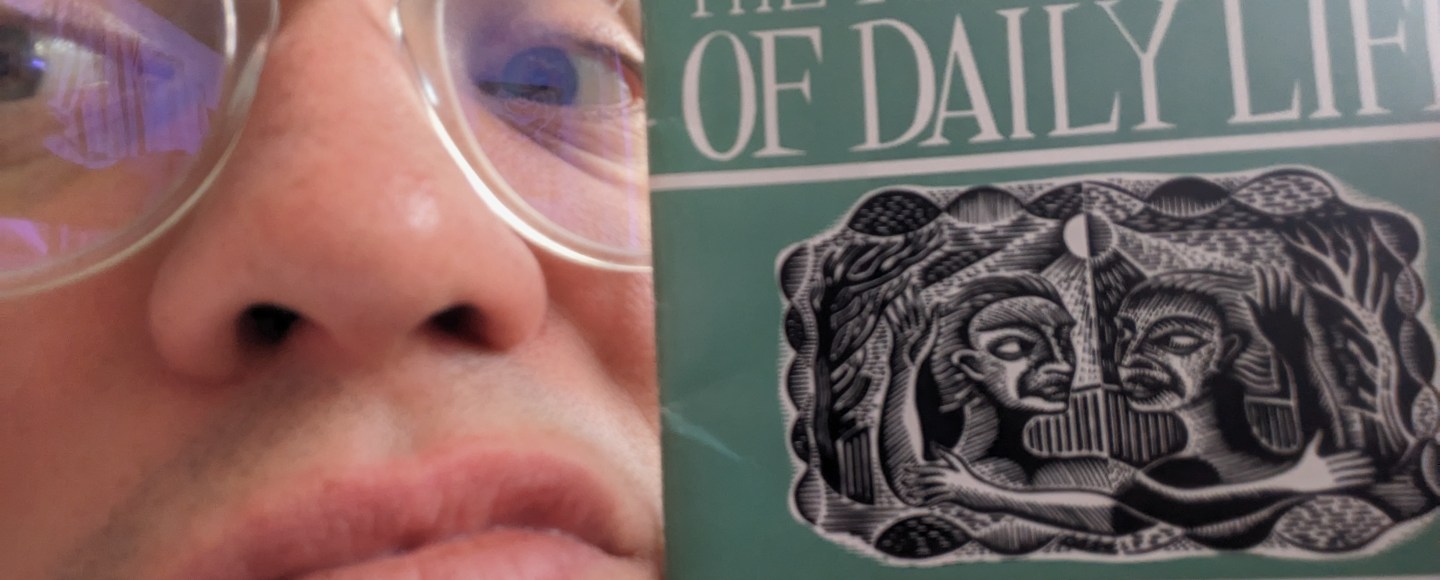

I buy books I don’t read, gain knowledge I don’t apply, make decisions I ignore, strive strive strive but for nothing, pretend, act, live as if, behave as if, do as if…….. it’s all a fuccen pointless fuccen waste of time like who’s even reading this or even not skipping skipping not skipping skipping not skipping the bit in italics at the top where I mention something about buying loads of fuccen radical pamphlets whatever the fuck I mean by that as I don’t fuccen know I know nothing no no no no no no no know nothing… notes on a radical pamphlet is an occasional series…
Why do we live the way we do? Why do we acquiesce? Why do we fucking accept it? Why, even when we fucking understand – which many of us fucking do – that the entire fucking base of our fucking society is drilling a fucking hole into the possibility of any kind of happiness or contentment, when when when the way in which we live, the way we have been conditioned to live is so fucking rotten and so fucking sick that it just that we just that it just that we just that that that that-
Oooooo
Why do we let it happen, let it keep happening? When we know, we understand, we get that we know that the the the the the the system is designed to perpetuate, the system is the system is
Why don’t we break it down? Why are we all so fucking weak as to not act or so fucking amoral or disconnected or unquestioning enough to not see that it needs to be broken down?
Why does it persist? Why do we all let the the the the the the propaganda fill us up with a sense that the world is as the propaganda claims, that what it says is inevitable and true is both, even tho we know it’s not???
Why do we let ourselves not change, why don’t we make ourselves change? Why do? Why don’t?
By having another “normal day”, we make another normal day more likely to happen… By not resisting, nothing is resisted; by not stopping the cycle of the status quo we remain trapped within it… By do be good we do be good; by basing our moralities and sense of self on the notions of good and bad, on the notions of productivity and responsibility, on maturity and wisdom, of of of of of-
We’re all fuckinf fucked.
Fredy Perlman (although conspicuous as the only individual I’ve ever encountered who spells Freddy/ie with only one d (the “y” or “ie” seems a personal choice) gets this. Got that. Writing in 19 fucking 69.
Writing in 1969.
Nothing has changed. Nothing changes. Nothing changed. Nothing has yet changed.
Maybe nothing will?
Someone start a global revolution and let’s all grow out of this sick self-destructive cycle that humanity has got itself stuck into…
We have to hope, we have to believe, that a better world is possible, believe that the statements that the capitalists spit are lies, to not believe that we get this or we get chaos… We have the extracted theft of labour (profit) or we have slavery and dictatorship and war lords and cruelty … I don’t think that’s fucking true. I can’t think that’s fucking true. How can fucking anyone???
Some excerpts from Perlman below:
In exchange for his sold activity, the worker gets money, the conventionally accepted means of survival in capitalist society. With this money he can buy commodities, things, but he cannot buy back his activity. This reveals a peculiar ‘gap’ in money as the ‘universal equivalent.’ A person can sell commodities for money, and he can buy the same commodities with money. He can sell his living activity for money, but he cannot buy his living activity for money.
The things the worker buys with his wages are first of all consumer goods which enable him to survive, to reproduce his labor-power so as to be able to continue selling it; and they are spectacles, objects for passive admiration. He consumes and admires the products of human activity passively. He does not exist in the world as an active agent who transforms it, but as a helpless, impotent spectator; he may call this state of powerless admiration ‘happiness,’ and since labor is painful, he may desire to be ‘happy,’ namely inactive, all his life (a condition similar to being born dead). The commodities, the spectacles, consume him; he uses up living energy in passive admiration; he is consumed by things. In this sense, the more he has, the less he is. (An individual can surmount this death-in-life through marginal creative activity; but the population cannot, except by abolishing the capitalist form of practical activity, by abolishing wage-labor and thus de-alienating creative activity.)
…
By selling their labor, by alienating their activity, people daily reproduce the personifications of the dominant forms of activity under capitalism, they reproduce the wage-laborer and the capitalist. They do not merely reproduce the individuals physically, but socially as well; they reproduce individuals who are sellers of labor-power, and individuals who are owners of means of production; they reproduce the individuals as well as the specific activities, the sale as well as the ownership.
Every time people perform an activity they have not themselves de- fined and do not control, every time they pay for goods they produced with money they received in exchange for their alienated activity, every time they passively admire the products of their own activity as alien objects procured by their money, they give new life to Capital and annihilate their own lives.
…
The worker alienates his life in order to preserve his life. If he did not sell his living activity he would not get a wage and could not survive. However, it is not the wage that makes alienation the condition for survival. If men were collectively not disposed to sell their lives, if they were disposed to take control over their own activities, universal prostitution would not be a condition for survival. It is people’s disposition to continue selling their labor, and not the things for which they sell it, that makes the alienation of living activity necessary for the preservation of life.
…
For labor to create Capital, the value of the products of labor must be larger than the value of the labor. In other words, the labor force must produce a surplus product, a quantity of goods which it does not consume, and this surplus product must be transformed into surplus value, a form of value which is not appropriated by workers as wages, but by capitalists as profit. Furthermore, the value of the products of labor must be larger still, since living labor is not the only kind of labor materialized in them. In the production process, workers expend their own energy, but they also use up the stored labor of others as instruments, and they shape materials on which labor was previously expended.
This leads to the strange result that the value of the laborer’s products and the value of his wage are different magnitudes, namely that the sum of money received by the capitalist when he sells the commodities produced by his hired laborers is different from the sum he pays the laborers. This difference is not explained by the fact that the used-up materials and tools must be paid for. If the value of the sold commodities were equal to the value of the living labor and the instruments, there would still be no room for capitalists. The fact is that the difference between the two magnitudes must be large enough to support a class of capitalists not only the individuals, but also the specific activity that these individuals engage in, namely the purchase of labor. The difference between the total value of the products and the value of the labor spent on their production is surplus value, the seed of Capital.
…
In terms of capitalist society as a whole, the total Capital is equal to the sum of unpaid labor performed by generations of human beings whose lives consisted of the daily alienation of their living activity.
…
As soon as a person sells his labor to a capitalist and accepts only a part of his product as payment for that labor, he creates conditions for the purchase and exploitation of other people.
…
Buyers for old and new products are created by any and all available means, and new means are constantly discovered. ‘Open markets’ and ‘open doors’ are established by force and fraud. If people lack the means to buy the capitalists’ products, they are hired by capitalists and are paid for producing the goods they wish to buy; if local craftsmen already produce what the capitalists have to sell, the craftsmen are ruined or bought-out; if laws or traditions ban the use of certain products, the laws and the traditions are destroyed; if people lack the objects on which to use the capitalists’ products, they are taught to buy these objects; if people run out of physical or biological wants, then capitalists ‘satisfy their ‘spiritual wants’ and hire psychologists to create them; if people are so satiated with the products of capitalists that they can no longer use new objects, they are taught to buy objects and spectacles which have no use but can simply be observed and admired.
…
Hard agree, as the academics say…

Thank you so much for reading TriumphoftheNow.com! If you like what you’ve read, please subscribe, share and order one of my books. If you love what you’ve read, why not order me something frivolous and noisy from this Amazon wishlist or make a quick donation via my ko-fi page?
I’m currently focusing on parenting and creative practice, so small donations are appreciated now more than ever!
scott manley hadley aka SOLID BALD live
Here’s a video of me recently performing at the prestigious (it has a Wikipedia page) comedy night, Quantum Leopard. Listen to how much fun the crowd is having. You could have that much fun, too!
Forthcoming gigs include the following – there may/will be others:
17th March 2026, 7pm: Slap & Giggle @ Coin Laundry, Clerkenwell
24th March 2026, 7.30pm: Lolipops, Southwark
26th March 2026, 7.30pm: Comedy @ Cosmic, Plymouth
9th April 2026, 7pm: Sunset Comedy, Chalk Farm
15th April 2026, time tbd: BALD PERSONALITY DISORDER 40min-ish WIP at Shirker’s Rest, New Cross (more details soon!)
27th June 2026: Twinkles Cabaret, London
9th August – 14th August: BALD PERSONALITY DISORDER at The Street, Edinburgh, part of PBH’s Free Fringe
Discover more from Triumph Of The Now
Subscribe to get the latest posts sent to your email.

 Triumph Of The Now
Pingback: The Conquest of Bread by Peter Kropotkin – Triumph Of The Now