
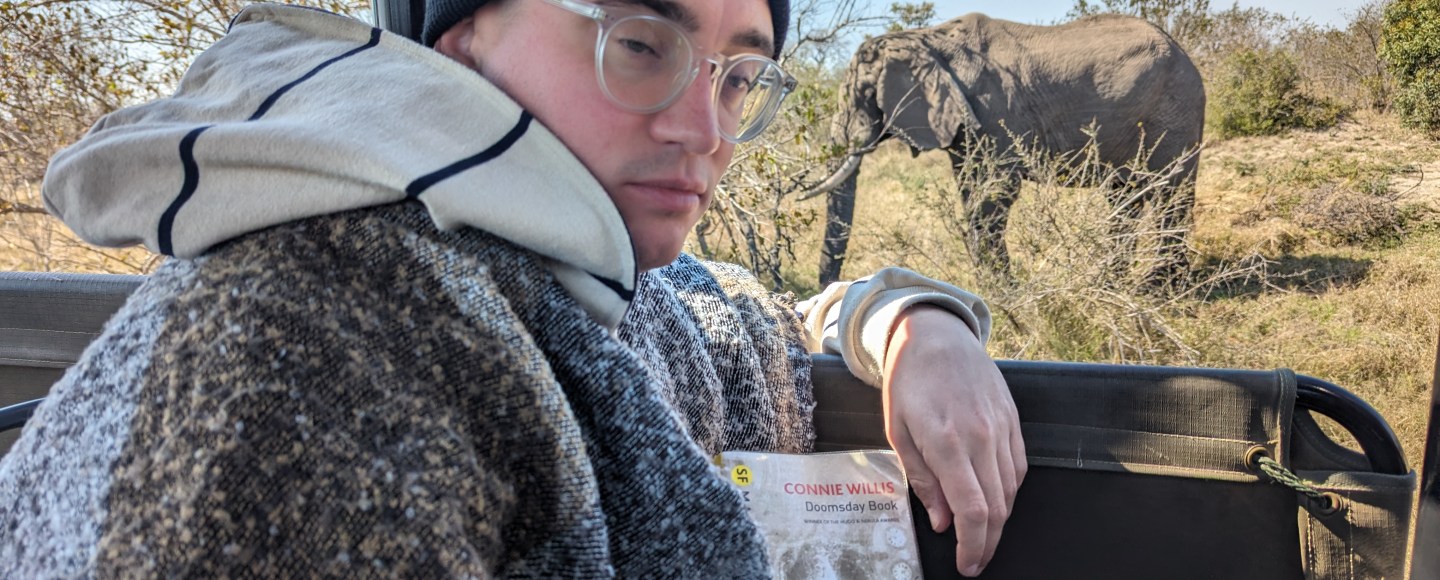

As you can probably guess from the photograph illustrating this post, I read this book on holiday. As such, I’ll be favourably commenting upon it in this capacity only, as a holiday read – where it does definitely stand up – while unfavourably commenting upon it as a highly regarded novel, winning multiple awards and receiving lots of acclaim, where – in my opinion (remember, readers, everything here is always just opinion!) – this book very much disappoints. Or disappointed me.
–///–
Ok, upfront comment here: Doomsday Book is a 1992 600 page tome about – and this is where I’ll probably lose a few readers of the post and that’s fair enough – time travel.
I like novels/films about time travel. I like good ones, I mean. Ones where time travel is part of the plot, rather than merely a device for a change of setting. So I’m also commenting on this novel in comparison to other depictions of time travel in literature.
Why do I like time travel? I like the way in which as a plot device it can be used to draw attention to inevitability, to mortality, to the fact that most acts – far more than we’d like to admit – are irrevocable, can never be undone…
Time travel used well (e.g. The Time Traveler’s Wife and yes I do mean that!) dramatises that a) fate isn’t real and that a belief in it is almost always used as an excuse for apathy, or for faith in an ideology that offers no proof; and b) we are stuck, trapped, riven and hemmed in almost entirely by our previous acts, our previous mistakes.
Time travel – when used well – is almost always a false promise, a way to divest someone of belief in a deus ex machina, a way to demystify by offering clarity through a changed perspective.
In good time travel narratives, nothing is changed – a well-constructed time travel narrative offers a neat, flawless, plot where everything that happened can be explained by other things as they happen: good time travel stories demonstrate that one cannot change the past, rather than that one may not change the future.
You get the difference, right?
It’s not about behaviour or rules, it’s about impossibility.
We (I) don’t want to fuck with no multiverses here on TriumphOfTheNow.com; we (I) just want time travel to be a straightforward back and forth thing set in and along one timeline, where nothing that happens changes anything in the future, and even when someone thinks it will or thinks it has, it has to turn out that it hasn’t. Is that too much to ask?
No, it’s not.
Connie Willis here has a very rigid structure for the time travel included in this novel: the time travel machines have an in-built mechanism where they will automatically reroute any plotted time travel journey in order to avoid potential clashes – the physical location of arrival never changes, but the machine automatically alters the moment of arrival so that no people, animals, bacteria etc are affected by the “drop”, the arrival of the traveller from the future.
But, of course, any repercussions that might happen would have already happened, so these changes are – by the book’s end – less straightforward than initially indicated.
I think this is intentional, but I’m not 100% certain.
In this novel, though, the only people going back in time are historians from Oxford University in the 2050s, and though the reader doesn’t know if this technology exists elsewhere and if it has been or is being used more recklessly by others and for other purposes in this fictional world, but that isn’t what Doomsday Book is about.
It is a simple, 600 page story, about a young history student (the “futuristically” named Kivrin) heading back to check out the 14th century, then chaos ensues when she ends up – future-inoculated against pretty much all pre-existing diseases so not at personal risk – in the midst of a pandemic, possibly (I mean, definitely, but I’m trying to avoid spoilers) an early wave of the Black Death, while the guys running the lab back in London – seemingly her only friends, a bunch of 60-something professors (and, later, Colin, the prepubescent child of one of the professors’ nieces, and William, a 20 year old always-offstage lothario who is able to get literally any woman in Oxford to do literally anything any of the gang requires in their rescue attempt, presumably by getting them off or possibly just by promising to? (Willis is unclear)) – end up having the lab shut down due to a separate pandemic in the 2050s that has Oxford quarantined and puts the lives of every character in danger…
So, yes, there are two parallel narratives – one about someone living through a detailed description of the (likely) realities of a massive pandemic prior to the inventions and interventions of modern medicine (which is all a lie, right?), while the second is about people in a future where video calling exists but mobile phones don’t (and the only other major change seems to be that the Tube (London Underground) has been extended to Oxford, but still takes two hours to get there – I could go on about this more) dealing with a similar event.
Willis, writing this almost 30 years before an actual major global pandemic – much like Soderbergh in Contagion – gets most things right: lots of protest about very minor lifestyle changes required to avoid transmission, lots of vaccine hesitancy, a race to get a vaccine produced and then a hyper rapid return to normal once that has happened, in spite of lots of deaths and lots of people injured/unwell as a result of infection…
–///–
Does Willis depict both pandemics well and with a believable level of detail? Yes, yes she does.
Does the time travel plot hold up to my rigid requirements of time travel narratives? Yes, yes it does.
Is it a great holiday read full of acts of sacrifice and risk-taking? Yes.
Buuuut is it satisfactorily paced? No.
Is the subplot about the most senior historian being AWOL because he has clearly gone time travelling on the DL ever resolved? No.
Did I – a highly emotionally volatile reader who loves to cry and is riding the horse of life bareback these days (i.e. not on mood-altering medication) – ever feel genuinely moved by any of the many, many deaths in the novel? Maybe a little for one or possibly two, but when there is basically a death a page from around halfway through the novel until 25 pages or so before the end, the fact that most – even some that Willis clearly meant to be impactful – failed to land in my catharsis-horny heart feels, to me, like a failure.
So, what I’m saying is this: if you want a 600 page novel about parallel pandemics to read now we’re a couple of years out of a real one, then it’s probably one of the best options.
Buuuuut if you want a flawless, emotionally resonant novel that heats every empathetic beat it tries for, then Doomsday Book just isn’t it.
Maybe reading it post-pandemic is reading it too late… Then again, I’m sure there’ll be another pandemic so maybe there will be a perfect time for it again later…
I mean, I’m saying it’s good, maybe very good, but it’s definitely not great. It’s evocative, it’s descriptive, it builds up readable and realistic dual non-contemporary settings (and renders the impact of travel between them real-feelingly), but it didn’t make me weep, it didn’t make me roar, it didn’t make me cry.
Then again, neither did the elephants or the rhinos or the monkeys or the hyenas or the warthogs or the hippos or the crocodiles or the- actually, safaris aren’t meant to make you cry, are they?
I enjoyed it. But I didn’t love it. And 600 is a lot of pages for something that isn’t love…

Thank you so much for reading TriumphoftheNow.com! If you like what you’ve read, please subscribe, share and order one of my books. If you love what you’ve read, why not order me something frivolous and noisy from this Amazon wishlist or make a quick donation via my ko-fi page?
I’m currently focusing on parenting and creative practice, so small donations are appreciated now more than ever!
scott manley hadley aka SOLID BALD live
Here’s a video of me recently performing at the prestigious (it has a Wikipedia page) comedy night, Quantum Leopard. Listen to how much fun the crowd is having. You could have that much fun, too!
Forthcoming gigs include the following – there may/will be others:
17th March 2026, 7pm: Slap & Giggle @ Coin Laundry, Clerkenwell
24th March 2026, 7.30pm: Lolipops, Southwark
26th March 2026, 7.30pm: Comedy @ Cosmic, Plymouth
9th April 2026, 7pm: Sunset Comedy, Chalk Farm
15th April 2026, time tbd: BALD PERSONALITY DISORDER 40min-ish WIP at Shirker’s Rest, New Cross (more details soon!)
27th June 2026: Twinkles Cabaret, London
9th August – 14th August: BALD PERSONALITY DISORDER at The Street, Edinburgh, part of PBH’s Free Fringe
Discover more from Triumph Of The Now
Subscribe to get the latest posts sent to your email.

 Triumph Of The Now
Pingback: The Psychology of Time Travel by Kate Mascarenhas – Triumph Of The Now
Pingback: To Say Nothing of The Dog by Connie Willis – Triumph Of The Now