
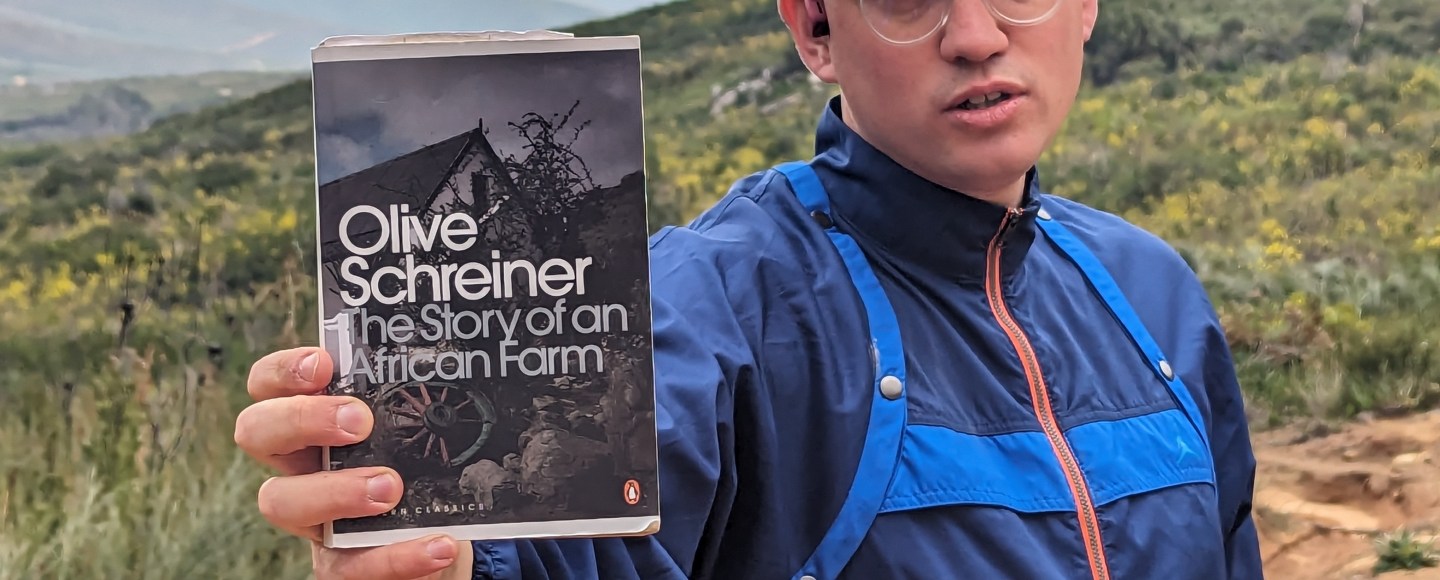

Story of an African Farm is an 1883 (check that) novel written by Olive Schreiner, a (then) young woman who had worked as a governess at several South African farms before moving to London with a manuscript in her suitcase and a dream of a more tolerant, more liberal, more expansive society than the white South African one she had previously lived in…
She did find that, in some ways, and her excellent proto-modernist novel did indeed find a publisher and an audience and she did make friends and colleagues, however over the rest of her career slash life, she quickly became – like many of us who try and think about the way society is organised and realise it’s fucking awful – became “too” left wing for her friends and career and ended up not as… not as important, maybe (?) as she deserved…
–///–
I first read about Story of an African Farm in the context of reading Doris Lessing – who was born two or three (or maybe even four given how long ago it was and how young humans used to breed?) generations later but grew up in a similar (tho posher) scenario to Schreiner two thirds of a century later.
Lessing loved this book, depicting that classic mode of English writing whereby people complain about being poor while having property and servants but no ready money and no interest in selling the property, even though doing so would a) solve all their problems and b) allow them to move to a city, a place where normal people live.
Schreiner, unlike Lessing, tho, was of the (white) servant class, so somehow in an arguably (?) more interesting position than being one of the poorer members of the explicit colonial elite: that’s not to say that Schreiner was somehow dramatically more progressive/less racist than Lessing, but it does mean that she perhaps became aware of the inanities and ridiculousness of racism at a younger age; it also evidences the fucking sickening and longevity of a perceived hierarchy of races that South Africa’s apartheid government would write into deeply corrupt and fundamentally evil law less than a lifetime after this novel was published.
The Story of an African Farm, then, is a novel about an African farm, in the Eastern Cape, the Transvaal. It is all third person, but still polyvocal and polyphonic within that: there are extended passages written as reported speech, there is an ensemble-type cast with no real individual ever feeling like *the* protagonist, tho the Afterword – written by Schreiner’s husband in the 1920s after the author had died – identifies two characters as supposedly a split self-portrait; both are orphans, both are unhappy; one tries to be happy and fails (and dies, because even though in many ways it isn’t “just” a 19th century novel it still is, y’know, a 19th century novel), while the other doesn’t try to be happy and so lives, unhappily, on into the future…
–///–
The characters meet lots of different people, most of them passing through their rural, remote, farmstead: some come to try and con them, some to try and educate them, some to try and work with them, some to try and help them, but always, always always always, people leave (or die) yet the farm remains…
–///–
Yes, although the novel does shift through many perspectives and many narratives in its dense-ish 300 pages, none of those perspectives belong to characters who aren’t white colonial Dutch (Afrikaner) or white colonial not-Dutch (i.e. Brits/Irish/Germans), and although Schreiner does almost imply that she thinks the racism with which the handful of mixed race (please comment below if that is an unsuitable term and I will amend asap) characters are treated might be a bit much (i.e. she makes it clear that these people have thoughts, feelings, intentions, opinions, motivations etc, even if they are pettier and less interesting than those of the whites), the way in which the even tinier portion of “native” African characters are treated is about as conservative as the opinions voiced by Schreiner’s most reprehensible characters…
I’m not saying that Schreiner condones or states the most extreme racism in the narratorial/authorial voice, but the most extreme racism isn’t countered and the narrative does not include a Black voice of any kind…
But saying that this 1880s progressive novel is too racist is a bit like err missing its point, perhaps…
It is about living in a deeply racist society and how that corrupts, how that limits the self, how the inhumanity required to maintain that shrivels up the soul…
It is about how white supremacist ideology is a bad thing, how misogyny and avarice and cruelty and traditional exploitative structures are bad things and no one can ever really be happy while trapped by them yet trying to break out of them on an individual basis is an impossibility and foolish? Maybe?
Perhaps I’m projecting too much onto Story of an African Farm. Maybe it’s not meant to be as bleak as I thought.
Maybe Doris Lessing liked it for nostalgic reasons and I’ve just been swept along with her enthusiasm and effusive praise. I don’t think so tho?
–///–
It’s not perfect in terms of its depiction of race and racial difference, but in terms of its structure and its rhythms and styles, it is undoubtedly proto-modernist, almost proto high modernist.
It reminds me of Under the Volcano (a book whose depiction of México and Mexicans might not be as palatable to me as an older, wiser, less naiver (by which I mean less forgiving) adult) in the way in which it shifts… It is like Ulysses, it is like Woolf, it is like maybe Henry James wishes he was, it is like the most accessible end of Conrad, which isn’t a bad end of Conrad to be…
I think it might be an excellent novel.
Of its time in some ways, yes, but also decades ahead of it, both literarily and politically, in some (tho not all) ways.
Definitely worth a read, and definitely a book that should probably be read a little more than all the dull dead middle class male crap that the canon more commonly perpetuates as the best the written world had to offer…
No, it’s not a non-colonial depiction of Africa, but it doesn’t hold with white supremacy and it doesn’t hold with any notion that the white man (and we do mean man here) should have any of the power or possessions that he does…
It’s very good. I think.


Thank you so much for reading TriumphoftheNow.com! If you like what you’ve read, please subscribe, share and order one of my books. If you love what you’ve read, why not order me something frivolous and noisy from this Amazon wishlist or make a quick donation via my ko-fi page?
I’m currently focusing on parenting and creative practice, so small donations are appreciated now more than ever!
scott manley hadley aka SOLID BALD live
Here’s a video of me recently performing at the prestigious (it has a Wikipedia page) comedy night, Quantum Leopard. Listen to how much fun the crowd is having. You could have that much fun, too!
Forthcoming gigs include the following – there may/will be others:
17th March 2026, 7pm: Slap & Giggle @ Coin Laundry, Clerkenwell
24th March 2026, 7.30pm: Lolipops, Southwark
26th March 2026, 7.30pm: Comedy @ Cosmic, Plymouth
9th April 2026, 7pm: Sunset Comedy, Chalk Farm
15th April 2026, time tbd: BALD PERSONALITY DISORDER 40min-ish WIP at Shirker’s Rest, New Cross (more details soon!)
27th June 2026: Twinkles Cabaret, London
9th August – 14th August: BALD PERSONALITY DISORDER at The Street, Edinburgh, part of PBH’s Free Fringe
Discover more from Triumph Of The Now
Subscribe to get the latest posts sent to your email.

 Triumph Of The Now
0 comments on “Story of an African Farm by Olive Schreiner”