
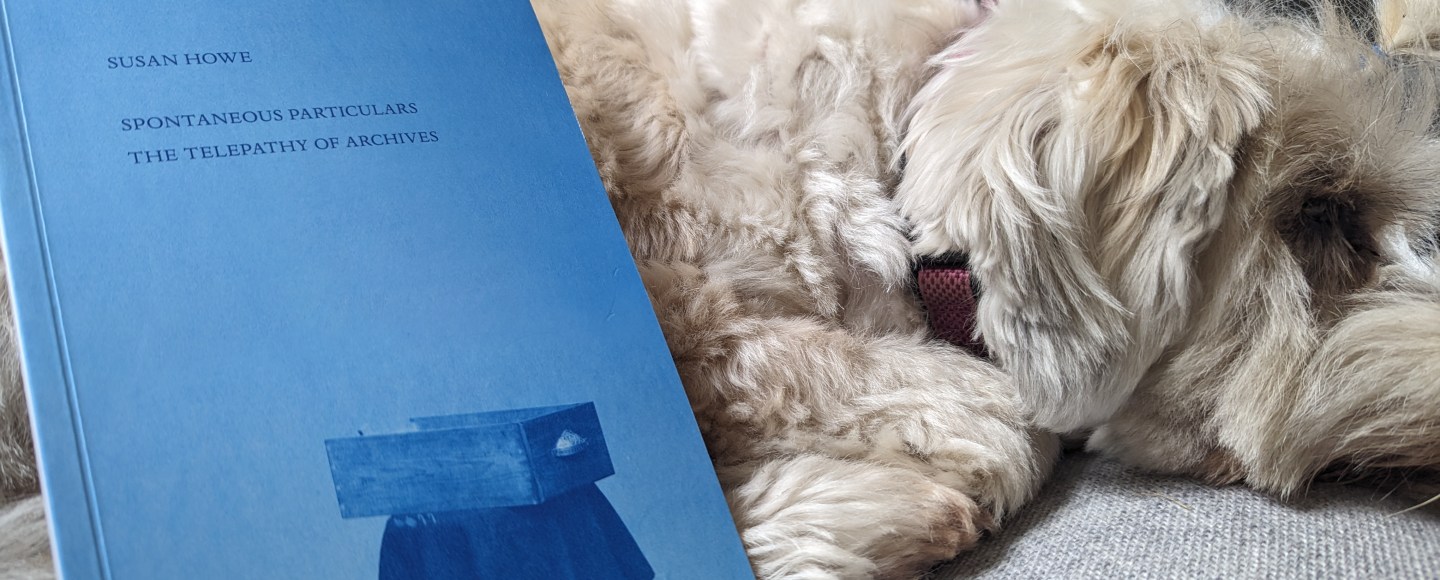

Susan Howe is another acclaimed American poet, and this is another book of (mostly) prose by an American poet that I bought for myself on my recent birthday.
Unlike the Anne Boyer I read a few days ago, though, Spontaneous Particulars is a singular piece of work rather than a collection, though it does incorporate a variety of voices from across American literary history, as it is a long-form piece on archives, archiving, memorialising and of echoes, repetitions, influences and historical shifts in meaning and material that have occured over the modern age.
In a response to digital technology increasing the ease of [some people’s] access to [certain] information/resources, Howe’s poetic essay – which includes beautiful high resolution photography of the notebooks, letters, drafts and scrawled-on rags of many American writers and thinkers (e.g. Henry James, Gertrude Stein, William Carlos Williams (who, as a poet and medical doctor, often drafted poetry on pages from his prescription pad), Emily Dickinson, Hart Crane and others (including a preacher called Jonathan Edwards who I’d previously never heard of and have no interest in hearing more about tbh)) – seeks to argue for the superiority of the physical archive.
Obviously texture is important, the touch of a page touched by a person as it was composed is key; it brings a humanity, a physicality, a sensuality to the exploration of an archive that is absent when one explores it merely by mouse, trackpad or fingers on a screen, perhaps as far from the paper’s physical location as said location is from the place of its composition…
–///–
I’ve never gotten deep into an archive. I’ve toyed around the edges of the B.S. Johnson rare material that’s in the British Library, but as a non-academic with very low self-esteem, I’ve always been too nervous and unimportant-feeling to order up the notebooks from down in the bowels of the building (or into the bowels of the building if they’re ordinarily stored in one of the not-London storage facilities), but I have gotten deep enough to find Johnson’s out of print novels that were gifted to the Library by Johnson’s friend and early-career collaborator, Zulfikar Ghose, with a handwritten dedication from Johnson to Ghose on the first page.
That was exciting enough, for me, and so I’ve never gone deeper, trusting in Jonathan Coe’s Like A Fiery Elephant to divulge the pleasures of that writer’s archive. I’d love to go to Vancouver and dive into (and eventually drown in, I suppose) the Malcolm Lowry archive, a writer who wrote far far far more than he ever published in his lifetime; simultaneously with reading Spontaneous Particulars I was also flicking through a book of interviews with Joan Didion, and over the course of the five decades or so of conversation, she regularly spoke about the hoard of incomplete, abandoned, barely started manuscripts of essays, novels, stories and articles that she continued to build up as she wrote one of recent literature’s most important oeuvres. I’d love to look at this, wherever it ends up, too.
Archives are fucking appealling.
And then there are writers like Gertrude Stein and Henry James, writers who Howe writes about and around here, who published reams and reams and reams of paper, yet left behind archives even deeper than their published works.
Archives allow us to track changes and edits and development not only of pieces and individuals, but also of periods, of moments, of movements, of genres and forms and cultural expectations and modes of thought.
Howe’s text isn’t likely to appeal to anyone who isn’t already interested in (and intellectually or emotionally invested in) archives of physical media, but I liked it a lot, even if I didn’t often understand what or how meaning was being expressed, I understood the beauty of the text and its concept.
Unless I didn’t understand it, and hidden here in passages of dense, vaulting, prose is actually an elitist tirade against anyone without the institutional access to historic material archives thinking they deserve even the whiff of connection to cultural history through digitalisation of archives.
I don’t think this is the case, but it genuinely could be. They do say “Never trust a poet” and “Never trust an American”, and Howe seems to be both.
I definitely didn’t understand parts of this book, so it’s entirely possible I misread it as a whole.
I guess we’ll never know – unless you, maybe more secure in your bigger intellect than little ol’ scott manley hadley’s, have read it and can let me know in the comments below whether my instinct (it’s good) or my fear (it’s bad) is correct.
Or order it online from New Directions and find out for yourself.
(You see what I mean? It’s published by New Directions so could feasibly be either way!)

Thank you so much for reading TriumphoftheNow.com! If you like what you’ve read, please subscribe, share and order one of my books. If you love what you’ve read, why not order me something frivolous and noisy from this Amazon wishlist or make a quick donation via my ko-fi page?
I’m currently focusing on parenting and creative practice, so small donations are appreciated now more than ever!
scott manley hadley aka SOLID BALD live
Here’s a video of me recently performing at the prestigious (it has a Wikipedia page) comedy night, Quantum Leopard. Listen to how much fun the crowd is having. You could have that much fun, too!
Forthcoming gigs include the following – there may/will be others:
17th March 2026, 7pm: Slap & Giggle @ Coin Laundry, Clerkenwell
24th March 2026, 7.30pm: Lolipops, Southwark
26th March 2026, 7.30pm: Comedy @ Cosmic, Plymouth
9th April 2026, 7pm: Sunset Comedy, Chalk Farm
15th April 2026, time tbd: BALD PERSONALITY DISORDER 40min-ish WIP at Shirker’s Rest, New Cross (more details soon!)
27th June 2026: Twinkles Cabaret, London
9th August – 14th August: BALD PERSONALITY DISORDER at The Street, Edinburgh, part of PBH’s Free Fringe
Discover more from Triumph Of The Now
Subscribe to get the latest posts sent to your email.

 Triumph Of The Now
Pingback: Malcolm Lowry: A Preface To His Fiction by Richard K. Cross – Triumph Of The Now