
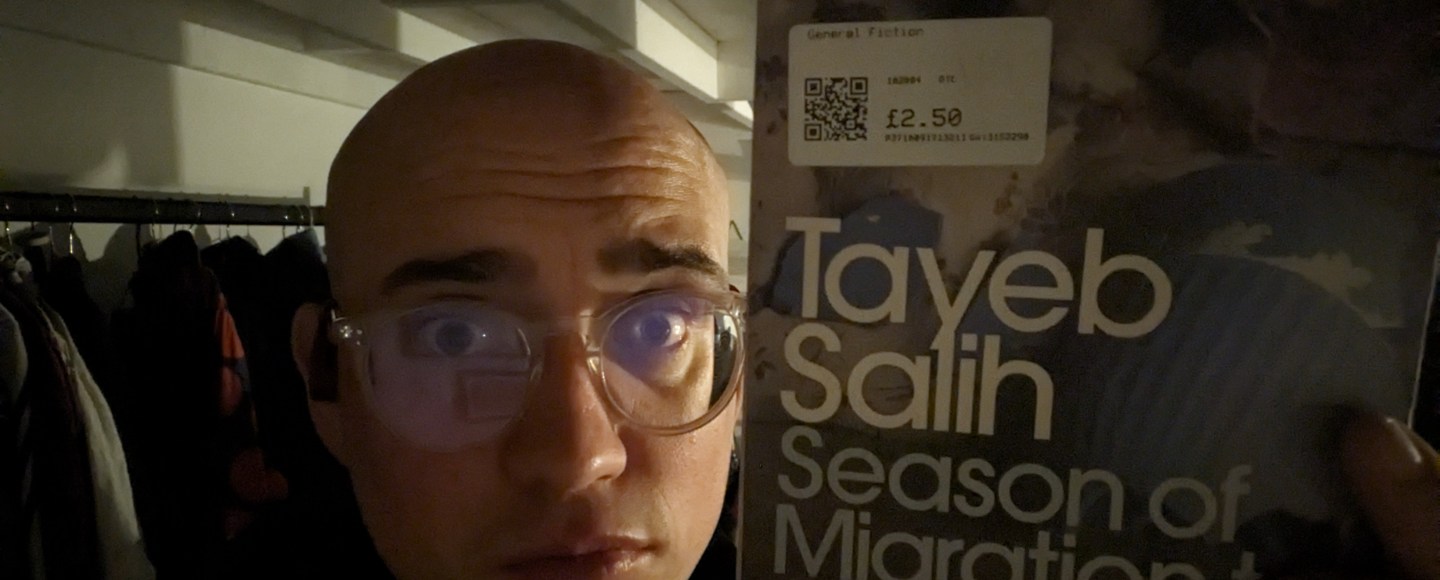

(the novel was translated by Denys Johnson-Davies in the sixties and this was not a new translation)
It’s been a while since I’ve read a novel whose sociocultural contexts I’ve had so little knowledge of I have felt it’s impacted on my enjoyment of the text.
In spite of an introduction written by the author (several decades after the novel’s initial publication) for this 2003 Penguin Modern Classics release, Tayeb Salih’s 1966 Season of Migration to the North unfortunately gave me that feeling.
I don’t mean I didn’t like it, I don’t mean I didn’t understand it, but I mean that I don’t feel like I knew enough about what it was about to understand the novel in the way it was meant to be understood, to approach it within its own contexts, its own meanings, rather than be sidetracked by the references and meanings certain elements conjure to the contemporary [progressive?] reader who is ignorant about Sudanese history…
By this I mean that there is a persistent depiction of violence against women – including FGM, marital rape, intimate partner violence (including spousal murder), forced marriage, and multiple female suicides depicted in the text as direct responses to abusive treatment by their male partner – that I honestly couldn’t work out if this was meant to be a focus or a background…
Like, I couldn’t work out if this novel was explicitly trying to say that the misogyny of early 20th century Sudanese (and British) culture was bad (which I think it was saying?), or if it was merely – mid-to-late-20th-centuryily – using female suffering as shorthand for showing male suffering, male distress, male loss of personhood… I honestly don’t know.
–///–
The novel is stories within stories and at first it seems, Conrad-like, as if the secondary narrator of the second chapter will narrate the rest of the novel, and though this character does function as a central figure, the rest of his personal history is reported by the original narrator in bits and pieces and from additional reported spots, rather than (Wuthering Heights-ly) secondhand. (Shout out to my main man Mr Lockwood!)
The main narrator, then, is a youngish man who has just returned to his home village in the bend of the Nile after studying in Europe for many years.
It is the mid 20th century, and though Sudan is now nominally independent of British colonial rule, the colonialism of capitalistic investment and overseas business interests means that many historic issues persist. Though he has been educated extensively far away, the narrator comes back and joins the civil service, hoping to be able to improve education in his homeland.
Upon first returning to his village, he finds there is a new face amongst the otherwise very familiar crowd: a conspicuously handsome man in late middle age who allegedly retired from “business” in Khartoum to become a farmer in the countryside, shortly after the younger man left home. This new (to the narrator) man, then, has been there a few years and is an established part of the community – he has also married a much younger woman (#agegap, shakes head) from the village and now has two very young sons.
Everyone thinks this man is a simple guy; yes, citified and good with money and admin, but cautious and shy and not at all adventurous. However, one boozy evening in the village, our narrator hears this guy reciting English poetry under his breath, so knows there are secrets somewhere. He confronts the older man, who invites him to hang out in private and he anecdotalises his life.
The older man, then, presents himself as a savant – highly intellectually and linguistically gifted, he was a scholarship boy who arrived at an English university in the 1920s with a giant intellect and a massive libido and proceeded to make a name for himself as a prominent academic economist, as well as as a prominent seducer of [white] women.
Setting himself up as an “exotic” entity, he ran from woman to woman around interwar-London, leaving heartbreak (and multiple suicides) in his wake, until eventually entering into a deeply toxic and (arguably mutually) destructive marriage, which ended with him being jailed for several years after stabbing his wife to death during sex, an act that is depicted in the novel as not only consensual, but also exactly what his non-monogamous wife wanted to happen.
She wanted to be killed by him as much as, if not more than, he wanted to kill her.
?
It is this depiction, then, where responding to the text becomes more complicated: is this version of a horny, suicidal woman who begs a man to stab her and fuck her a creepy male fantasy?
Or is it a legitimate depiction of the supposed liberal, middle class, response to the gradual end of British colonialism? The othering and the eroticising of the black male body? Is this, then, a fair critique? Wanted to be fucked, literally, and killed, erased, overwhelmed? Is this a biting and perennially relevant satire of “white guilt” as an inherently patronising and masochistic sexual impulse?
Maybe it is. But, either way, women and violence towards women is featured here merely as a way to dramatise the feelings, motives and desires of men, so even if the symbolism of its female characters is sophisticated, this doesn’t cancel out the absence of characterisation.
Definitely an interesting read, but whether or not I liked it, or even whether or not I thought it was good, is much harder to decide…

Thank you so much for reading TriumphoftheNow.com! If you like what you’ve read, please subscribe, share and order one of my books. If you love what you’ve read, why not order me something frivolous and noisy from this Amazon wishlist or make a quick donation via my ko-fi page?
I’m currently focusing on parenting and creative practice, so small donations are appreciated now more than ever!
scott manley hadley aka SOLID BALD live
Here’s a video of me recently performing at the prestigious (it has a Wikipedia page) comedy night, Quantum Leopard. Listen to how much fun the crowd is having. You could have that much fun, too!
Forthcoming gigs include the following – there may/will be others:
17th March 2026, 7pm: Slap & Giggle @ Coin Laundry, Clerkenwell
24th March 2026, 7.30pm: Lolipops, Southwark
26th March 2026, 7.30pm: Comedy @ Cosmic, Plymouth
9th April 2026, 7pm: Sunset Comedy, Chalk Farm
15th April 2026, time tbd: BALD PERSONALITY DISORDER 40min-ish WIP at Shirker’s Rest, New Cross (more details soon!)
27th June 2026: Twinkles Cabaret, London
9th August – 14th August: BALD PERSONALITY DISORDER at The Street, Edinburgh, part of PBH’s Free Fringe
Discover more from Triumph Of The Now
Subscribe to get the latest posts sent to your email.

 Triumph Of The Now
0 comments on “Season of Migration to the North by Tayeb Salih”