
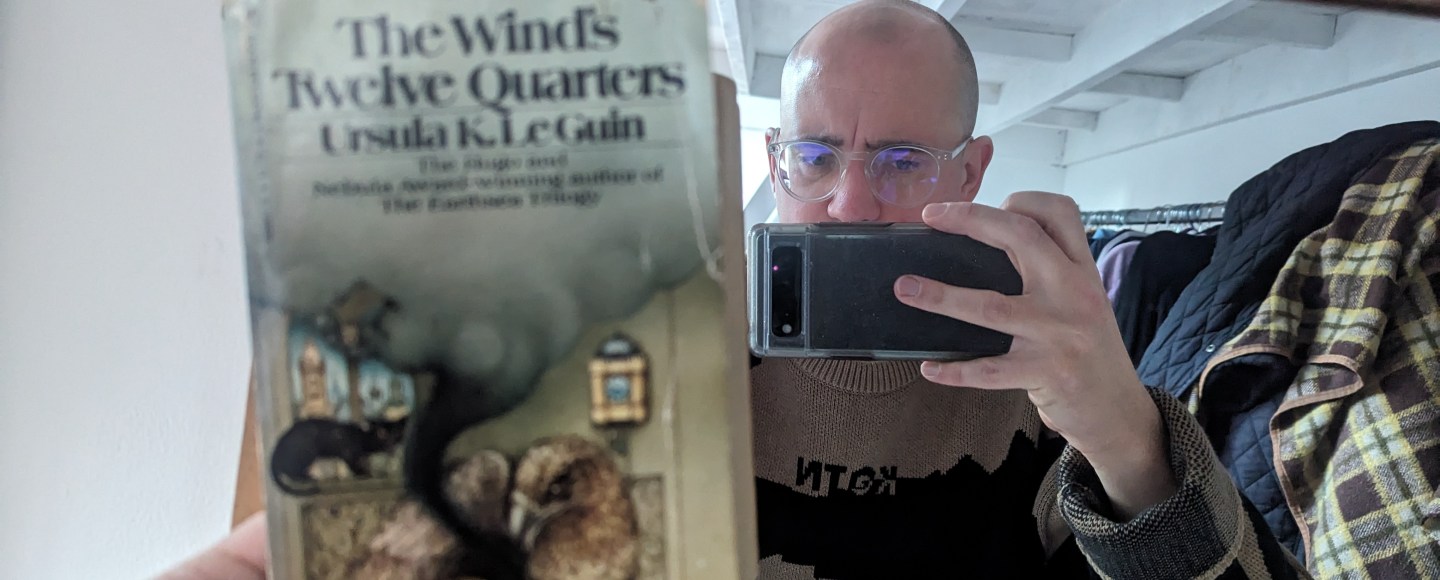

The Wind’s Twelve Quarters is a bizarre collection that incorporates vacuous, juvenilia-adjacent, near-drafts with some of the most powerful, affecting and flawless pieces of short fiction you are ever likely to read, ostensibly as a retrospective selection of Ursula Le Guin’s writing, published a decade and a half or so into her writing career.
It is this that bothers… it is this that is strange…
The selection process, the collation process, the editorial process…
There are 17 pieces here in this under-300 page paperback, with some of Le Guin’s first published stories in the first half moving through to multiple award-winning stories by the end.
Yes, there is a chronological ordering and, yes, it is of course interesting to see a writer develop and grow across the course of a collection of writing, but this is the kind of experience I would usually associate with a voluminous Collected Stories rather than with a writer’s first book of shorter pieces.
I suppose, though, that although Le Guin still had around a further half century of literary production to go in her highly acclaimed career, this wasn’t something she knew in the 1970s, and she’d already written many (far far far from all) of her big hit novels by this point… The Wind’s Twelve Quarters feels more like it is aimed at a Le Guin aficionado eager to read more, understand more, of her process rather than for the general reader wanting to have a very good literary time.
Which I found strange, because I don’t understand why a piece of writing that feels like a sketch towards the first draft of a novel (and little more) is included as if an equal with ‘The Ones Who Walk Away From Omelas’, for example, which is well wow which is wow well which is yes yeah exactly that’s exactly it-
If you haven’t read that, follow this link and do it now.
There are other pieces here in the second half of the book that are almost as good as that highlight- e.g. ‘Vaster Than Empires And More Slow’ about space exploration and a highly trained empath accidentally tuning in to the vibes of a terrified planet, ‘The Field of Vision’, a haunting Annihilation-like narrative constructed through prose and transcripts about the fucked up returnees of a trip to Mars, and ‘The Stars Below’ a potentially Orsinian tale about an astronomer hiding in a mine in response to religious persecution of scientists – but there are also texts here that are far less interesting and far more derivative than anything Le Guin would elsewhere turn into a book…
The first half, in particular, is characterised by texts that feel incomplete – unfleshed out, testing, teasing, playful, and while some do work, that is largely due to them being recognisable as progenitors to longer form writing Le Guin would elsewhere produce – namely two pieces about Earthsea (neither of which appeared in 2001’s Tales from Earthsea) and several pieces beginning to develop the Hainish universe, as would be further explored in City of Illusions and Planet of Exile (plus later stories and novels that are often considered among her best), with some of the phenomenal later pieces in this book also being includeable in that decade-spanning story cycle.
–///–
So, ya, this, then, is a book that has highs of incredibly high highs and the bad bits aren’t like unreadable, but in this context (and also having recently read Driftglass by Samuel R Delany, which is a collection of a similar length from a similar year and is fucking flawless front to back and back again (that makes it sound like I re-read it, which I obviously didn’t (re-reading without purchasing a new copy of the book is theft, as I often “joke”))) the lower qual stuff is hard to swallow.
It was fun to read two stories set in Earthsea, but would I have enjoyed them if I hadn’t read all six of the Earthsea books over the past few years and grown to love them? Maybe not.
There are a couple of postmodern-y things that remind me a little of Mantissa by John Fowles (a book I compare other things to quite a bit, but haven’t revisited it since I read it when a floppy-haired undergraduate so might be totally misremembering it) and feel similarly dated…
Despite my own open-minded attitude/s towards hallucinogens, I don’t have much of an interest in reading descriptions of fictional acid trips any more than most people do, though maybe stories on this theme would have felt fresh and interesting when they were new. Maybe they were!
So, ya ya ya, I did find it interesting to explore the development of Le Guin from normalish writer of normal sci-fi to transcendental literary expert writing deeply important prose, I didn’t pick this book up with the expectation or the plan to read things that weren’t A grade Ursula.
The good stuff here, though, is just so fucking good that it’s difficult to to to to-
The good stuff here, tho, is perfect
I don’t have a conclusion.

Thank you so much for reading TriumphoftheNow.com! If you like what you’ve read, please subscribe, share and order one of my books. If you love what you’ve read, why not order me something frivolous and noisy from this Amazon wishlist or make a quick donation via my ko-fi page?
I’m currently focusing on parenting and creative practice, so small donations are appreciated now more than ever!
scott manley hadley aka SOLID BALD live
Here’s a video of me recently performing at the prestigious (it has a Wikipedia page) comedy night, Quantum Leopard. Listen to how much fun the crowd is having. You could have that much fun, too!
Forthcoming gigs include the following – there may/will be others:
17th March 2026, 7pm: Slap & Giggle @ Coin Laundry, Clerkenwell
24th March 2026, 7.30pm: Lolipops, Southwark
26th March 2026, 7.30pm: Comedy @ Cosmic, Plymouth
9th April 2026, 7pm: Sunset Comedy, Chalk Farm
15th April 2026, time tbd: BALD PERSONALITY DISORDER 40min-ish WIP at Shirker’s Rest, New Cross (more details soon!)
27th June 2026: Twinkles Cabaret, London
9th August – 14th August: BALD PERSONALITY DISORDER at The Street, Edinburgh, part of PBH’s Free Fringe
Discover more from Triumph Of The Now
Subscribe to get the latest posts sent to your email.

 Triumph Of The Now
Pingback: Babel by R. F. Kuang – Triumph Of The Now
Pingback: Rocannon’s World by Ursula K. le Guin – Triumph Of The Now
Pingback: Rocannon’s World by Ursula K. le Guin – The Free