
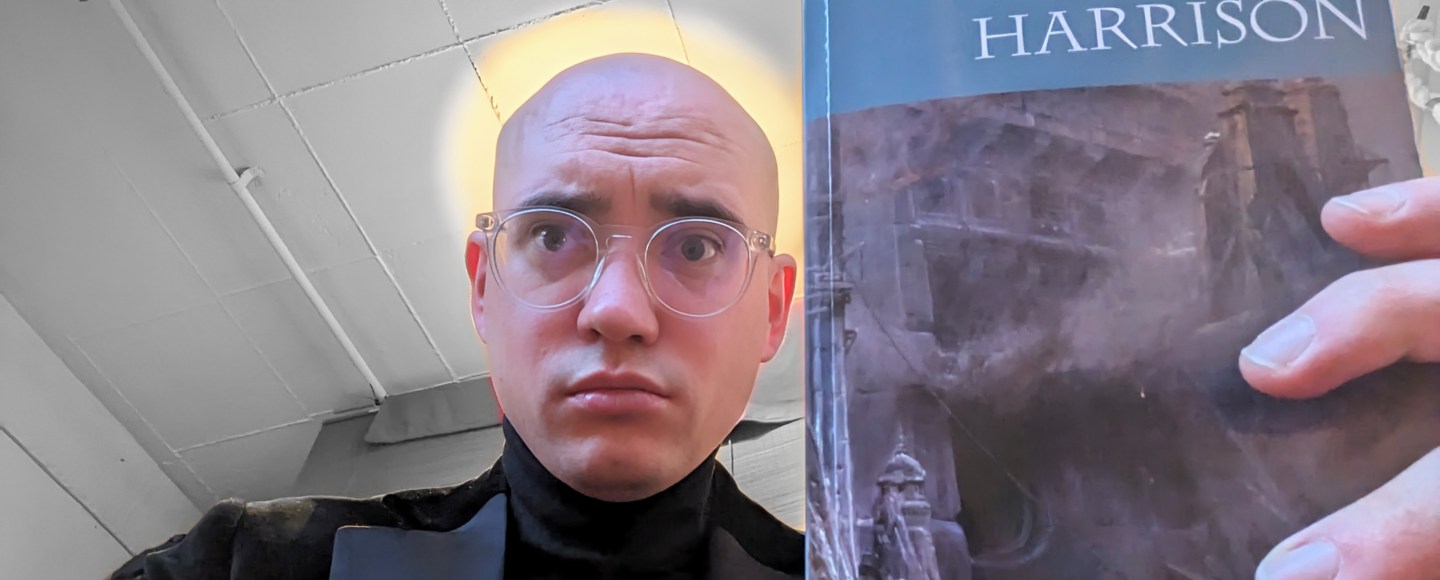

M. John Harrison is a writer you hear a lot about.
A lot of people – particularly several writers whose work I enjoy slash whose literary interests align with mine – raaaave about him.
Harrison himself is a prominent literary figure both on and offline and he has a lot of insightful, articulate things to say about the minutiae of texts and the publishing industry, but also about the wider reality in which we find ourselves. As an elder statesman of the British written word, with success both within genre fiction and outside of it, Harrison is an important figure, and his memoir (Wish I Was Here, published by Serpent’s Tail in 2023) received universal acclaim, as have many of his books.
An exception to that, then, was my previous experience of reading one of his works, a 2018 collection of short fiction that I didn’t really get on with. In hindsight, seeing the baubles attached to the memoir and recalling my historic initial dismissals of other writers whose work sits in non-naturalistic spaces, I thought that perhaps my lack of vibing with the fiction of M. John Harrison was just because I encountered it at an inopportune time, i.e. one where I still felt so intellectually insecure and confused that I didn’t feel comfortable enjoying literature that wasn’t about (and by) isolated depressed male alcoholics.
Now, as I’ve (probably) said before, I think there is a case to be made that the form of the novel – in many ways the ultimate form of the rambling, self-absorbed anecdote – is best suited to tales of the slow destruction of unhappy dipsomaniacs, but now I am far less limited in what I choose to read. I read books with… err… like vampires in them now. And spaceships. And time travel. And, of course, also serious things about like politics and stuff and also more trad literary novels about sad families etc, but I also now understand that non-naturalistic narratives aren’t solely the preserve of pulp, or trash, and that it is absolutely possible for a novel to be serious and emotive and human and mature, while also being about weird things that couldn’t possibly happen.
So, wiser, older, balder (even tho I probably read that other M. John Harrison book after shaving my head, I am sure that where the remaining follicles pop up on my pointless scalp now would be further back than it was those few years ago), I had a mental note to return to this writer at some point, when on a bulging shelf in the surprisingly brilliant – and fucking huge – secondhand bookshop Broadhursts of Southport (in Southport, where I was attending a friend’s wedding last October) when I found this tome at a very reasonable price…
Viriconium was published as part of the Fantasy Masterworks series (an apparent companion to the Science Fiction Masterworks series that can be found in stacks in every remainder heavy bookstore in the UK and North America), and contains four – that’s right, four – of Harrison’s early books, three novels and a collection of short stories (the stories – for no apparent reason and not in any obvious order – split out before, in-between and after the three novels, rather than together as a set), all set in (or around) the fictional city of Viriconium, also known as The Pastel City, also known as Uroconium, also known as- Actually that might be it.
But it does have multiple names. And it does have multiple realities.
–///–
Sorry, had to go to work. Down with the capitalist system man, innit, bro, yo-
Was working from home today, which I obviously hate (because I’m opposed to the aggressive attempt to erode the boundaries between work and personal life, and also whenever I work from home there’s always someone playing like really stressful free jazz or something like it right next to me which doesn’t happen in the office (because it’s not appropriate for me to do that there)), but there is a blunt satisfaction that comes from not having to enter the fray of the city’s public transport system before being able to waltz from being on my work computer to running around the local park growling at and chasing my dog like I’m a sinister human-dog-hybrid who chases dogs.
It’s a blunt satisfaction, yes, but it’s also a dishonest one: by doing this, I have normalised saving my employer on heating bills, on coffee bills, on water bills, on toilet paper bills, and I have invited an employer and their devices (equipped with cameras and microphones) into a distanced space and onto a private Wi-Fi network, and though I don’t think the employer I have is using those to stalk/audit/control/eavesdrop/monitor me, I think that by acquiescing to remote work I am contributing to the normalisation of a practice that does permit the in-home surveillance of many people.
But, yeah, it’s great to be growling in the park when, on an ordinary day, I’d be growling on the tube. Which is a much less responsible place to growl. But when has being morally opposed to something ever got in the way of sad unprincipled scott manley hadley enjoying its benefits???
–///–
Spoilers from the next paragraph onwards, but if you want to avoid those, I’ll put my conclusion here instead: overall I thought there wasn’t enough humanity here; nice ideas, some good, florid, turns of phrase and some genuinely interesting structural choices, but – aside from two excellent short stories that almost (or not quite… though maybe they did actually???) made the book feel worthwhile – I just found characterisation was distant and this Viriconium, this mysterious and strange land… It just meant fucking nothing to me, most of the time…
–///–
Of the four books included here, the first novel (The Pastel City, 1971) was a relatively straightforward quest-style narrative set in a fantasy-like far future where the echoing technologies of the world’s distant past function like magic…
Essentially: evil, brain-destroying robots had been released from a millennia-long shutdown by one faction in an otherwise horse-bound civil war, and a group of old warriors were brought out of retirement for “one last job” to find the oldest man in the world, who potentially knows how to turn them back off. (It is not a comedy.)
Anyway, it turns out that the brain-destroying robots were actually brain-collecting robots created by a historic race that had perfected resurrection from human brains, and the brainus-ex-machina (that’s actually a clever joke, no, it is) is the heroes realising this and turning back on the machines that do resurrection and unleashing a massive army of resurrected people from millennia ago whose brains were in storage, and then these people defeat the people who were attacking the heroes’ side and the day is won, now with thousands of resurrected people from the past to join them.
It’s fun. It’s fine. I didn’t hate it. I didn’t love it, and though I didn’t really consider putting it down, had that been the end of the text I likely wouldn’t have read its sequel, A Storm of Wings (1980).
This one is, tbf, more interesting, and is set eighty years in the future of the previous novel and the resurrected people and the normal people live side by side but separate, with the resurrected people really struggling to adapt to a completely different world.
There is also a massive new cult (that uses insects as symbols) going around denying the reality of existence on the rise, and the ghost/projection of an astronaut (in this far, far, future, humanity’s space travel days are looooooong behind them) bouncing around, and then some heroes (including some (now very old, but not decrepit) of the figures from The Pastel City) must go on a journey to investigate the source of all these troubles, and it turns out the planet has been invaded by dimension-shifting entities who now, with the appearance of giant insects, are trying to turn the Earth into a suitable habitat for themselves, all growing out of the grossly expanded and very rotten giant, humongously bloated, and somehow still kinda alive body of this astronaut whose psychic projection the heroes were seeing, which they destroy, which in turn destroys all the giant bugs and their plans. Fin.
Is the present real?
Is the past real?
Can we, may we, should we, trust anything?
Even the evidence of our own eyes..?
This one has some playful things to say, I suppose, about notions of reality, about nostalgia as a trap, a weakness, a risk, and though I also did kinda enjoy this one, too, I just didn’t really feel any cathartic or emotional connection with it.
It didn’t make me cry, it didn’t make me want to cry, it didn’t make me laugh, it didn’t make me sing …
Sure, maybe, you could argue, it made me think a little bit, but not about anything that mattered, not about anything that had any potential to like make any like difference…
–///–
The Third novel, In Viriconium (1982) is set even more within the city and has no quest-like journey segment, and though obviously it’s nice that it’s different, I didn’t ever really feel like what it was replaced with was of much more… I dunno…. Validity. Value. Meaning.
It’s about an artist living in the time of a plague. It’s about warring factions in a city, it’s about violence and cruelty and coercion, and it’s also about perceptions of reality and meaning and veers far further from the “all the weird stuff is dilapidated future technologies that could potentially exist”, into there being quite a lot of inexplicable occurrences that do seem to be straight up like magic or whatever.
This one, then, in its incoherence, is perhaps the most coherent..?
The furthest from its source materials, the least derivative, perhaps?
And maybe this, then, is the problem? My problem?
I don’t know enough about the tropes and the standard practices of “fantasy” to understand where and how this diverges from them.
For me, a bunch of lads going on a quest with like monsters and dwarves and towers and resurrections and immortal people and monsters and gods and swords and magic and stuff, all of that just seems to be, like, what I would have imagined fantasy was like?
So maybe, in not knowing, I’m not understanding what it is about Viriconium that’s meant to be good? For me, it just largely felt like Jeff Vandermeer’s Ambergris but with slightly better (though less playful) prose and just no… I dunno… Just no people in it, right,for me to grab on to???
But even then, I found myself at the book’s end considering going back…
The final piece in the book is a short story (all the short stories are from 1985 (or ’84?)’s Viriconium Nights), set in “our” world, about someone chasing rumours about travels made between “reality” and Viriconium, via a mirror in a café in Huddersfield (unless I’m misremembering the location), which really whangs on those themes of perception and nostalgia, of hope and emptiness and failed lives, of lost potential, thwarted dreams and, essentially, failure as a state of mind…
It’s a great piece of writing, but only works with the context (though maybe you wouldn’t need all 600 pages) of the volume of Viriconium behind it… I liked this story a lot. I saw what it was doing and what it was saying and I emoted. I liked it. I actively liked it.
The penultimate story in the book, tucked in a run of three short pieces between the second and third novels is also very powerful.
It is a flashback into the life of the main hero character of The Pastel City, and details his journey on, yes, another quest, again with a bigger stronger man and a dwarf, yet this one contains a romance, contains regret, and contains a great narrative twist… fighting in the polluted marsh with one friend already dead, when the hero’s monster is killed in a fight with his bigger friend, instead of celebrating the victory, the hero murders his friend in cold blood as he had felt doomed to die in his fight with the monster, and will now always be in his own, active, afterlife… Hard relate, innit. Yeah.
It’s a bleak, serious, piece of writing that is stuck right in deep with the fantasy tropes (shapeshifters, camaraderie, swords), twisting and turning that (queer sex, depression, despair, murder, etc) in such a way that – for this story – I almost kinda got what I was missing…
Is all of Viriconium as good to someone who knows the tropes of 1970s and ’80s fantasy epics as that one story is to someone who read Lord of the Rings and Discworld at the appropriate age for reading Lord of the Rings and Discworld (i.e. about twenty five years ago1) but hasn’t ever delved any deeper into the genre?
It might be. Honestly, it might be???
–///–
Have I left Viriconium determined to never read M. John Harrison ever again?
No, quite the opposite.
Like Viriconium in that final story, I think that a life where I enjoy the work of M. John Harrison exists, and if I find the right mirror (book) in the right Huddersfield café (read that book at the right time (i.e. not too depressed or too whatever it’s called when you forget you’re depressed for a bit?)) then maybe I can pass over to the other side?
I’ll try his work again. I will try his work again.
Three novels and seven short stories and only about forty pages I loved… But those two pieces, I think, I really liked a lot.
Onwards, onwards, onwards…
Nothing else this long for a coupla weeks!

Thank you so much for reading TriumphoftheNow.com! If you like what you’ve read, please subscribe, share and order one of my books. If you love what you’ve read, why not order me something frivolous and noisy from this Amazon wishlist or make a quick donation via my ko-fi page?
I’m currently focusing on parenting and creative practice, so small donations are appreciated now more than ever!
scott manley hadley aka SOLID BALD live
Here’s a video of me recently performing at the prestigious (it has a Wikipedia page) comedy night, Quantum Leopard. Listen to how much fun the crowd is having. You could have that much fun, too!
Forthcoming gigs include the following – there may/will be others:
17th March 2026, 7pm: Slap & Giggle @ Coin Laundry, Clerkenwell
24th March 2026, 7.30pm: Lolipops, Southwark
26th March 2026, 7.30pm: Comedy @ Cosmic, Plymouth
9th April 2026, 7pm: Sunset Comedy, Chalk Farm
15th April 2026, time tbd: BALD PERSONALITY DISORDER 40min-ish WIP at Shirker’s Rest, New Cross (more details soon!)
27th June 2026: Twinkles Cabaret, London
9th August – 14th August: BALD PERSONALITY DISORDER at The Street, Edinburgh, part of PBH’s Free Fringe
1. I’ve been told that it is technically possible to still enjoy the novels of Terry Pratchett after you’ve had sex but only if – and medical science has proven this in multiple peer-reviewed studies – your partner didn’t come. ↩
Discover more from Triumph Of The Now
Subscribe to get the latest posts sent to your email.

 Triumph Of The Now
0 comments on “Viriconium by M. John Harrison”