
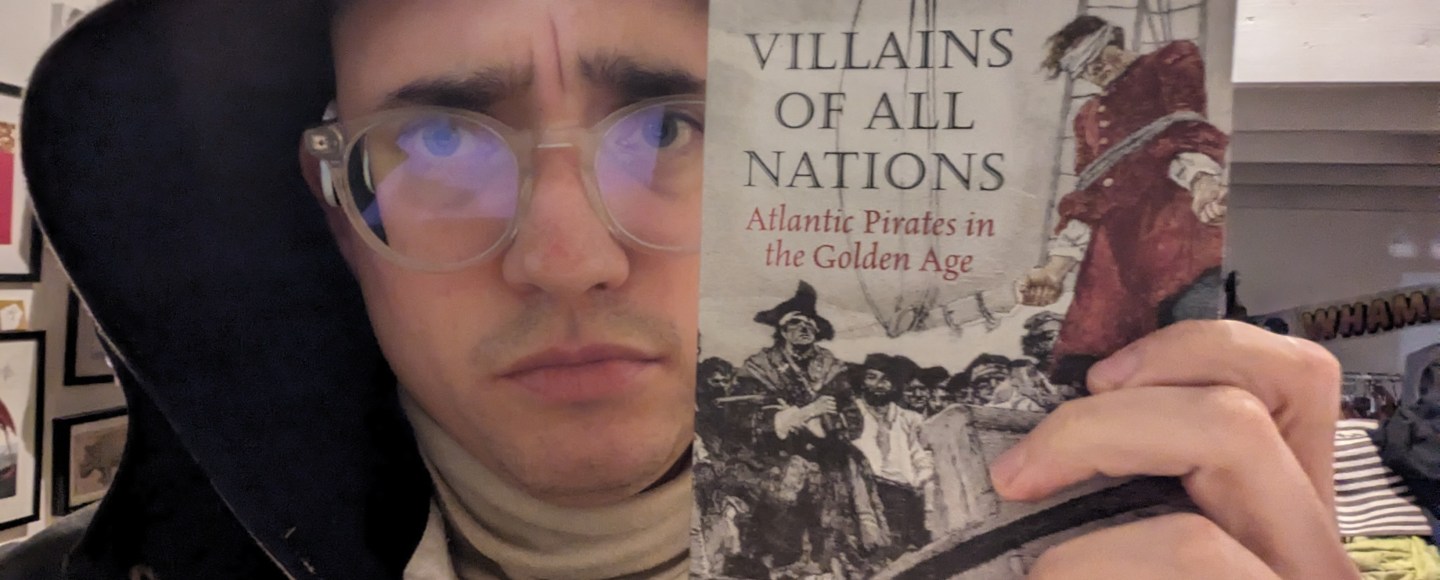

Villains of All Nations: Atlantic Pirates in the Golden Age, published by Verso Books, 2004
Like many people of my generation who should know better, I’ve been watching and enjoying the TV show Our Flag Means Death.
If you’re not familiar with this, it’s a (now cancelled) HBO sitcom about pirates, starring the guy who played Murray Present in Flight of the Conchords (Rhys Darby) and Taika Waititi, the now infamous (or near-infamous?) actor-director (yet to make a narratively (if not medically) needed trip to rehab), who seems to have squandered some genuine directorial talent in exchange for big money bucks (I highly recommend Boy, if you’ve never seen it… (maybe Waititi will return to prominence with a film that doesn’t try to humanise Hitler at a later point, but apparently his recent low(er) budget film wasn’t great so maybe not???))…
Although there are two Kiwis as the leads (Waititi plays the infamous proto-pirate Blackbeard, while Darby plays the man known as “the Gentlemen Pirate”, Stede Bonnet) this is very much an American production, and one that it’s difficult to feel much/any lingering warmth about whenever not watching it, due to its dialogue, which can basically be summarised as making younger Gen X types read lines written by someone (probably a millennial) trying to appropriate linguistic tropes of Gen Z TikTok-ified social justice/therapy speak.
Although while one is watching the show, the genuinely charismatic performances of the two leads and the majority of the key supporting cast deliver all this with sufficient conviction for it all to stick, the hollowness of a lot of its script is hard to forget when thinking about the show while not watching it.
Where the show does hold up, though, is in its plots, and why it does seem to have developed quite a hefty fan base (I’m not typing “fandom” earnestly, I’m an adult) in spite of its creaking dialogue, is because of the community-building that the show is about.
The pirate communities – both on sea and on-land in the many pirate-controlled places that popped up along the world’s coastlines during the “Golden Age of Piracy” – are depicted as being generous, progressive, warm, kind, supportive, egalitarian, tolerant, equitable, diverse and democratic (democratic in a “true” rather than a representative way).
People who feel like they lack these things in life – myself included – feel drawn to this flawed (and decommissioned) show that depicts people emotionally and psychologically thriving in ships filled with people who collaborate and protect each other, who not only tolerate but celebrate non-heteronormative, binary-gendered relationships and identities.
The bracing lack of subtlety in its dialogue notwithstanding, Our Flag Means Death offers (offered, it’s been cancelled) a brief window into alternative, non-mainstream lifestyles… Found families, innit; egalitarian sharing rather than capitalistic hoarding… Hedonism and joy rather than pointless toil and pitiful wages… Dignity and camaraderie instead of individualism and the blunt horrors of the growing capitalist hegemony…
Marcus Rediker’s book, Villains Of All Nations, is on the same topic, focusing on the lives – and, alas, the deaths – of the great bulk of pirates involved in global piracy’s last big run of the seas, a period that ended pretty dramatically over the first half of the 1720s as the amassed forces of global capital decided to, essentially, publicly execute all of the pirates of the world and leave their corpses hanging visibly so that no one took up their cannons and jolly rogers to continue the good fight after they were gone.
Rediker – in a much more satisfying read than the more recent comic book adaptation of some of the content of this book – looks at not only the end of popular piracy, but at how it became such a big deal, why it became such a big deal and what life onboard pirate ships was like for those who “went on the account” (that was pirate slang for becoming a pirate).
Exploring the history of Piracy prior to its Golden Age and the geopolitical situations that made the beginning of the 18th century such an important time for sea-based theft, Rediker discusses who became pirates, why and how they did so, and what being a pirate was…
–///–
Piracy was a form of collective living.
With decision-making by committee, with equitable and group-decided wealth distribution…
Pirates covered the medical expenses of each other, created funds for dispersal to pirates too injured to work, and even did some massive big robberies just to score medicine and medical professionals.
Pirates treated captives well (except for when they didn’t) and sometimes spared the ship captains whose boats they stole if the captains’ crews seemed to like them… Most of the time they didn’t, though, as piracy was first and foremost a movement that attacked the elites and the ship-owning classes.
Rediker cites the main impulse pulling people into Piracy as the terrible conditions and terrible pay of ordinary merchant shipwork, especially when contrasted with the massive profits most sailors knew were being made off the back of the goods they transported.
Pirates often began their lives of Piracy by mutineering, taking the goods or the profits of a full hull and sharing it out amongst the people who actually did the work, rather than the pricks waaaay back in the offices by the boatyards who believed the money created by this labour was theirs…
–///–
It’s easy to look at Piracy, and the communities built by these North Atlantic based pirates three hundred years ago, and see utopias there.
It’s always, of course, easy to feel sympathy towards any group that has been persecuted with murderous violence by the slave trading imperialists of the ruling elites, and it’s easy to empathise with and form psychological bonds with people who were able to – temporarily, at least – form alternative cultures…
Cultures and communities where status-based wage theft (all profit is theft innit, ultimately, unless you fundamentally like and approve of this nightmare world of excess extraction and constant exploitation that we live in, which means you’re either a bit ignorant and due a reckoning or you’re genuinely fucking evil in which case I hope you’re as hated as you deserve to be) isn’t tolerated, where justice is group-decided and swift and egalitarian… Where cruelty is a by-product not a central cultural element (capitalism baked cruelty and barbarian and inequality into its foundations and we can’t unroot those factors (which remain deep in our society) without dismantling the whole fucking thing)…
Sorry, what was I saying?
Rediker doesn’t pull punches. He doesn’t pretend utopias of peace and comfort and safety. He doesn’t lie about barbarous acts committed by pirates, but he does contextualise them and point out that pirates weren’t doing anything that wasn’t being done elsewhere by others who weren’t considered “criminals”.
Was Piracy ultimately shut down because it offered hope and a promise of alternative lives that the colonial elites couldn’t countenance existing?
Maybe.
Also, though, they just fucking loved money and slavery and extraction of natural resources, and pirates made doing those things harder.
This is a short book, but it’s a detailed one, evidencing a comprehensive and long term detailed academic study (the notes and referencing take up around a quarter of the pages), filled with historical anecdotes that entertain, terrify, humanise and describe and demonstrate an elaborate and different world.
Pirates weren’t saints, no, but they were (not in name) anarchists who – for a bit – were able to make for themselves better, happier, more human lives for themselves, out there on the unknowable ocean…
It’s a great read and I highly recommend it. So enjoyable, it made me forget how periodically irritating Our Flag Means Death is. Pirates and piracy is fucking interesting.
A good book. A short book.
And I do – and I probably shouldn’t – wish I’d been a pirate. It can’t have been worse than… [gestures at the dry rot of a pointless life]
Buy Villains Of All Nations direct from Verso via this link
MY GLASGOW INTERNATIONAL COMEDY FESTIVAL WIP SHOW IS ON 12TH MARCH! TICKET LINK HERE!

Thank you so much for reading TriumphoftheNow.com! If you like what you’ve read, please subscribe, share and order one of my books. If you love what you’ve read, why not order me something frivolous and noisy from this Amazon wishlist or make a quick donation via my ko-fi page?
I’m currently focusing on parenting and creative practice, so small donations are appreciated now more than ever!
scott manley hadley aka SOLID BALD live
Here’s a video of me recently performing at the prestigious (it has a Wikipedia page) comedy night, Quantum Leopard. Listen to how much fun the crowd is having. You could have that much fun, too!
Forthcoming gigs include the following – there may/will be others:
12th March 2026: BALD PERSONALITY DISORDER 30 MIN WIP at Glasgow International Comedy Festival
26th March 2026, 7.30pm: Comedy @ Cosmic, Plymouth
Various Dates and Times, May 2026: BALD PERSONALITY DISORDER FULL LENGTH WIP at the BRIGHTON FRINGE
27th June 2026: Twinkles Cabaret, London
Discover more from Triumph Of The Now
Subscribe to get the latest posts sent to your email.

 Triumph Of The Now
Scott Hadley, you fool, I haven’t seen you on my website:
http://www.catxman.wordpress.com
I keep looking for your comments but you turn your nose in the air. Oh well, may as well try one last time.
LikeLike