
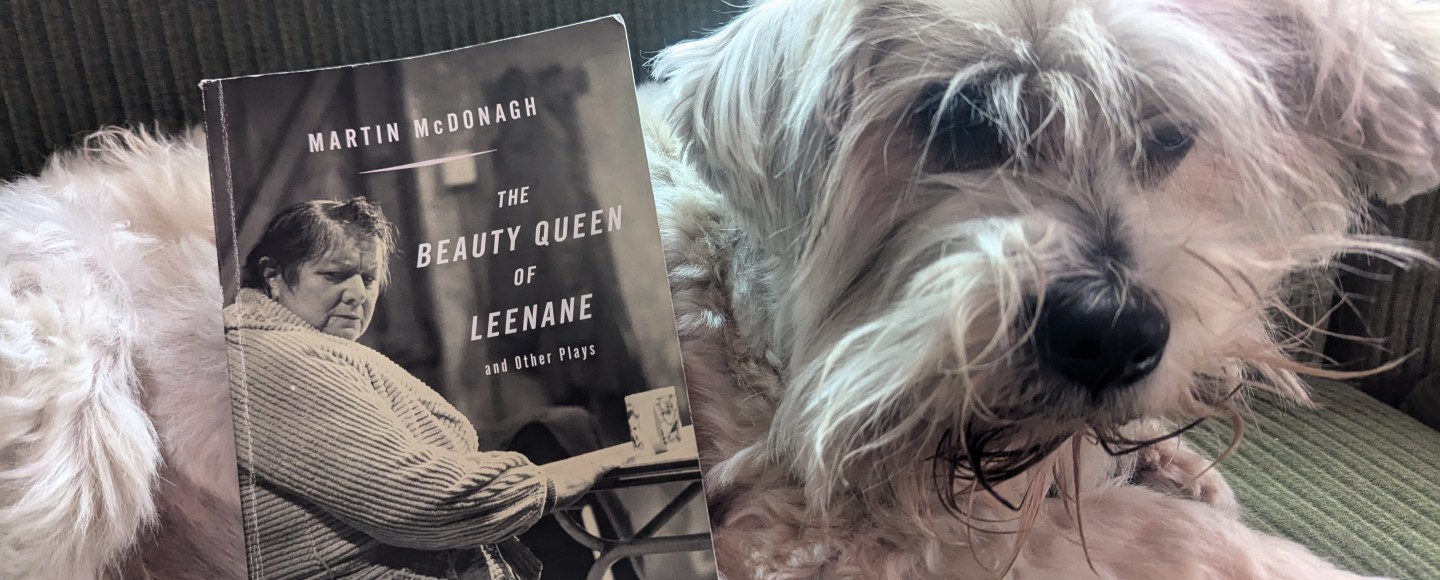

You all know Martin McDonagh, of course you do.
You all know – and probably really like – Martin McDonagh’s best film, The Guard.
You also probably like his second best film, Calvary, and some of you might even realise that those two films aren’t actually his films, and are instead the two best films by McDonagh’s younger (I mean older) brother, who is slightly better at making films than he is. Or at least was for a bit a decade and a half ago…
Martin McDonagh did, of course, write and direct the excellent (though not as good as The Guard) In Bruges, and the equally excellent (and almost as good as The Guard) The Banshees Of Inisherin.
(complete aside: The only time I’ve been to the city from In Bruges was when my dog was a small puppy and my resounding memory of the trip was my then tiny dog getting a small twig stuck between his lip and his eyelid. Absolutely harrowing. A beautiful town.)
Before, though, McDonagh won the Oscar for best short film (and launched a cinematic career that has also seen the acclaimed (yet swiftly forgotten) Three Billboards Outside Ebbing, Missouri and the panned (and even more forgotten) dog-napping comedy thriller Seven Psychopaths), McDonagh was – and remains – an internationally and massively acclaimed playwright, having had many pieces performed in the UK, Ireland and the United States (and probably elsewhere, too) in hugely prestigious theatres and performance spaces… McDonagh’s plays have now been regularly staged for almost 30 years!
Obviously, his films have overshadowed this part of his ongoing career (and possibly contributed to inflated ticket sales for some of the later and less well-received ones), but for McDonagh’s early work – the pieces prior to and around the most famous one (The Pillowman – recently revived in an unloved production in London) – all of the attention and acclaim for McDonagh came organically.
McDonagh’s films – the successful ones at least – have the reputation and the legacy that they have due to the power of their writing, i.e. the darkness and humour, the pathos and bathos, the swift wit, cruel violence and fascinating insights into blunt human morality. Again, the good ones have that. And lots of it.
This book – which I read sat in a hospital while my tiny tiny tiny baby (much smaller than my dog was when he visited the city from In Bruges) was getting some UV treatment for the mildest possible form of jaundice that required some UV light treatment – is a collection of three of the playwright’s earliest texts (back from when he was exclusively a playwright), and includes arguably some of his finest writing. Who’s arguing that? I am.
What’s nice about this secondhand edition I recently bought from Juniper Books is that it pre-dates all of McDonagh’s film work – there’s no blurb or introduction trying to recontextualise the Hollywood bigshot (the younger brother of the person who made The Guard and the long term partner of the person who made Fleabag) as a younger man, this edition is instead no more than a raucous celebration of a dilettante hotshot young playwright, which is what McDonagh was.
In the late 1990s, Martin’s long-term partner maybe wasn’t even born yet (she def. hadn’t co-written a James Bond film) and his older brother certainly hadn’t by that point written and directed The Guard. This book, and that early success, was all Martin. Martin McDonagh.
–///–
The Beauty Queen of Leenane & Other Plays contains three plays, all of which are set in the same small town on the West Coast of Ireland and all of which are linked by theme and tone, of course, but also by character, by narrative and by overarching plot.
The overlaps and consistencies are fun and enjoyable and expansive to notice when reading the three plays in a couple of sittings while passing time next to a radiating baby (I don’t know what UV light is or does or how “light” can be a cure for any medical issue, though I’m not typing this from the hospital so it did whatever the medics were expecting it to do!), however as these three plays were initially performed months to years apart in completely different places, it’s difficult to see them as fundamentally essential to the functioning of the texts…
These aren’t three one-act plays designed to be watched over the course of a long(ish) evening, so these overlaps are not likely to be remembered by an audience as – unless things were very different in the 1990s – productions of new plays are not seen as episodic parts of a single whole work…
Maybe my memory is much worse than the average theatregoer’s, but I doubt I’d remember the names of off-stage characters from a new play I’d seen once two years ago, so many/most of these connections would have been unnoticed on initial watch. (Were these plays to be revived, though, it would presumably be in such a way that these details were clear, as they do add to the experience!) These details, then, although illuminating and impactful to a reader treating this as a set of closet dramas a quarter of a century later, were therefore evidentially not necessary in these three pieces’ ability to function as highly successful theatrical works… it is not the inter-connectedness that gives these plays their great emotive heft.
–///–
The first piece – the one the collection is named for – is about a woman who is 40 years old and lives with her ageing and cruel mother. The mother sabotages her daughter’s opportunity to be invited to leave the village with a handsome local man who’s long had a crush on her, following which the audience slowly comes to see that the cruelty doesn’t always run in the direction we initially see…
There is torture and violence and lots of great dialogue gags, as you would expect, and at the end someone ends up murdered and no one onstage is happy.
The local priest is mentioned repeatedly though no one is certain of how to pronounce his name.
The second piece, A Skull in Connemara, is about a man who has been hired by the local church to dig up and destroy bones from the overflowing graveyard, including the remains of his long dead wife, who he is rumoured to have murdered. At the time, her death was considered – and prosecuted as – a terrible drink driving accident, and the man spent time in prison because of this.
The play follows him and the young apprentice who will be helping him destroy the bones (who is rumoured to have cut the ears off a dog) as the apprentice’s older brother – an incompetent local police officer who watches too many detective shows and dreams of a more interesting life – shows up and tries to cajole the protagonist into a confession about his erstwhile probable murder… Chaos and violence follow, with allegations flying and many people trying to kill each other on the small stage.
The local priest is mentioned and no one knows how to pronounce his name.
The third one, which is probably the one I enjoyed the most, is called The Lonesome West.
This one is about two brothers, one of whom has suddenly acquired some money and the other one has recently killed their father with a gun. These circumstances are related, as – in exchange for 100% of their father’s estate – the now propertied brother agreed to lie at the inquest and say that the intentional killing was an accident.
The two brothers regularly drink with the local priest, who finally appears onstage and confirms the pronunciation of his name, though by the end of the play – which features two other offstage suicides (the police officer from A Skull in Connemara and a local teenager) – has drowned himself in a lake, due to the shame at working in a parish that boasts so many murders and cruelties and unnatural deaths.
And that’s the end of the trilogy.
It’s fun, it’s funny, it’s emotive and it’s engaging…
Big gags, big personalities, big life and death and death and life narratives…
And lines like: “I’m saying this quietly and without any spite at all, but you know well that that wasn’t right, Coleman, shooting Dad in the head” and, about a character known to be a little tight with money, “He’d steal the shite out of a burning pig”.
–///–
It’s all great, but…
Is this rural Ireland for the non-rural Irish?
Is this not even a Dublin, but a London, a New York version of Ireland? These criticisms were certainly launched at McDonagh following the release of The Banshees of Inisherin in 2022, but what do I know? And is it even my place to care?
This is a set of three well-constructed, funny, emotive – if somewhat laddish – plays from the late 1990s, and whatever metrics you use, they’re pretty successful…
Anyway, I’m off back to post-Tory (for a bit) Britain in what is being branded as 1997 version 2.0, though seems more like 2010 version 0.9 to many commentators…
See “y’all” later.

Thank you so much for reading TriumphoftheNow.com! If you like what you’ve read, please subscribe, share and order one of my books. If you love what you’ve read, why not order me something frivolous and noisy from this Amazon wishlist or make a quick donation via my ko-fi page?
I’m currently focusing on parenting and creative practice, so small donations are appreciated now more than ever!
scott manley hadley aka SOLID BALD live
Here’s a video of me recently performing at the prestigious (it has a Wikipedia page) comedy night, Quantum Leopard. Listen to how much fun the crowd is having. You could have that much fun, too!
Forthcoming gigs include the following – there may/will be others:
17th March 2026, 7pm: Slap & Giggle @ Coin Laundry, Clerkenwell
24th March 2026, 7.30pm: Lolipops, Southwark
26th March 2026, 7.30pm: Comedy @ Cosmic, Plymouth
9th April 2026, 7pm: Sunset Comedy, Chalk Farm
15th April 2026, time tbd: BALD PERSONALITY DISORDER 40min-ish WIP at Shirker’s Rest, New Cross (more details soon!)
27th June 2026: Twinkles Cabaret, London
9th August – 14th August: BALD PERSONALITY DISORDER at The Street, Edinburgh, part of PBH’s Free Fringe
Discover more from Triumph Of The Now
Subscribe to get the latest posts sent to your email.

 Triumph Of The Now
Pingback: The Cripple of Inishmaan by Martin McDonagh – Triumph Of The Now