
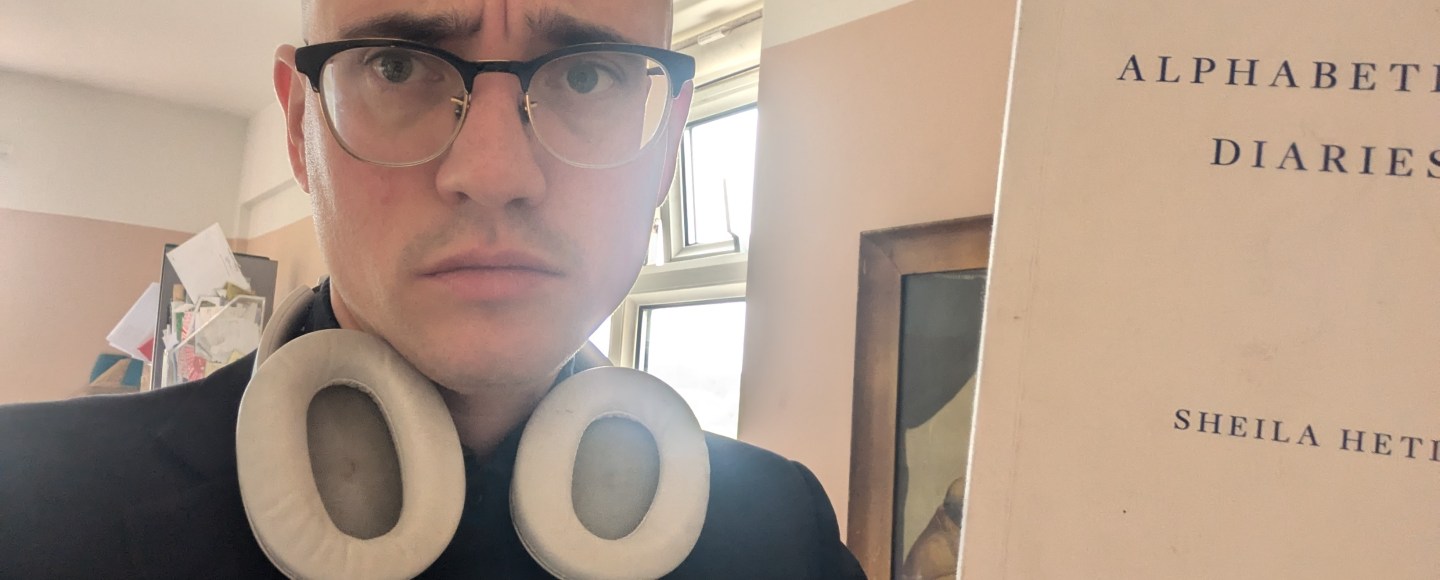

Alphabetical Diaries, Fitzcarraldo Editions, 2024
Honestly… I think that Alphabetical Diaries by Sheila Heti is one of the best books I’ve ever read.
–///–
Alphabetical Diaries is deeply moving and energetic, somehow managing to give an impression that the text is both lazy and labored, without either of those things feeling like a negative, or like that isn’t how the book is intended to feel…
Alphabetical Diaries feels like something that absolutely achieves what it is trying to do, whatever that is…
This is a book that is full of deeply moving and sad moments, and thoughtful and thought-provoking questions on the nature of creativity, art, friendship, sex, romance and self-hood.
It is highly emotive in places, even upsetting, and is somehow both nonsensical and redolent with narrative, the simple narrative of being alive.
–///–
If you don’t know anything about Alphabetical Diaries, wH3eRE ha4aVe yYoUou bBe3eNn?
Sheila Heti is one of those hip American writers who’s actually Canadian, and has published numerous hit books, kicked off with that decade ago smash hit How Should A Person Be?, which me and all of the people like me read and loved at the time (I was less conspicuously weird and out of place a decade ago. Much more miserable, much more medicated, much more in danger. Or not?)
This newest book was published early this year (2024) and contains parts of the text of a decade’s worth of diaries from about 10 years ago. The content has been cut up into sentence-length sections (i.e. the sentences that were originally written in Heti’s diary), and then all of these sentences have been alphabetised.
Names have been anonymized most of the time (they’re not when it is a famous person, who the older, newly successful, Heti meets towards the end of the 10 years covered by these diaries) and lots of the initial bulk of the content has been excised: it says on the back cover that this is roughly 10% of the total word count Heti initially had once all the sentences were collated.
Whatever the process Heti used to sift through these alphabetised sentences, the successful results of the final text are very plain to see.
Although the sentences themselves were written without the intention of publication or the expectation of readership, the level of collation, editing and selection that has happened to them afterwards means that this is, interestingly, an extremely intentional text composed of sentences each written unintentionally.
–///–
Heti describes relationships and romantic encounters, she talks about working as a hairdresser in the years before she became a successful writer, she writes about friends, about colleagues, about rivals, about things she’s read and things she’s seen, about places she’s been to, about family members, about sex and even of abuse.
Each sentence authentically feels like a piece of text written for and by the self, rather than for a reader.
Ordering them in this way (obviously) means they are out of time, though there do tend to be sectional thematic links throughout.
Of course, every sentence that starts with “Why?” is followed by a question about purpose … every sentence that begins with a person’s name is about that person, telling narratives in miniature over a page or so … every sentence that begins with “because” offers a reason for something, anything … to which “why”, we never know…
The text then becomes … incantatory, almost like ritual, like prayer … as if for speechifying, to be read out loud…
Patterns emerge, characters are built up through sentences where they appear for a moment, before suddenly bursting for a page or two into focus before returning again to the pile…
the significant people and relationships are an editor/friend, a boyfriend who was nice, a boyfriend who wasn’t nice (anonymised with a first name beginning with V, meaning the moment of focus hits as a hefty emotional wallop very close to the end of the book once the reader has built up an intense sympathy with [and presumed understanding of] Heti), a girlfriend, and a parent… there are others, of course, but these are the people who suddenly appear and burn through a section…
It created an intensity that I (though I don’t approach human relationships well, apparently) found very relatable… Very evocative of the intensity of life, when people and places and experiences feel like an inevitability then, later, feels like nothing at all…
–///–
Because time is not linear here, even on a sentence by sentence basis, we sometimes move instantly from Heti young and poor and working as a (possibly bad?) hairdresser in Toronto, to her as an internationally lauded writer holidaying in glamorous European spots and attending glittery New York literary parties with Zadie Smith…
…we bounce between relationships … every date turns into the same date … every drink turns into the same drink … every party into the same party but also all of these feel separate too.
It is layer upon layer, the repetition of life and the horrors and the joys that this very repetition can provide… this all coalesces in a way that is deeply, deeply, deeply satisfying to read, and often incredibly moving.
One could read every single sentence as a detached whole and get some literary pleasure here, and the way in which the sentences are placed means that you both do do this and do the opposite…
because of the way the human mind applies narrative where it doesn’t necessarily exist, it’s easy to find one presuming sentences are about a particular moment or a particular time or person or event, while also presuming that everything is unrelated, save for when names or places or chronological contexts clarify who, where, what and when is happening…
–///–
It was nice for me as a former resident to read something set in Toronto again, as though it frequently appears in film and television, it’s usually not playing itself and it’s not a terrible place (I’ll be there again this Winter, showing off the baby to the in-laws)…
Heti’s writing on feelings of frustration with living in her hometown is interesting, too, and one that it’s rare to see from a writer who has chosen to remain living in a hometown that’s also a “global city“.
Heti isn’t literally “trapped” there, and it’s also somewhere people want to be (especially for Canadians). Toronto is slower than London, yes, but it has its charms. (It has that nude beach on the islands and summers warm enough to enjoy it.)
It’s rare to see someone not be in love with a place they’ve chosen to never leave.
(I was born in a charmless nowhere place, which obviously I left as soon as I could, though maybe that wasn’t soon enough to not be trapped with the bleak smalltown mentality that misery and tedium are inevitabilities and a failure to embrace them is a failure in itself. Being born is not a guarantee of hating being alive: kill the hometown in your head, unless your hometown wasn’t shit in which case leave it there, happily, and enjoy.)
–///–
Mostly, the questions and the ideas explored here drill down on the exploration of a sense of purpose (how, indeed, should a person be?), the importance of creativity and art and friendship, and the fear of an overreliance on romance as a central part of life.
There is a fear expressed repeatedly that romantic excitement/involvement will continue to dominate life until Heti is old, and there is more than one moment when she encounters someone over 60 talking about dating and feels both repulsed and terrified that this might be her own distant future…
–///–
Every section (there are only paragraph and page breaks where the first letter changes) feels like one of the best prose poems you’ve (I’ve) ever read… these sections are very irregular lengths due to some letters having more words that start with them (there’s gotta be a better way to express that, e.g. “Z” has one sentence while “I” lasts for 30/40 pages.)
–///–
I thought it was magical, incredibly human and incredibly interesting and structurally fascinating and a useful way for a person to engage with their own archive…
I feel like it’s a text that one could take whatever wanted from it…
Alphabetical Diaries could be skimmed as an interesting collection of thoughts, but it could also be reread and analyzed and studied as a deeply constructed text that evokes a person and a time in their life using their own writing as a way to both subvert and emphasise their own personal sense of self.
Honesty, I think it’s one of the best books I’ve ever read, and to be perfectly frank I would have continued reading had this been 10 times as long. Yes I think I would have been really happy to do that.
A really fucking magical book. I highly recommend it.
Order direct from Fitzcarraldo Editions via this link.

Thank you so much for reading TriumphoftheNow.com! If you like what you’ve read, please subscribe, share and order one of my books. If you love what you’ve read, why not order me something frivolous and noisy from this Amazon wishlist or make a quick donation via my ko-fi page?
I’m currently focusing on parenting and creative practice, so small donations are appreciated now more than ever!
scott manley hadley aka SOLID BALD live
Here’s a video of me recently performing at the prestigious (it has a Wikipedia page) comedy night, Quantum Leopard. Listen to how much fun the crowd is having. You could have that much fun, too!
Forthcoming gigs include the following – there may/will be others:
17th March 2026, 7pm: Slap & Giggle @ Coin Laundry, Clerkenwell
24th March 2026, 7.30pm: Lolipops, Southwark
26th March 2026, 7.30pm: Comedy @ Cosmic, Plymouth
9th April 2026, 7pm: Sunset Comedy, Chalk Farm
15th April 2026, time tbd: BALD PERSONALITY DISORDER 40min-ish WIP at Shirker’s Rest, New Cross (more details soon!)
27th June 2026: Twinkles Cabaret, London
9th August – 14th August: BALD PERSONALITY DISORDER at The Street, Edinburgh, part of PBH’s Free Fringe
Discover more from Triumph Of The Now
Subscribe to get the latest posts sent to your email.

 Triumph Of The Now
0 comments on “Alphabetical Diaries by Sheila Heti”