
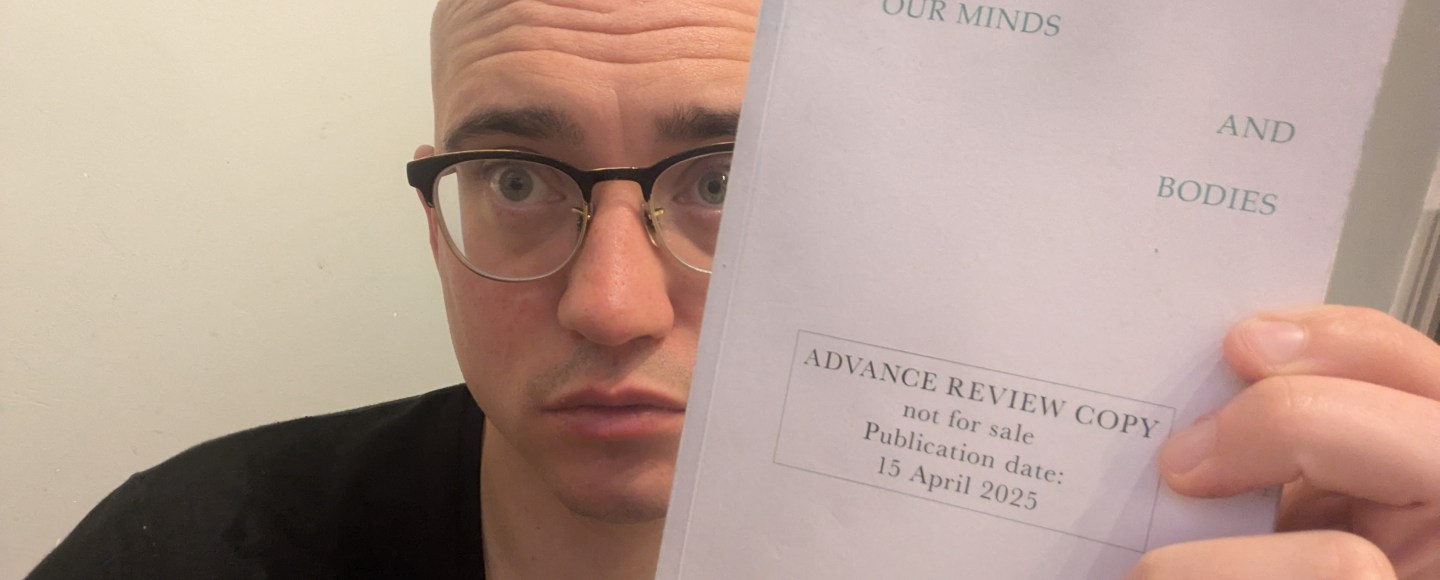

Coming from Les Fugitives in 2025 – I was lucky enough to receive an ARC!
To Rest Our Minds & Bodies is a beautiful, upsetting, serious novel, yet also seriously funny…
A blunt yet complex portrait of obsession, but also of misjudgement…
Armstrong depicts an obsessive personality whose obsession is stoked by the minor attentions of a minor person who is mostly well-behaved and well-intentioned only because they’re not interesting enough to be cruel…
Is the avoidance of cruelty a strength?
Is failing to reject (to clearly and firmly push away) an obsessee as much of a taking advantage as fucking them (which they want) would be?
A dark, serious, engaging and important novel about youth and growing up and and and –
–///–
I read this over a week ago, before my recent trip mentioned in the previous post and probably again in the one to follow – I read some (but not all) of The Motion of Light In Water while away – and I have been thinking about it a lot since.
Percolating.
Digesting.
It’s a haunting, engaging, echoing novel.
It echoes.
It’s about an undergraduate in her final year at an elite university1 who is isolated and alone, bouncing between intellectual engagement (reading, going to seminars and lectures on disparate and often disconnected-seeming topics (maybe that’s what education is like at the fancy universities, though I wouldn’t know‽ (omg they have interrobangs here‽‽‽)) and a growing obsession with her university-arranged housemate, a Masters student named Luke who is studying something to do with digital manufacturing models… computers … programming or design or something… who has a long term partner who breaks up with him very early in the first term and opens up the / the / the / the possibility… of romance.
But this guy, Luke, isn’t interested. He clearly isn’t interested, even though the protagonist-narrator is so desperate for something to happen that she has meaningless, horrible, awful, sexual encounters with other awful local men largely just to be able to tell him about them in the hope it provokes a reaction (but she also does these things, yes, out of genuine curiosity (though not genuine desire) making these descriptions all the more unpleasant to read …
… descriptions of a tired and openly faked performance of willingness …
… depictions of unenthusiastic consent in encounters with men who don’t look for interest and connection but only for formal approval to go ahead… The letter not the spirit of the language etc etc etc…
The narrator wants Luke to feel something because of her… Jealousy… An urge to protect… An understanding of her as a sexual being which leads to sex that she wants… Something…
Anything.
But nothing.
Luke isn’t interested. Yet he doesn’t push her away.
Luke is boring. Luke is dull. But Luke is present, in a room in the same building. And he becomes a focus and a vector of the protagonist’s need for connection…
–///–
Luke, ultimately, is not interested in romance with this non-neurotypical (a dyspraxia diagnosis is mentioned), younger, person (she is three or four years younger, which might not be much when you’re as old (ancient) as I am, but is a big fucking difference when you’re in the first half of your twenties… it’s lifetimes… it’s aeons…)…
Luke is clearly flattered by the attention, and clearly lonely, but clearly (too) decides that anything beyond chatting here would be outside of his own permitted behaviours.
Armstrong’s depiction of this self-identifying “good guy” is raucous and accurate and awfully recognisable.
–///–
There is an acquaintance of mine who a friend refers to as “Cupcakes” and – if you’re old enough to remember when cupcakes were a thing – it’s an evocative name.
What are cupcakes?
Cupcakes are nothing special.
Cupcakes are flimsy treats that are never satisfying and rarely flavourful. Things that are considered an indulgence yet rarely feel indulgent.
Cupcakes aren’t objectionable, sure, but cupcakes aren’t nutritious, cupcakes aren’t restorative, cupcakes aren’t going to change, elevate or electrify anyone’s life.
To call another person a cupcake is to perceive their worth and state that it is wanting.
It is to qualify someone as not worthy of interest. As lacking. As uncomplex and – possibly – as incomplete.
The person known as “Cupcakes” may otten be referred to by this name, but there are other examples, often (but not always) men, other Cupcakes, who each explain and define and justify the nomenclature.
Luke – the character who the narrator of To Rest Our Mind & Bodies is needlessly obsessed with – is an absolute cupcake.
Like, he’s not “a bad guy”! Not at all.
In fact, he conspicuously ensures that he “isn’t a bad guy” by not taking advantage – sexually – of the obsession of this not doing great young woman, yet he does allow himself to enjoy all of the non-sexual benefits of being the target of romantic obsession and he does this seemingly with little guilt, if perhaps some lingering questions…
When someone is obsessed with you, genuinely interested (or pretending to be so) in the things you have to say, there are heaps of benefits:
There’s always someone to vent to.
Always someone to gossip with.
Always someone to share a meal with, a walk with, to go with to places you don’t want to go to alone, to be around.
Normally (in my experience, at least) you either have to perform sex acts or [feign] reciprocal interest in order to get those interpersonal benefits. Not for Luke, though, not for Luke at all.
And I think this is why the character and the novel is so powerful – Luke isn’t a villain, Luke is nothing, blank, boring, minor – he becomes only what the narrator chooses for him to be; the person she adores isn’t a real person.
It could be a real person (her hopes and expectations aren’t stratospheric!), but (on this occasion) the reality and the fiction don’t quite connect.
And, narratively, it all makes sense – it is nice to be adored!
To receive attention and adoration is very pleasant!
Certainly it is nicer than the guilt which most people (especially any even slightly guilt-prone person) would feel if they came a bunch of times with someone they could tell isn’t the most psychologically stable person when they have made it very very clear that all you have to do for that to happen is act.
The depiction of this relationship, of Luke, is all the more meaty, weighty, hefty, because Luke isn’t fucking the narrator. Because the obsession is never “consummated” (as they say) its nuances and intricacies are all the more apparent and literarily interesting.
It’s very well put together.
–///–
One slight irritant in the text (to me) is its failure to definitively locate itself within the world, despite the majority of its actions only being possible in one of two English cities – there aren’t any other universities in the UK that have the short term times, the no part time jobs, the “living in” in the third year, the being an hour or so away from London…
That said, there may well be clues (would these be “Easter eggs”?) within the text that clarify the location as either Oxford or Cambridge to someone who has spent more time in either place than I have, but for me the false-universality ran cold-
(Alas, my higher education was second rate (i.e. red brick, so ultimately fine but not elite lol (I learned less of any use during my two degrees than I did on the mean mean streets of Central London (because I often walk and read, not trying to falsely claim that I’ve ever slept rough (in the UK, though I don’t know if bedding down on the lowest balcony of a closed ski lodge (scared of wolves) in the Pyrenees in July 2016 while hiking the Camino de Santiago counts as “rough sleeping” or just hiking misadventure))))
-and it did feel to me like false universalising.
It’s not “anywhere”, is it, at all(?), it’s one of two possible institutions in the world…
I don’t think that a lack of specificity makes much sense, especially when references to popular culture releases (film, music, etc) and a specific celebrity death that occurs during the timeframe of the narrative site the plot at only one possible time – the academic year 2020 to 2021… Then again, it is possibly set in an alternative version of that year when COVID didn’t happen or – perhaps this is more likely – the way in which COVID was treated in the UK was so different from the experience I had living through it in Toronto that the self-destructive self-isolation depicted in this novel was meant to imply a pandemic without stating it and merely seemed to me that it wasn’t there at all…
So, yes, I don’t know…
Maybe the young people in the UK by the Autumn of 2020 had given up on caring about the pandemic, or it had become so normalised that it no longer needed to be commented upon?
Or, maybe it’s also there and clear in the text and I just missed it (and it’s maybe meant to explain the isolation and loneliness of all of the characters that I instead read as a more standard (to me) social awkwardness that I recognise from my own youth (prior to the mass uptake of social media, which I imagine made things worse? (I mean we had Facebook when I was an undergraduate, but does that one even count tbh???)) so didn’t see as pandemic-related?)
–///–
So, yes, maybe there’s lots in here that I (old) cannot empathise with or recognise due to changing-
That isn’t at all true, sorry.
It’s allllll fucking universal and recognisable, isn’t it?
The horrors of performed socialising and the social expectations of desire and sexual response… The need to be loved and to love… The wish to understand and to be understood…
The crack crack crack of loneliness and confusion that life is filled with…
The empty vessels who we find ourselves trapped with because we mistake attention for love, because feeling something is better, more real, than feeling nothing, and feeling something good feels like an impossibility…
I read this and I recognised a lot.
I empathised a lot.
And I had to contend, once again, with my own plethora of memories and regrets that I do my absolute hardest to ignore and avoid (which has been made very very very difficult since my return to London (where I don’t want to be)) and though it is nice to try and paper over or even paint over or even re-fucking-plaster over all those metaphor-walls with new experiences, new memories, it’s not discoloration or mould or even cracks that are back there, but abysses, holes, walls that fall and fall and fall away.
Yes.
Crumble. Shatter. Break.
I am not in a terrible place any more. But would I sacrifice the good things I have if I meant I never would have had to suffer? Yes. Nothing is as good as misery is bad. Or maybe not. Maybe some things are. I honestly don’t know.
We are all the sum of our pasts, I suppose. Each horrible present, each moment of despair, something we can build on and/or [away] from.
I don’t know.
I don’t know.
I don’t know.
–///–
Some excerpts without comment or context:
We were talking about books that night. Luke told me his favourite book was about a very old man depressingly ageing and losing his mind and I said I really admire how your favourite book actually has nothing to do with you. All of my favourite books were about vaguely disembodied cerebral girls and if I wrote some book it would be about a vaguely disembodied cerebral girl too, I told Luke this but suddenly I couldn’t think of any examples. Maybe I had made that idea up, the idea of all those countless favourite books about those disembodied girls. I couldn’t think of a single one of those girls, in that moment. (p. 171)
. . . . . . .
We went into a cafe and Luke bought a decaffeinated coffee. He poured some of the coffee into a glass which was standing on the counter, possibly that glass wasn’t even clean, I thought I saw some dirty fingerprints on its insides. The coffee in the glass was for me and Luke’s coffee was the coffee in the mug. Once I was finished he refilled the glass with some more coffee from the mug which made the separation between mug and glass pointless: the coffee which had touched Luke’s body was entering my body anyway. He bought me a random piece of gluten-free lemon cake. That didn’t feel like any kind of gift to me, Luke hadn’t given me a birthday present or even a card and I felt that that was a very active step that he was taking away from me. Maybe one of Luke’s friends had advised him not to give me a birthday card, maybe David had. Maybe David had said Luke be careful, don’t give her anything. Maybe David had said Luke remember, anything you give her she will use against you. (p. 201)
–///–
I liked it a lot. I thought it was warm and engaging, emotional and articulate, witty and funny and very, very, bleakly, real.
Thoughts of hope and desire and wishfulness and regret and confusion and aloneness and optimism and despair and and and and and everything, really
It’s my kinda book. Maybe it isn’t yours.
But I fucking liked it a lot a lot a lot…

Thank you so much for reading TriumphoftheNow.com! If you like what you’ve read, please subscribe, share and order one of my books. If you love what you’ve read, why not order me something frivolous and noisy from this Amazon wishlist or make a quick donation via my ko-fi page?
I’m currently focusing on parenting and creative practice, so small donations are appreciated now more than ever!
scott manley hadley aka SOLID BALD live
Here’s a video of me recently performing at the prestigious (it has a Wikipedia page) comedy night, Quantum Leopard. Listen to how much fun the crowd is having. You could have that much fun, too!
Forthcoming gigs include the following – there may/will be others:
17th March 2026, 7pm: Slap & Giggle @ Coin Laundry, Clerkenwell
24th March 2026, 7.30pm: Lolipops, Southwark
26th March 2026, 7.30pm: Comedy @ Cosmic, Plymouth
9th April 2026, 7pm: Sunset Comedy, Chalk Farm
15th April 2026, time tbd: BALD PERSONALITY DISORDER 40min-ish WIP at Shirker’s Rest, New Cross (more details soon!)
27th June 2026: Twinkles Cabaret, London
9th August – 14th August: BALD PERSONALITY DISORDER at The Street, Edinburgh, part of PBH’s Free Fringe
- “Does the world need another one of these?” you might ask. And though I’d love to be able to agree with you and say “no no no”, I’m afraid that unfortunately I don’t think that a proliferation of things necessarily means that another example becomes invalid. This is a great example of a type of novel that, yes, already exists. But this doesn’t feel tired and repetitive or unoriginal, not at all. These types of fiction resonate because everyone grows up. And, sure, maybe not everyone goes to University (and certainly not everyone goes to an elite one), but everyone matures. Everyone makes foolish romantic decisions (and not making romantic decisions at all also counts as a mistake), everyone embarrasses themselves, everyone feels displaced and ashamed and confused and alone and strange. Or at least everyone who likes reading introspective novels like this does, and we all have a bottomless hunger for this kind of narrative. It grounds us all, the strange, it makes us all feel almost as if our existences are as valid as the lives of people who feel nothing at all… ↩︎
“Does the world need another one of these?” you might ask. And though I’d love to be able to agree with you and say “no no no”, I’m afraid that unfortunately I don’t think that a proliferation of things necessarily means that another example becomes invalid. This is a great example of a type of novel that, yes, already exists. But this doesn’t feel tired and repetitive or unoriginal, not at all. These types of fiction resonate because everyone grows up. And, sure, maybe not everyone goes to University (and certainly not everyone goes to an elite one), but everyone matures. Everyone makes foolish romantic decisions (and not making romantic decisions at all also counts as a mistake), everyone embarrasses themselves, everyone feels displaced and ashamed and confused and alone and strange. Or at least everyone who likes reading introspective novels like this does, and we all have a bottomless hunger for this kind of narrative. It grounds us all, the strange, it makes us all feel almost as if our existences are as valid as the lives of people who feel nothing at all…
Discover more from Triumph Of The Now
Subscribe to get the latest posts sent to your email.

 Triumph Of The Now
0 comments on “To Rest Our Minds & Bodies by Harriet Armstrong”