
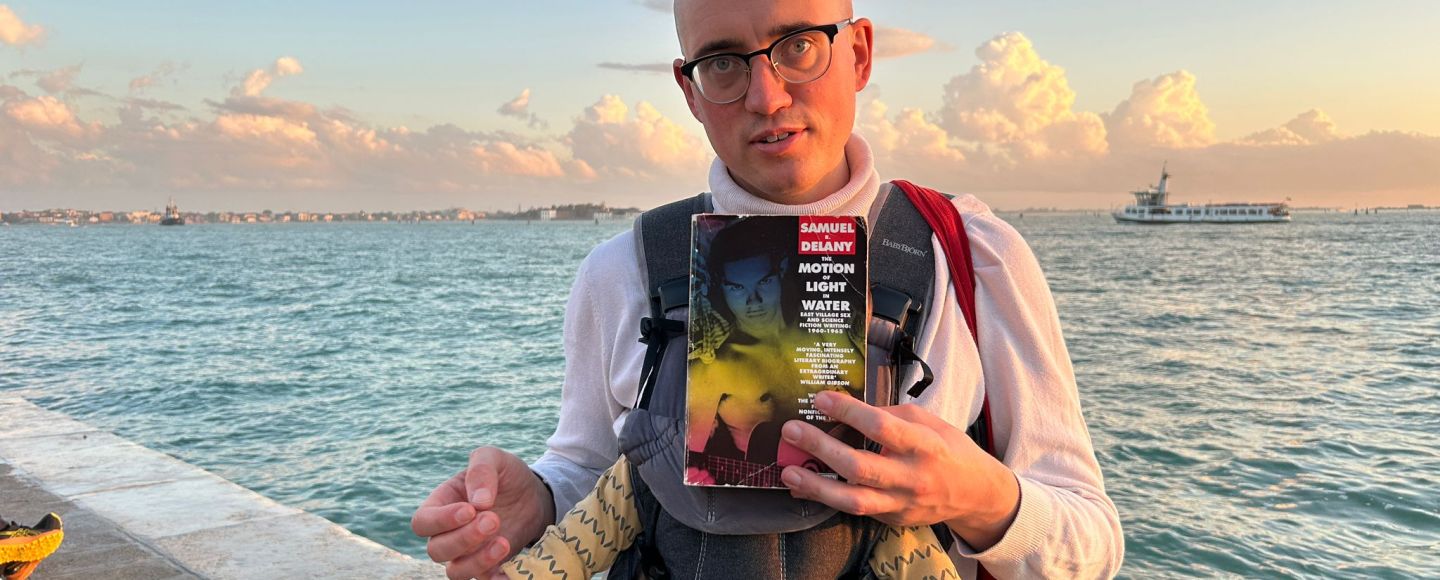

During my recent trip to Venice I decided to skip ahead in my broadly chronological reading through of Samuel R Delany’s oeuvre to something bigger, chunkier, longer and – crucially – not fictional.
Leapfrogging some of his most acclaimed and successful texts (e.g. Dhalgren (1975), most of the many-volume fantasy series he published from 1979 through the ’80s, others), I landed on one of the two paperback copies I’ve somehow acquired of a 1990s edition of Delany’s 1988 memoir The Motion of Light in Water. (If you’d like the other one, please let me know in the comments!)
The 1990s edition is significantly expanded from the original (though as it describes itself as “unexpurgated”, perhaps it’s less a revision than the first published version was) and clocks in at just under 600 pages – a hefty tome.
Most of the extra material comes in the body of the text (i.e. the memoir itself (retitled within the book as “The Peripheries of Love”)), though there is also an interview added at the book’s end, which is a serious, analytical (and near-academic in places (i.e. almost too difficult for dumbdumb scott manley hadley)) discussion of the themes of historicisation, and how any and all depictions of sexuality and writing/recordkeeping are political, with direct discussion of the memoir one has just read, Delany’s series of fantasy (always here referred to as “sword-and-sorcery”) novels, and also the entire genre of Science Fiction.
This interview includes Delany offering two different histories of Science Fiction as an evolving genre – one which he believes is true, and places it as a forward-looking, expansive, energetic and enthusiastic style of writing that began relatively recently, while the other – “the academic history” – sees it as something that can be traced back for centuries and is reflective and timely, rather than truly transgressive.
It makes sense why a science fiction writer would want to characterise their chosen genre in such a manner.
It also makes sense why a book that is subtitled Sex and Science Fiction in the East Village 1960-1965 might want to add a little bit at the end where it… err… speaks about science fiction directly and in detail for a few pages at least as, well, one of those two subjects gets a much heftier proportion of the main body of the text…

This memoir covers the period (with some significant dips into childhood and adolescence to the point where it likely feels exhaustive of biographical juvenilia) during the first half of the 1960s when the prolific and very young Samuel R. Delany first began publishing novels.
During this period he wrote and published The Fall Of The Towers, The Jewels of Aptor, Empire Star, The Ballad of Beta-2 and has begun work on (or just finished, I don’t remember) Babel-17 at the end, as he heads off to Europe on a trip that will be folded into the text of The Einstein Intersection. (Those links are all to my blog posts about those books, so don’t click them expecting anything else.)
There is, yes, lots about the process of writing, of inspiration and editing and reading ones own work and structuring a text and tracing the narrative and character sources of his novels…
There’s also lots (bits) about the literary scene, about encounters with literary and sociocultural figures (all very brief and all mentioned by name in the blurb of most editions of this text, which would somewhat remove the readerly pleasure I experienced when arriving at an unexpected paragraph about a run-in with an arrogant singer-songwriter (destined to win the Nobel Prize), a paragraph about a single phone call with [friend of TriumphOfTheNow.com] James Baldwin, a few pages on a dinner with the [in]famously craggy-faced British poet WH Auden before he became quite so craggy faced, as well as less literary (and thus less relevant to this self-described “literary lifestyle blog”) celebrity figures.
This isn’t Delany writing about Delany as a bestselling and award-winning novelist or as an academic, but Delany writing about how he got to the beginning of that point.
Disappointingly, yet bleakly inevitably, Delany came from a position of relative privilege – the family had a holiday home in the country, there were bishops in the family, and though, yes, he was a Black, queer (genuine question: should queer be capitalised?) person at a point in time when those two things were very much treated as unideal, he wasn’t also fighting against the worst of poverty.
His father – who was the owner/operator of a reasonably successful undertaker’s business – died when he was in his late teens, so there was less money around after that, but it seems like the situation was never so bad that the holiday home needed to be sold or rented out when not in use, so let’s not pretend there’s ever real peril here financially…
So, yes, Delany lives in some precarious and rat-infested places and spaces, he works hard at the writing which he is quickly able to monetise (through luck, persistence, and also because his then-wife is working at a science fiction publisher when he initially has a novel to share, so gets to skip to the top of the slush pile), he also does assorted odd jobs (including a period towards the end of the text (when his marriage is nearing its end and the huge amounts of actual time they spend apart need to be expanded though huge amounts of geographic distance, too) working on a shrimpfishing boat in Texas), makes friends, enrolls and de-enrolls from university courses a few times, plays a lot of live music for money and performs in a few folk bands, explores art and literature in the big city, but the thing he does more than anything else is explore the sexual opportunities of New York Citu, which – at least in Delany’s depiction – are endless, unceasing, safe, supportive and (mostly) huge amounts of fun.
— I don’t think I’m hallucinating (it’s been a while since I’ve done anything that should cause that but on the morning of typing this I’ve felt/seen/found THREE ladybirds inside my clothes, which feels like something someone who’s slipped outside of reality somewhat might perceive when not really there? Or are there a load of ladybirds hatching in my small flat and embedding themselves in the pure Egyptian cotton of my base layers??? —
Delany started having sex with men at a young age, and though some of the earlier experiences with non-peers recounted here do seem a little unpleasant, these are not the initial ones and these – luckily for him, I think – don’t happen until he’s already got some idea of what he does like, so when something happens that he doesn’t, he’s better able to understand and articulate that.
Delany takes the reader on tours through bathhouse orgies, to queer night spots, to the NYC truck stops where the action is, to the benches in the parks and the street corners and the bars and the parking lots and all the other locations in Manhattan in the early sixties where it was easy to find anonymous sexual encounters. Some of these encounters lead to friendships, some to romances (though the one rule his wife has is that he can do whatever he wants as long as he never gets sad about it at home), but mostly all of the casual sex functions a fun, relaxing hobby to while away evenings following a hard day of writing increasingly acclaimed science fiction.
Delany’s wife at that point in time was the poet Marilyn Hacker, who was a friend of his from high school and always aware of his homosexuality. The story Delany tells of their marriage is that one day while she was sad because of a break-up with an older boyfriend, Hacker convinced Delany to have sex with her as an experiment. She became pregnant from this one encounter, so the two quickly married (because that was what one did!) and even though that pregnancy miscarried, they remained a couple and cohabiting for several years.
Delany writes about he and Hacker having sex sometimes, but it does seem like the only time the sex they had was ever as exciting as the sex he was having out of the home most nights was on the occasions when a second male body joined them in the conjugal bed.
The last quarter of the novel becomes a rather moving and beautiful romance, then, when Hacker and Delany invite a third person to not only sleep with them, but to “live with them and be their love” kinda thing.
This man is a compelling and strange ex-convict and part-time sex worker (work which the two of them then also get into doing from time to time because it pays well and they enjoy it) who loves them and they love.
Unfortunately, he has an estranged wife, estranged children (maybe just stepchildren, I don’t remember) and an estranged family who, alas, eventually all intrude upon the idyll and cracks begin to appear. It is the erosion of this three-person relationship that forms the melancholic tail at the end of the book, rather than the slower erosion of Delany and Hacker’s friendship-marriage, which is also functionally over when their shared boyfriend ends up back with his ex.
It is in pursuit of one last glorious Summer with the boy that Delany heads south to become a shrimpfisher, but instead all he finds is a Summer of rigorous manual labour and a committment to returning to the life of the mind in New York once it is over.
The memoir proper ends with Delany finishing the manuscript of Babel-17 (his first award-winning book) and deciding to head off backpacking around Europe with a friend, and with the wife and the boyfriend gone.
It seems, though, a step forward, not a step back.
A running toward, rather than a running from. It doesn’t feel like the wrong thing to be doing, it feels right. It feels good. It feels appropriate. It is, I suppose, a happy ending.
–///–
…In my opinion at least, sex as an instigator/motivator muddies decision making. Whereas the clarity and the ease with which connection is available in the 1960s cruising scene makes it all seem so… Carefree, so easy, so – and I never thought I’d use this word about any kind of sex – enjoyable…
Delany makes sex sound fun here. That really is the power of literature.
–///–
Sorry, I’ve been writing this in fits and bursts over the past week as this is my final week in my current job and then I’m flying to Canada at the weekend for a couple of months. And there’s a baby who I love being attentive to. And I’ve been continuing my performance practice. And I had to proof read a job application my sister wrote. And other chores and tasks and living. And also the trainline I usually take to work has been closed for repairs this week so instead of 25 peaceful minutes on the same train every morning (and most evenings) I’ve instead had to take FOUR trains, each lasting under ten minutes instead. Which I’ve found very disrupting and unhelpful to my blogging practice. Or to my reading practice, I also haven’t finished the 300 page (much worse) memoir I’ve been reading this week either.
Sorry, I don’t know who this paragraph is for.
–///–
The Motion of Light in Water is an engaging – though very long (but not too long) – memoir that explores counterculture, mainstream culture, politics, creativity and – centrally – sex and sexuality in early 1960s New York.
This is a book about love and romance, about companionship and friendship, yes, but it’s also one about sex, about fucking, about getting it on, and doing all of those things without the trappings or expectations of relationships.
It seems near-fantastical, but – of course – one must acknowledge that it happened, it has happened, it continues to happen and it will happen for as long as there are people with bodies.
I myself can’t quite imagine being so unencumbered by constant and unceasing bodily shame and self-recrimation to be able to access this kind of experience, and I ultimately don’t really believe anyone who claims to be both unrepressed and not even nominally interested in cruising as a hobby. If you could, you would, right?
No, it’s not for me (too repressed) but it does seem to represent a clear source of pleasure and joy for Delany and the many adherents of this hobby he encounters, and cruising functions as the kind of consequence-free release of pressure and anxiety that, I suppose, most of us (too many of us) live without.
Would we all be happier, calmer, more relaxed and more content if all of us were heading out for 30mins or so after dinner to give and receive quick, anonymous, pleasure before going back to a nice read and a snooze? Honestly, I don’t know, but The Motion of Light in Water makes a very strong case that we would.
Engaging, exciting, open, honest [seeming] (for a reader can never know), I thoroughly enjoyed this, and will continue on with my Delany reading as time goes on.
–///–
I just finished working my job to spend more time with my baby (and spend less money as I’ll have less) and hugely excited for the future right now. Yes! To futures that strive for something good!
See you soon, blog readers!

Thank you so much for reading TriumphoftheNow.com! If you like what you’ve read, please subscribe, share and order one of my books. If you love what you’ve read, why not order me something frivolous and noisy from this Amazon wishlist or make a quick donation via my ko-fi page?
I’m currently focusing on parenting and creative practice, so small donations are appreciated now more than ever!
scott manley hadley aka SOLID BALD live
Here’s a video of me recently performing at the prestigious (it has a Wikipedia page) comedy night, Quantum Leopard. Listen to how much fun the crowd is having. You could have that much fun, too!
Forthcoming gigs include the following – there may/will be others:
17th March 2026, 7pm: Slap & Giggle @ Coin Laundry, Clerkenwell
24th March 2026, 7.30pm: Lolipops, Southwark
26th March 2026, 7.30pm: Comedy @ Cosmic, Plymouth
9th April 2026, 7pm: Sunset Comedy, Chalk Farm
15th April 2026, time tbd: BALD PERSONALITY DISORDER 40min-ish WIP at Shirker’s Rest, New Cross (more details soon!)
27th June 2026: Twinkles Cabaret, London
9th August – 14th August: BALD PERSONALITY DISORDER at The Street, Edinburgh, part of PBH’s Free Fringe
Discover more from Triumph Of The Now
Subscribe to get the latest posts sent to your email.

 Triumph Of The Now
Pingback: Flight From Nevèrÿon by Samuel R. Delany (Book 3 of 4) – Triumph Of The Now
Pingback: Dhalgren by Samuel R.Delany – Triumph Of The Now