


Abolish the Family: A Manifesto for Care and Liberation by Sophie Lewis, published by Verso in 2022
nb: the below post was dictated via my phone’s voice to text function while I wandered around Windsor, Ontario in very light rain (yet still too heavy for my dog to want to walk in it) with a baby strapped to my chest and it has been edited (mostly) just for clarity (the photos are from a different walk fyi):
I’m almost 100% sure – but not quite – that this Sophie Lewis – the American academic and author of Full Surrogacy Now – is different from the highly acclaimed literary translator from the French (Noémi Lefebvre! Annie Ernaux!) of the same name, but it feels like more hassle than I’m willing to take on to figure that out definitively.
Once and for all.
I haven’t read Sophie Lewis’s other book (title above) on progressive reconceptualisations of care and ideas of family and parenthood, though I have perused its back a couple of times.
This one though, is much shorter, hence why I felt able to have a little dive in with my non-intellectual mind.
Similarly to Full Surrogacy Now, the central argument and theme of the text is also clearly conveyed by the title, and only an idiot or an extreme traditionalist would choose to see this simple, understandable and comprehensively enticing statement as confrontational or difficult.
Of course the institution of “the family” should be abolished, was my thought on first seeing this book. So maybe, alas, I am the choir that Lewis is preaching to. And, yes, that isn’t a bad thing to be.
–///–

Abolish The Family looks at several ideas around its titular proposal, opening with an exploration of the word “abolition” and its varying uses in contemporary (and historic) abolitionist movements, before drilling into the main topic: abolition of restrictive structures that limit care, caring, support, love and community.
The opening chapter is titled “Abolish Whose Family?” (or something like that, I’m not going to double check) and it looks at what exactly Lewis means by “The Family”. And yes, she does mean ALL families, so your lovely family where you all love each other, as well as the more normal families where people don’t.
Lewis rightly points out that it’s very strange, the way in which we are nuclearised and compartmentalised by things as simple as genetic bonds…
Capitalism’s focus on family units and how beloved they are by right-wingers very much clarifies that these units are bad. If people with terrible, destructive politics like something, it’s probably bad (or at absolute best neutral to the point of being boring).
It is cruel, it is reductive, for people to be forced into presumed units of relational care and commonality with people who are not checked for suitability, and then expected to remain “bonded” with these people until death.
Families aren’t all suitable for the people who are members of them, and this unsuitability can can come from the trivial end (members of a family not having much in common in terms of interests and/or (later on) shared experiences) through to irrevocably unaligned values and politics, through to the much more serious – and sadly common – cases of familial abuse, neglect, exploitation and those differing outlooks and opinions (esp. re: religious extremism) becoming used as justifications for cruelty, conversion therapies etc (this is most significant w/r/t queer children of extremist zealot parents).
(I think it’s important here to emphasise that anyone who objects to the identity of their children based on sexuality, sex etc is someone who has essentially given up their right to exist within society; it is cruel, it is unacceptable and anyone who rejects their children in these terms for these reasons should be rejected by the rest of us. The feelings and opinions of people as unloving as this should be paid zero attention by anyone, except for the people who are responsible for teaching care and compassion, if there is an attempt to rehabilitate these people, though most of them don’t want to be rehabilitated and it does take two to tango.)
So, yes, terrible things can happen in families, but those more trivial differences are still significant and upsetting and can make you feel, from a young age, like you’ve fucked up existing in the world….
So what if the key differences are fundamentally just vibes? Like, if you don’t have any shared interests, any shared meaningful experiences, shared values with blood family, then (barring significant events to cause state intervention), in most of our societies, until late teenage years at the earliest you are forced to spend almost all of your time not at school with them!
In our societies, there are lots of settings and situations – especially as a child but also as an adult, tbh (Christmas, other public holidays, weddings, funerals, etc) – when one feels like you are required to engage only with “blood family”, even if you have nothing in common, y’know. There are times of the year when it can feel like the externalised societal pressure means that wanting to do anything other than spend time with blood relations is a dereliction of normalcy.
And that’s because it is!
You do become an aberration if you don’t yearn for “home cooking” or “the family hearth”. You become seen as “off” when you would rather be alone than be with “your family”. You don’t have to strike a child to make it feel like it’s in the wrong place…
It does sound trivial, but it is true… it is very alienating… it does make you feel very lonely and alone, when you don’t gel with the people you have to return to every evening when you’re at school and are expected to return to every holiday (which is meant to be “the best” time!) once you’ve moved out…
When an adult, yes, you do often have to spend time around people who don’t get you or don’t share your values, with whom you don’t share any interests, etc, but normally these interactions form part of an economic transaction that justifies itself through you being paid to have those conversations. For some people, sure, there is the element of inheritance economics that renders pandering to the family unit a personal opportunity for remuneration, but that isn’t the standard thing that holds these units together…
But it does come down to cruelty, it does come down to neglect, when the people you are forced to return to aren’t people who you have any interest or commonality with, and you are forced to introduce people you care about to people you don’t care about and and and and and it’s fucking horrible, right, it is horrible, it is not nice, to have to return to places that you desperately worked to leave, because as a society we overvalue family and we undervalue all other relationships.
Yes.
–///–

Next in Abolish The Family, Lewis explores a history of alternative models of familiarity and child rearing, i.e. constructions of shared communal care. This history goes back several centuries and looks at different schools of thought from various thinkers, as well as literal practitioners of these alternative models of care.
Everyone thinking about – and living – these ideas were people railing against the increasingly tightening grip of capitalism (and, later, neoliberalism more specifically) as it rose and cut down and made ever harder the opportunities for any type of life bar that which is prescribed from the hegemonic, normalised, conservative modal option.
These historic precedents are inspiring and inspirational, but they are also very simple, and uncomplex – more people share care, and not only in tiny genetically-linked groups!
However (for me at least), it seems inconceivable to imagine getting into a situation where one has a community with which one can share food prep, share child care or share anything, really, because as a victim of the capitalist hegemony of 21st century Western living, it is difficult to have regular interactions with people that aren’t fundamentally rooted in capitalistic modes of exchange.
I realise, yes, that it is possible to find more communal spaces, but in order to have the financial resources necessary to exist in London, one must work many hours and one must travel to work those many hours, and when those many hours of [often emotionally and psychologically draining and almost always exploitative and depressing] work are done, it is far easier and feels more necessary to find a way to relax or engage with culture in some way, rather than with organisation.
This is why I am very excited about the changes I am bringing into my own life in the coming year. I have quit my full-time job and do not intend to return to full-time work for as long as it is practically (economically) possible. Obviously – as you can tell from my accent and/or general demeanour if you are someone with money – I don’t have any free money anywhere and I don’t have any passive income (though if I did I’d probably lie and said I didn’t because I understand how and why it’s very unethical to have that), but I have made the decision (for now) that what is important to me is that I extract myself from a lifestyle and a recurring trap that causes unhappiness and is used to justify its own continuation.
Once I had digested the fact that had I chosen to stay in my full time job, the cost of child care required to permit me to do that would have essentially meant I was working for between a quarter and a third of the previous take-home total (maybe slightly more, maybe slightly less, depending on the availability of lower cost child care options in my part of the city), it wasn’t hard to decide to ditch it. I definitely didn’t like my previous job enough to do it for a fraction of the take-home pay!
I also have a baby and I want to spend time with that baby!
To me, it seemed like a simple decision to make: if having a baby means I’m definitely going to have a significant drop in my disposable income (no more minibreaks to India boohoo lol), then I would far rather have that significant drop in my disposable income and have the time to spend with the baby…
So, fundamentally, yes… by doing some part-time work at evenings and weekends and maybe doing some sort of project-based or freelance work from time to time, I probably will end up with as much take home pay as I would have done had I stayed in full-time work and paid for the child care necessary to facilitate that, but I would also have spent vast swathes of time neither with the baby nor doing something fulfilling.
So, unless my baby turns out to be an absolute dickhead – which seems unlikely given the evidence of its first five months (it’s a big sweetie so far) – my plan to spend a few years mostly just looking after this baby makes me feel incredibly excited about the future. Doing it this way round, too, makes me feel far less worried about economics, because the goal isn’t to get enough money to cover childcare from 8am to 8pm five days a week, so if I ever do need – or want – more money I can just work more hours…
I can get an overnight job as a cleaner if I need to do that… I can get an overnight job as a security guard at a supermarket or something if I need to do that…
I don’t feel any sense of entitlement to the (relative) middle class comfort that I am used to, but I also feel that there are things that feel necessary when working full time that suddenly stop feeling necessary once you have more control over your own time… flat whites, pastries, sandwiches, y’know, other “treats”, essentially, pale in their need when your morning is focused on care and play rather than, well, emails and meetings…
Like… I don’t envision myself being desperate for a holiday to somewhere beautiful and far away every couple of months…
Already, a month out of full time work, I don’t find myself desperate for a flat white as a treat everyday… I don’t find myself yearning for one crisp beer at the end of the day or a beautiful, delicious, bottle of wine on the regular…
I won’t need to regularly go to restaurants for interesting food if I have the time to plan, prepare and cook new meals at home, which is time I expect to have in the New Year once I’m back into a routine in London that doesn’t include being in an office and then commuting until almost 7:00 p.m. everyday…
But this approach – prioritising care and time for domesticity over accrual of money – is essentially considered revolutionary!
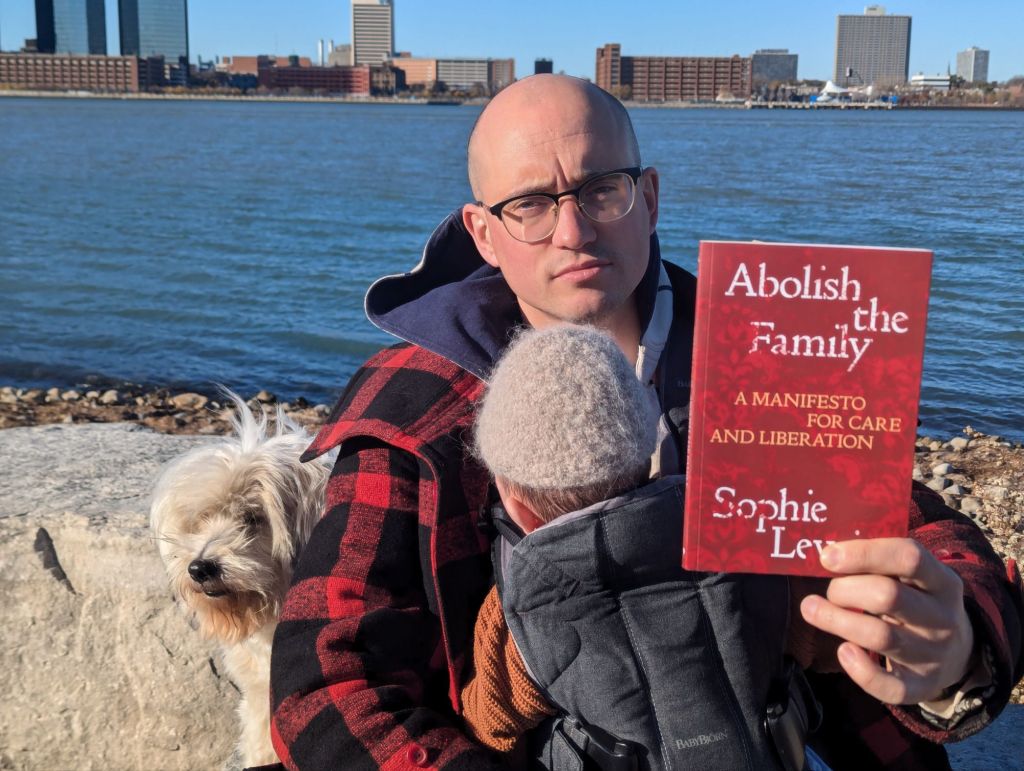
As Sophie Lewis discusses – and is very clear from living in the society in which I live – my response to being aware of the cost of childcare is meant to be, is expected to be, is propagandised to be: “I need to make more money”.
I’m meant to, right now, be thinking: “I need to spend more time working and more time earning, in order to own a [bigger] house and own a [fancier] car and have fancier holidays and spare cash for private education and private healthcare and horse riding lessons and Mandarin lessons and mandolin lessons, or whatever, in order to to be a big grown up in the world.”
But that’s the opposite of what my thoughts have been.
I believe there is no way my baby is going to grow up happy and content and optimistic about life if every day it sees – for maybe 30mins in the morning and maybe for an hour before bedtime – a depressed, unhappy, likely functioning alcoholic on the verge of a breakdown for the thirty or maybe even 40 years it will take until a non-wealthy millennial parent like me would be able to die or retire and/or both.
I have found, actually, that having a baby has forced me to be far more aware of the bleak, depressing “compromises” that I have made in my life so far, because creating a home environment where capital-P Productivity (i.e. economic productivity) is treated as if central to life – even though I know that it shouldn’t be – is something that it is imperative for me to avoid.
Life is not worth living if all you are doing is working in a pointless manner and doing things required in order to maintain that state of work.
Ironing and completing online training courses and commuting and schedule-sending emails late into the evening, and receiving and responding to emails and Slack messages before you’ve left their house is pretty standard for any kind of 21st-century employment and it’s just a fucking waste of time and it’s an absolute waste of life.
I would far rather work less and have much less money – and this is the choice that I’ve actively made.
Maybe, though, I will regret this and maybe, sure, I will change my mind and maybe, okay, in six months time this blog will consist of me desperately writing about how I regret spending a few months out of the workforce and how I’m now desperately chasing a six-figure salary and training for a fucking law conversion in the evenings and never thinking about anything but money. But I think it’s unlikely. I hope that isn’t what happens. I hope I’m even further away from that thinking than I am now…
I think it’s important to enjoy life.
I think it’s important to not be miserable.
I think it’s important to not feel trapped.
One of the few advantages of the misery of my 20s (check out my book the pleasure of regret if you’re unaware of what happened there) is that I have seen very clearly and very directly that there is absolutely no fundamental contentment to be found in material comfort.
Sure, it’s nice to have nice things, but nice things do not make one content, not when you spend the time you’re wearing those nice clothes or sitting in that nice chair fucking miserable.
Glamour, elegance, luxury, it’s all a balm, it’s all a balm, much in the way that the glass of wine or the oat milk flat white was for my person-with-an-office-job-in-my-30s life.
And it’s pointless, because if all of your moments of fleeting pleasure are the distractions, are the sides, are not the meat of your life, then what is the purpose of living?
If you are spending 80-90 hours of your week (including the commute) working a job, and that job gives you no fulfillment, no assistance with your sense of self, your sense of commitment to existence, then it’s an absolute waste, right?
It’s an absolute dereliction of your responsibility to yourself.
It is an act of self-sabotage, of self-harm, to persist in misery without pursuing other options.
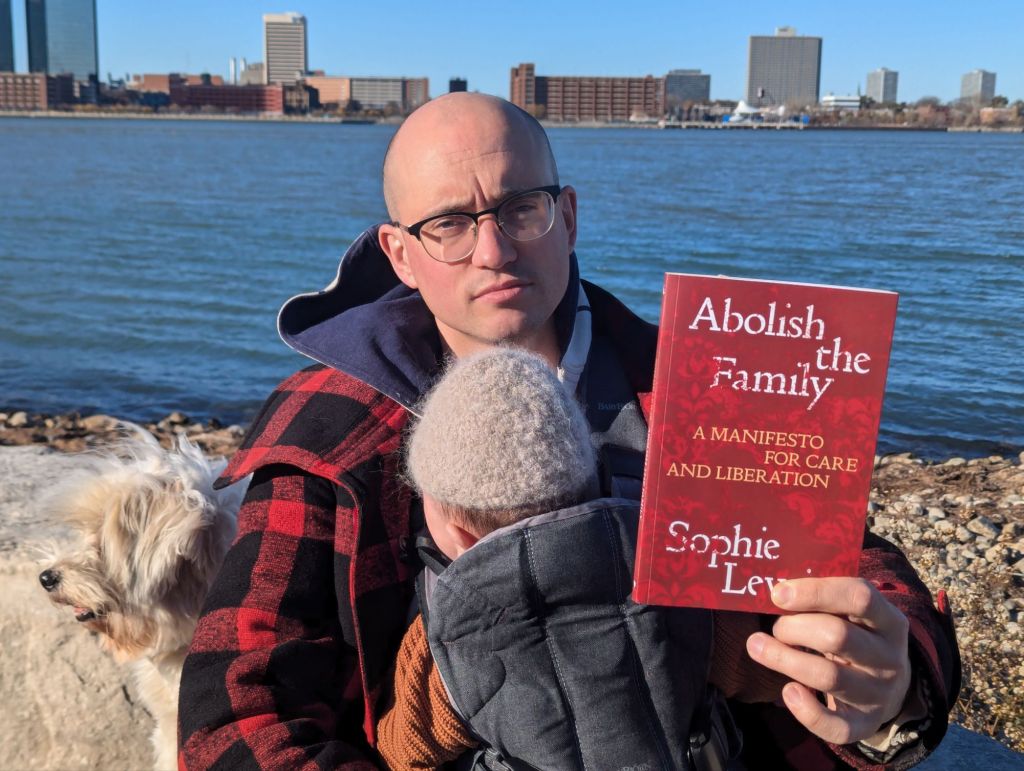
So, yes… I fundamentally agree with Sophie Lewis’s theory/manifesto that families as units are destructive to the self, to the individuals within them and also to the state and the communities who otherwise should and could have responsibility for individuals who live within that situation.
To put responsibility of care, of education, of food and of emotional support onto a small group of biologically-linked people – rather than sharing that around a wider community – means that, for example, people who are not suited to emotional support end up being the sole offers of that which people (especially children!) get… it means that people are reliant on one or sometimes two individuals for very important things, and those individuals very often are not qualified, interested in or able to fulfil those roles, all of which would be much easier to fulfil to a higher level for more people in a more shared, a more communitarian, a more egalitarian, situation and society.
Accidentally, my personal decisions are almost revolutionary.
And I realise that makes it sound like I think my choices are elevated and escalated and like I’m taking myself far more seriously or significantly than I am, but in reading this short book about the the normative expectations and the normative realities of people’s responsibilities and responses to family and family life, I’ve become very aware of the ways in which my interests and my expectations and my hopes for the future divert from what is considered to be the standard.
However, though, I also worry if my realisation that I must seek more personal contentment and situate my own needs and interests more centrally is an example of exactly what Sophie Lewis is writing in opposition to?
Is me (scott manley hadley) seeing a baby in my life and then wanting to not be fucking miserable when I’m spending time with it… is that me responding in a traditionalist way?
Is the only actual diversion from the norm in me seeing myself as a maternal rather than a paternal figure and thus still responding as a person would in that situation more traditionally?
Maybe I am???
But, by not wanting to follow patterns of traditional conservative behaviours, by not wanting to be stuck in unsatisfying but economically justifiable ruts, I’m now in a position where I have caring responsibilities (to a baby), yet I am looking forward to my own future in a way that I honestly don’t think I ever have in my entire adult life before…
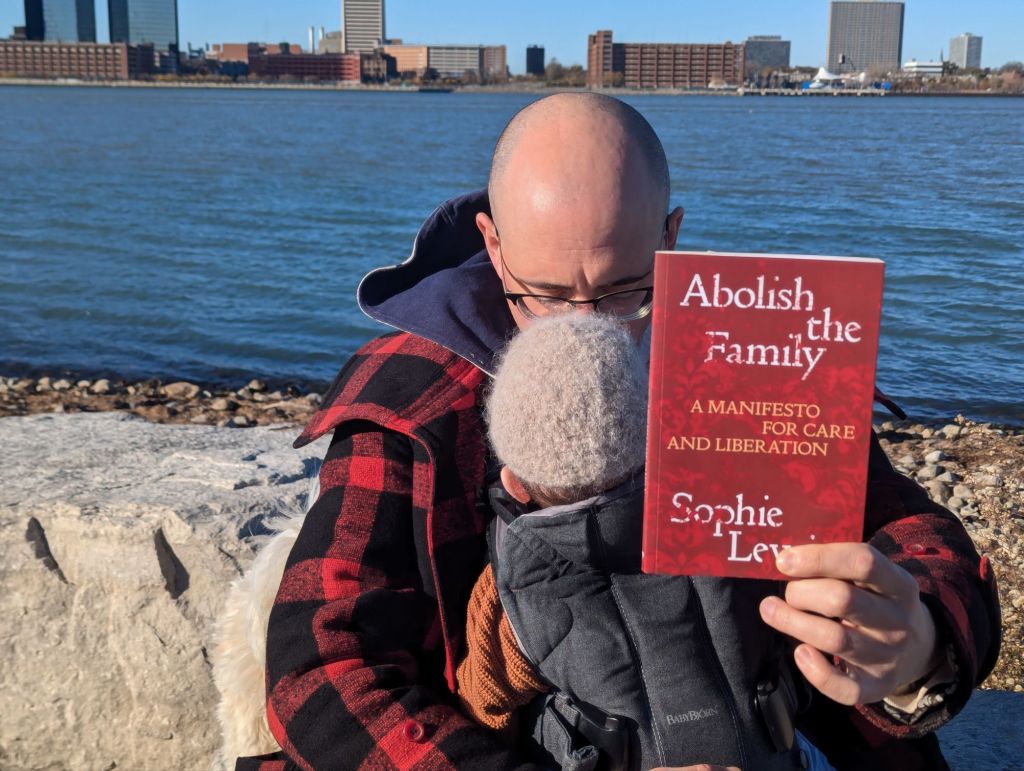
Hopefully, I will be able to spend time in 2025 finding other people with shared values, politics and ideologies…
Hopefully, if I’m able to find part-time work or freelance work at a reasonably remunerative hourly rate (by my standards), I’ll be able to spend time I’m outside of the house doing some, like, sort of working in, like, charitable locations, volunteering at a food bank or volunteering at a soup kitchen, things like that, things that are work that I have not had the time or the energy or the opportunity or the drive to engage with previously, because ordinarily at the end of the working week I’m too depressed and unhappy and need to make myself feel like an individual again, to recalibrate…
I hope that I will be able to find that energy, that opportunity, that drive to be a functional member of at least, like, one kind of community.
I’m not a member of communities, ultimately, is what I mean, but hopefully with the additional time available to me, I’ll be able to find some.
Or maybe I won’t.
I may not be literally abolishing any families in my life in the short term, but I am absolutely interested in and following through on abolishing traditionalist paternalistic notions of family and family expectations, and I’m very excited to be doing that.
I don’t want to be fucking miserable for the rest of my life, and I would have been had I taken on these ideologies in the longer term, and what I don’t want to do, what I’m not going to do is, y’know, be like a depressed alcoholic who’s dead at 45 because that would also be unhelpful and unkind, because until families are abolished in the United Kingdom I am (alas) financially and emotionally and care wise responsible for my child, BB Whamathan.
So, I think it is right for me to see that responsibility as a meaningful one, rather than as an excuse to disengage from my own need for contentment and fulfilment, as many other people do…
I’m not going to bury myself in meaningless remunerative work, I’m going to (hopefully) bury myself in satisfying community building and (hopefully also) artistic expression and (definitely) meaningful care and love and support for my small baby.
I liked this book a lot, thank you.
Order Abolish the Family: A Manifesto for Care and Liberation direct from the publisher here

Thank you so much for reading TriumphoftheNow.com! If you like what you’ve read, please subscribe, share and order one of my books. If you love what you’ve read, why not order me something frivolous and noisy from this Amazon wishlist or make a quick donation via my ko-fi page?
I’m currently focusing on parenting and creative practice, so small donations are appreciated now more than ever!
scott manley hadley aka SOLID BALD live
Here’s a video of me recently performing at the prestigious (it has a Wikipedia page) comedy night, Quantum Leopard. Listen to how much fun the crowd is having. You could have that much fun, too!
Forthcoming gigs include the following – there may/will be others:
17th March 2026, 7pm: Slap & Giggle @ Coin Laundry, Clerkenwell
24th March 2026, 7.30pm: Lolipops, Southwark
26th March 2026, 7.30pm: Comedy @ Cosmic, Plymouth
9th April 2026, 7pm: Sunset Comedy, Chalk Farm
15th April 2026, time tbd: BALD PERSONALITY DISORDER 40min-ish WIP at Shirker’s Rest, New Cross (more details soon!)
27th June 2026: Twinkles Cabaret, London
9th August – 14th August: BALD PERSONALITY DISORDER at The Street, Edinburgh, part of PBH’s Free Fringe
Discover more from Triumph Of The Now
Subscribe to get the latest posts sent to your email.

 Triumph Of The Now
Pingback: Julian by Fleur Pierets – Triumph Of The Now
Pingback: The Earth Is Falling by Carmen Pellegrino – Triumph Of The Now
Pingback: Finding Your Comic Genius by Adam Bloom – Triumph Of The Now
Pingback: 2025 Resolutions? That’s too many resolutions, I have 10 – Triumph Of The Now
Pingback: Five by Doris Lessing – Triumph Of The Now