
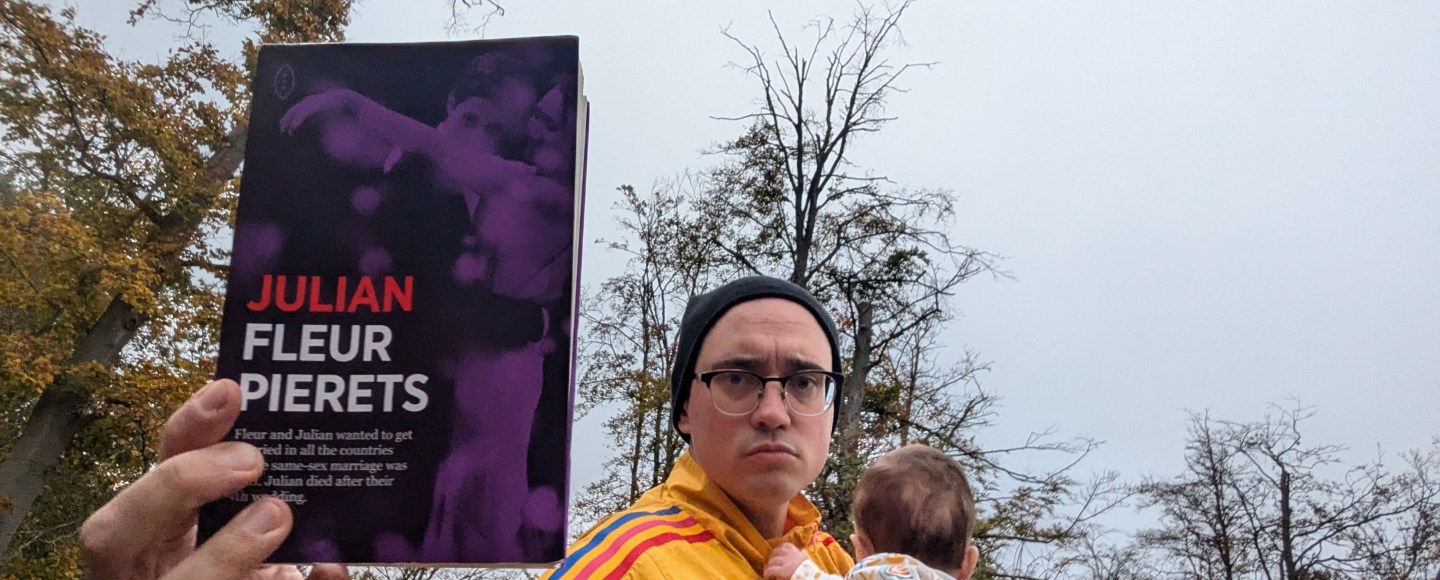

Julian was published by 3TimesRebel Press in 2023, translated from original Flemish by Elisabeth Khan
A promising portrait of grief and devastating loss slowly becomes an exercise in self-promotion for the corporate speaking circuit…
I read this about four weeks ago but left my copy at the last place I stayed in the UK before flying over to Canada.
I took a lot of photographs of pages of the book because I really wanted to drill down into the text in detail when I had the time because the way I responded to Julian was strong and very different from what I had expected to happen and I felt I needed to provide evidence. At this point – doing voice-to-text in ~3 degree weather while walking 30 minutes from the subway to my accommodation in Toronto after working an event – I don’t know if I’ll get round to that (you’ll find out below), but I have to get these thoughts out of my head and into a post so that I can move on with my life.
The premise of Julian is there on the cover as you can see in the image at the top of the page (if you zoom in) and it is enough (for me, at least) to start weeping as soon as reading. It’s also typed here:
Fleur and Julian wanted to get married in all the countries where same-sex marriage was legal. Julian died after their 4th wedding.
Devastating.
Heartbreaking.
It’s a fucking sad image.
It’s a beautiful, sad, premise for a book, and the performance of multiple international weddings as part of an intentional art practice is a beautiful idea, too.
I love the idea of people trying to engage in a work of art to celebrate their romance, their love, while drawing attention to how many places in the world still hold arbitrary and unjustifiable rules and regulations about the shapes of relationships and families.
For what happened, then… for this beautiful performance, created as what was planned to be the beginning of a full, shared, life… for this to be interrupted by death… for death to get in the way and stop it from happening, that’s really sad.
In my opinion, that’s really sad.
I think it’s, honestly, a moving and upsetting idea and reality, because this is a memoir, not a fiction.
The book has a split timeline structure, much like the most recent Alan Partridge book, and it uses it with a similar tone to a similar effect, almost acting as if it is a unique idea.
The first few chapters bounce between the summary of a death and the beginning of a romance. They’re beautiful. They’re sad, they are moving, they are exactly what you expect from a romantic memoir.
Then as the book goes on, it bounces between the romance timelines and the aftermath timeline, taking us from the beginning of the romance through to lives becoming intersecting and the development together of an online magazine and then the spark and beginning of the wedding art project… Alongside this, though, cancer is found, treated and then believed to be gone… but then, well… it’s not, and death happens.
We bounce between that time and the time of the narrator in the aftermath of the death, deep in grief.
The first few chapters really are very sad, they really are genuinely moving and upsetting. However – and I was astounded by myself for feeling this way and that is why I plan to do some uncharacteristic textual analysis (will I???) below – but very soon I found myself shocked to be moved to disinterest for large swathes of the book, especially for the half that is set following the death of Julian, which-
–///–
The mention of the fictional blowhard Alan Partridge in the earlier paragraph was not a brain fart, it was intentional, because Julian reeks of “Needless to say, I had the last laugh”- type self aggrandisement, and as the memoir progresses it feels far more like an exercise in trying to change a narrative than to tell a story about grief… And that narrative is the opinion that (at the start of the book) the writer and everyone they’d ever known or met had believed that Julian was the cool, interesting, fun one in the couple, in the marriage, and this book is instead an attempt to repeatedly evidence the opposite…
–///–
At one point, Julian is described as voluntarily watching a documentary about the American rock group, the Foo Fighters.
If you don’t know who the Foo Fighters are, then you’re neither lucky nor unlucky – they’re one of countless middle-of-the-road outfits who produce (probably intentionally) forgettable music… Rock music for shopping malls. Rock music for drive time radio shows. Rock music for adverts. You know the type. Which is why watching a documentary about them – when there is a world of premium and intentional content available online for all of us to watch – is a deeply shameful act.
No one with any interest in music and/or visual media – save for (possibly) the close friends and family of the Foo Fighters and the people who work with them – is going to voluntarily watch a documentary about the Foo Fighters. It is muzak with guitars and drums. It isn’t of interest to anyone.
Why would anyone be watching that documentary (after the friends and family screening)?
I would presume that anyone watching a Foo Fighters documentary had lost the ability to think or read or engage or had – and this has to be the only possible option as I can’t believe any streaming service would autoplay a Foo Fighters documentary – fallen asleep or passed out in front of ad-supported broadcast television due to serious intoxication or a very destructive hangover.
Something must be wrong to be watching this.
Or – if it’s happening by choice – you’re simply someone devoid of intellectual vigour, which doesn’t connect with the role of internationally known artist and performer.
I just don’t believe that anybody is interested enough in the Foo Fighters to watch a documentary about the Foo Fighters.
It’s also, therefore, more difficult to find irrevocable tragedy in a story about the death of someone who’s interested enough in the Foo Fighters to watch a documentary about the Foo Fighters.
Obviously, I’m over egging this (because I’m doing voice-to-text transcription while walking around Toronto in the dark and so I can without having to type anything), but this kind of thing persists throughout, with references to all of the interests and the performers and media figures that Julian liked all being absolutely dog shit.
I’m not exaggerating here! At one point it’s mentioned that during breaks from admin tasks Julian would watch James Corden’s Carpool Karaoke videos, which is content made for people without, y’know, critical faculties, not content made for internationally famous artistic intellectuals!!!
And part of me, as I read through the book, patronisingly, initially, presumed that this was a bizarre Belgian cultural thing (Fleur and Julian are both Belgian, I think, though apologies if I’ve got that wrong – I imagine confusing Belgian and Dutch people would cause similar offence to confusing Canadians and Americans, though I don’t know which way around)) and that Belgians maybe have a weird blind spot when it comes to quality and validity of American cultural products, but this isn’t the case at all, as becomes clear with the passage of time and text…
After the death of her life and artistic partner, Fleur Pierets becomes increasingly and individually more noted and more successful than her now dead ex spouse, and then she really gets into name-dropping and the thinkers, the artists, the musicians, and the the the the people in general who she begins engaging with about halfway through the book are suddenly completely fucking different and from a different tier.
–///–
Pierets writes about Julian watching James Corden (something that that that like brings to mind a sea lion clapping, y’know (it’s not something a mature functioning human would do))—
I’m exaggerating, kinda, but this book is meant to be about a serious, artistic, creative, intellectual person, and to say that they enjoyed trash culture is not a cheeky “getting to know them” thing because Pierets only mentions elite, intellectual, artistic connections when she is talking about her own work, her personal post-grief work.
It becomes – by the end, to me at least – an offensive-feeling book, a book that feels lacking in compassion and almost an attempt at reframing a relationship on the page (but we’ve all done that, right?)…
It feels like it feels like it feels like a cruel thing, it feels like a sad thing to have done, but it also feels calculated and it feels so comprehensively done to feel potentially intentional. Yes.
And yes, there is a return to empathy and beauty and sadness and regret and meaningful emotional content towards the end of the book, as one of the timelines does hit that moment of final decline and final death, but in order to have got there, one has had to have read through some often uninteresting and too self-agrandising material.
And I think part of this comes from – and I feel I’m being generous here – Julian being written while grieving, rather than afterwards.
And it may well be that this isn’t meant to be an attack on the personality and personhood of a deeply missed and deeply loved spouse, but here – when writing about Julian’s love of shit American things – this doesn’t come across as endearing or cheeky or unexpected, because there is nothing there to weigh against it, there is nothing there to indicate that these things weren’t the only things that Julian liked, because we don’t see the other things.
The reader doesn’t witness the other interests.
And it may well be, y’know, that the person writing this text thought those things were obvious, felt those things were obvious, but they’re not there in the text and I, I I I the reader and thus the main character, wasn’t there, I wasn’t there, and all I see is someone I am told is great and interesting and has done great and interesting things, yet all I learn of them makes them seem like someone who is neither of those things…
But – and – but/and Julian does become deeply sad and deeply moving again by the end because death is often (almost always) a sad thing, because most people don’t want to die and most people aren’t ready to die when they do, but there’s also a fucking difficult dichotomy in this book, because there is a person depicted who is diagnosed with cancer and doesn’t want to die of cancer but chooses to not continue cancer treatment, and chooses to not have cancer treatment not because she’s ready to die and willing to accept death, but because she genuinely doesn’t seem to understand and believe in the realities of 21st century medical science.
This choice to abandon treatment comes across in the text in a jarring way.
It seems to be written as if stopping treatment was a totally positive choice with no repercussions, that not being treated for cancer had no link to an early death from cancer, and the text almost seems to want the reader to believe that the cancer returning was a coincidence, given Julian’s choice to walk away from positive – but not all cleared – treatment.
That’s jarring too.
–///–
And death is often sad.
Death is always sad, I suppose, and I did cry a lot reading this book.
It is really moving.
I have a partner. I have a spouse who I deeply love and I read this book and I imagined them dying early of cancer and I wept and wept and wept thinking about that, too, because it is fucking sad when people love each other and don’t want to be apart but-
but-
but-
But yes, yes, I think this might be a text that is too raw to have been published, but it also might be a text that has been written and produced absolutely and intentionally to be marketed towards… ummm sort of the the the the… I don’t know what the right word is for it, but like… people who enjoy talking about “positive affirmations” and people who like… talking about inspiration… and that kinda thing…
Julian is structured as if overcoming grief and becoming an important person is is is, y’know, an “aspirational” thing to do, whereas I don’t think the only way to become an interesting person is to lose a spouse, and I don’t think that having lost a spouse makes someone a more interesting person than someone who hasn’t.
I mean I don’t know what I’m talking about, do I?
I don’t know if I’ve ever really been bereaved. I’ve mourned losses, sure, but never mourned, hard, any literal deaths.
I’ve known people well who have died, and been affected by the deaths, sure, but they’ve only ever been people beyond three score years and ten and never people that were sprightly and I think that over-mourning the end of a natural life span is something deeply unchic. That isn’t exactly the word I mean, but it also exactly is. Y’know?
You know, like, I haven’t had any family members die for ages and, as I’ve mentioned before in books and poems, I’ve had chronically unwell parents for a very long time. Which sorta means that, y’know, grieving is is is is is a thing that’s already happened when they’re already still alive, kinda thing… Which often happens with lots of people, y’know…
And
And
And
Death is messy. Death is surprising. Death can change the way people are… People respond to death in ways that they’re not expecting to respond to death and that’s… errr… that’s that’s that’s true in itself too, and maybe a lot of the things that I found… sticky… in Julian… maybe a lot of those things are there by accident because grief really fucking fucks you up. And maybe by noticing them, I’m a massive-
–///–
I finished reading this book about romantic grief not feeling like I’d read a beautiful love story, though there is a beautiful love story in there.
There really is, and there is beautiful writing about finding ones sense of self and sense of personhood and and sort of finding a a a a a a a way to live and a way to be happy that isn’t following the prescribed norms of the society one lives in, especially when at a point in life when one doesn’t think that is possible…
That is something that I also found very interesting and could have found that inspiring, I suppose, because I too am trying to reinvent for contentment and I too am the unchic side of 35 but I just don’t know if I can describe a text as being “intentionally inspirational” in any way that isn’t a critique…
That said, the first page of Julian – and indeed the cover of the book – tells one of the saddest stories that I’ve ever read. They were going to get married in every single country where they could and one of them died after the fourth one.
That sentence, that narrative, is fucking devastating.
What a fucking elevator pitch!
It’s fucking sad.
It’s so so so so so fucking sad, and when something that sad happens to you, when something that that that that that that really upsetting happens to you, it obviously affects the way in which you empathise, it obviously affects the way in which you emote and it obviously affects the way in which you reflect on that relationship…
But I read this… I read this book through and by the end it didn’t feel like a book about one of the saddest stories I’ve ever heard.
Instead, it felt like a Gen X Belgian woman repeatedly telling me that “needless to say, she had the last laugh.”
Below are some quotations that I feel back up what I’ve said here:
[insert quotations if time]
Honestly, I hugely apologise if I’ve offended anyone with this post, but I found the book kinda offensive…
A person cannot be sympathetic, human, rounded, whole… if they are voluntarily watching a Foo Fighters documentary. Maybe in life, just, maybe just in life this is an option, but Julian isn’t life, this is literature, and in literature language matters, language has meaning, language and reference and image and metaphor and detail are all important…
The cover contains one of the saddest stories I’ve ever read. Sadly, alas, the pages don’t.
Order direct from the publisher via this link

Thank you so much for reading TriumphoftheNow.com! If you like what you’ve read, please subscribe, share and order one of my books. If you love what you’ve read, why not order me something frivolous and noisy from this Amazon wishlist or make a quick donation via my ko-fi page?
I’m currently focusing on parenting and creative practice, so small donations are appreciated now more than ever!
scott manley hadley aka SOLID BALD live
Here’s a video of me recently performing at the prestigious (it has a Wikipedia page) comedy night, Quantum Leopard. Listen to how much fun the crowd is having. You could have that much fun, too!
Forthcoming gigs include the following – there may/will be others:
17th March 2026, 7pm: Slap & Giggle @ Coin Laundry, Clerkenwell
24th March 2026, 7.30pm: Lolipops, Southwark
26th March 2026, 7.30pm: Comedy @ Cosmic, Plymouth
9th April 2026, 7pm: Sunset Comedy, Chalk Farm
15th April 2026, time tbd: BALD PERSONALITY DISORDER 40min-ish WIP at Shirker’s Rest, New Cross (more details soon!)
27th June 2026: Twinkles Cabaret, London
9th August – 14th August: BALD PERSONALITY DISORDER at The Street, Edinburgh, part of PBH’s Free Fringe
Discover more from Triumph Of The Now
Subscribe to get the latest posts sent to your email.

 Triumph Of The Now
Pingback: The Earth Is Falling by Carmen Pellegrino – Triumph Of The Now