
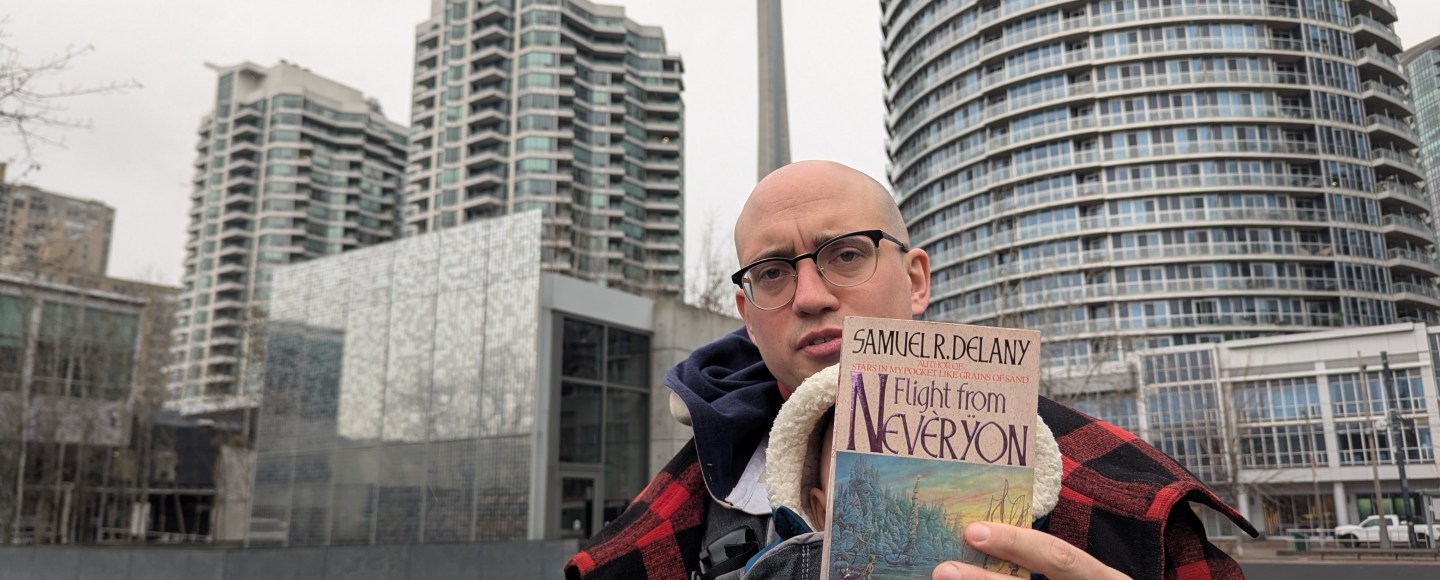

Exactly my kinda thing…
I love it when fiction and fictitiousness dissolves…
–///–
Flight From Nevèrÿon (1985 (though this late ’80s edition includes meaningful non-fictional afterwords)) is an absolutely spectacular dissection, expansion, evocation and totalisation of the fictional world of Samuel R. Delany’s Return to Nevèrÿon sword-and-sorcery series…
This is a literary, logical and metatextual endpoint for the longer form of the multi-volume text (though not of its widest narrative, necessarily..?) as fiction crumbles into fact, fantasy into reality and ancient Nevèrÿon into 1980s New York City…
It’s a simultaneously serious and silly text that maintains the genre joys, semiotic plays and broad sociocultural commentaries of the previous volumes of the series, while adding to them an (understandably) urgent, direct and long-form discussion of the AIDS Crisis…
–///–
Flight From Nevèrÿon left me feeling moved, impressed and thoroughly entertained, though also incredibly curious as to how there may be a fourth volume in this series, as here we reach the fictional limits (i.e. the borders) of the fantasyland, as well as its literal ones (i.e. the sword-and-sorcery project fails as an effective metaphor for the real world issues Delany wants to explore)…
–///–
There are three “tales” included in this third volume of the series (up from the singular “tale” of Neveryóna, but down from the five of Tales of Nevèrÿon), and this time there is no fictionalised appendix or introduction, because the metatextual, postmodern, elements of this series have (finally?) made their way into the text itself…
The third “tale” included here (‘The Tale of Plagues and Carnivals’) takes up over half of the pages of the book and is not – as the rest have been – a singular and focused (if digressive) sword-and-sorcery story, instead it is an evocative and contemporary retelling of the AIDS crisis in New York City as it was happening. The physical formatting of this tale even changes, too, matching Delany’s other major 1980s project – The Motion of Light in Water, a memoir – rather than the rest of this series…
We are not solely in the imagination any more…
This is reportage, not story-telling…
This is something very special.
–///–
The first two tales here are enjoyable, sure… I liked them a lot, I did, it’s just-
–///–
The first tale – ‘The Tale of Fog and Granite’ – tells the wider life story of the smuggler who Pryn briefly travelled and hooked up with in Neveryóna, particularly his later life adventures as he pursues knowledge of Gorgik The Liberator and eventually has a singular encounter with him, though not after he believes he has possibly met him several times, having encounters with people who both do and don’t claim to be this former slave who now nears meaningful power…
This story is about the use of constructed mythologies as political tools, how ambiguities are useful to politicians and how these kinds of political seductions are similar to the seductions that take place in the sexual marketplace (with nods to this meaning both casual sex and prostitution).
The second tale – ‘The Mummer’s Tale’ – is delivered as one side of a dialogue, a la Brief Interviews With Hideous Men (though this was published about twenty years earlier, which means that (Brief Interviews With Hideous Men) is more like this (Flight From Nevèrÿon) than this (Flight From Nevèrÿon) is like that (Brief Interviews With Hideous Men))-
Sorry…
This second tale similarly features (though less directly) that same smuggler (passing through more of his life) and it is told from the perspective of a mummer (an actor) who is talking to a friend of his who runs an elite school.
The conversation is about performing life and the world in which the mummer lives, plus his friendship with (and knowledge of) the smuggler as he ages from young hustler through rocky patches and a failed marriage to a dull, risky (but not as risky as before) later life. It’s enjoyable and engaging, too…
What both of these tales have in common is a focus on ‘The Bridge Of Lost Desire’ (this was the initial name of this book when first published, but was changed to show that it’s part of a series of well-selling novels), which is the location in Kolhari (the capital city of this fictional empire) of the equivalent of a red light district with adjacent cruising spots…
This bridge is where sex is bought and sold, and sometimes given away…
These two tales explore hustlers and sex workers, and the people who enjoy spending their time and money with them…
Mostly, but not solely, queer desire focused, Delany describes people from a wide range of classes and backgrounds from his city as they enter into this location, further and deeper sketching out his fictional world with a focus on sex and sexuality.
These literary ingredients (themes, tones, characters, actions, narratives, whathaveyou) are all present yet exploded in the third tale…
–///–
The third tale is a deconstruction of the entire series, including the fictionalised appendix bits…
In this 200 page plus literary event, the reader now bounces between third-person storytelling of Nevèrÿon and first-person descriptions of Delany writing the text, live, as the cruising scene in New York City is ravaged by AIDS…
It becomes memoir, reportage, non-fiction, for pages at a stretch, while also telling the story of a similar “plague” in the fictional city and the carnivals used to distract the populace, and also falls into a magnificent fictional digression from the non-fictional digressions as a lengthy, uninterrupted, story about a journey the schoolmaster mentioned above took all over the Empire as a youth, in pursuit of the architectural legacies of a significant builder and designer (Delany again on ideas of myth-making, especially the standardised and automatic-seeming process of the erasure of women and the non-privileged in historicisation)…
The fiction that appears here is as good as anything from the series so far, but the slips and the digressions into a very real reality are far more significant…
At the time of the book’s composition, AIDS was still almost inexplicable in the ways in which it was scientifically understood (links had been made between its spread and both intravenous drug use and sex, but the details – and crucially the relationship between AIDS and HIV – was not yet established… This means that Delany is writing rumours, anecdotes, hopes, fears and reports of experiments and studies and sometimes describing mistakes and sometimes writing of breakthroughs…
There are some bluntly non-fictional afterwords included at the end (from multiple later editions) that apologise for and correct(!) errors in the main text, then apologise for and correct errors in the afterword[s]… These passages also offer some unexpected closure re the non-fictional ambiguities of the main text (i.e. which “real” characters were composites, which weren’t and, for the latter case, who made it out of the eighties alive)…
–///–
Elsewhere in this final tale, there are a few glimpses of the fictionalised academics who were previously credited with writing the appendices… there are many stories set in a fantastical city about people living in a time of a plague that predominantly affects queer people… there are sections about Gorgik The Liberator moving towards total control of Nevèrÿon while looking for and failing to find forgiveness for his most regretted acts… and there are also true (or nearly true (ethically true if not legally true (journalistically true)) stories about lives and deaths in NYC in the 1980s…
There are digressions and explorations and expansions and twists and turns and heart-rending detail about the cruelties of AIDS itself and the right wing politicians who failed to act promptly in ways to reduce or slow down the crisis…
There are multiple threads and multiple narratives being told about multiple different people in the ancient fantasyland and in the real world’s past…
Narratives slip, too, with people from the 1980s sometimes wandering in the background (or even in the foreground) of sections set in Nevèrÿon, and vice versa…
The fictional academics discuss how Nevèrÿon is a real place, with real meanings, while Delany expounds further that it isn’t, it isn’t true at all, that he’s writing about a place he’s made up to talk about things of significance in real life, but the metatextual blurring of boundaries between truth and fiction feels whole, tangible, touchable, present as as as as as as as as…
–///–
I wept and wept and wept for the fates of real people I never met who lost significant people and themselves in the 80s… I wept, too, for completely fictional people living completely fictional lives in a completely fictional place…
Delany evokes both of these settings in a way that is textually extremely playful … silly, even … yet deeply fucking serious.
This is a powerful and significant text and I’m surprised it’s not more famous, more canonical, as there are plenty of other well-known 1980s postmodern texts that crumple meanings and fictions but have nothing to fucking say at all…
This is human, artful, literary, political… It’s also exciting, joyous, cheeky, genre writing. It’s a book that does all the things literature promises to do, and it dissects them, draws attention to how and what it’s doing and then it fucking does them again.
This might be one of my favourite books. It’s an absolute fucking pleasure – so serious, so silly, so fucking good.
Highly recommended.
I do not know how the series can function for another 400 pages beyond this, but I will certainly find out in the first couple of weeks of 2025… (I have less than two weeks left in Canada and will be returning to London having read (or at least started) all of the books I brought with me, which is a victory of the kind I’ve rarely yet experienced. Haha!!!)

Thank you so much for reading TriumphoftheNow.com! If you like what you’ve read, please subscribe, share and order one of my books. If you love what you’ve read, why not order me something frivolous and noisy from this Amazon wishlist or make a quick donation via my ko-fi page?
I’m currently focusing on parenting and creative practice, so small donations are appreciated now more than ever!
scott manley hadley aka SOLID BALD live
Here’s a video of me recently performing at the prestigious (it has a Wikipedia page) comedy night, Quantum Leopard. Listen to how much fun the crowd is having. You could have that much fun, too!
Forthcoming gigs include the following – there may/will be others:
17th March 2026, 7pm: Slap & Giggle @ Coin Laundry, Clerkenwell
24th March 2026, 7.30pm: Lolipops, Southwark
26th March 2026, 7.30pm: Comedy @ Cosmic, Plymouth
9th April 2026, 7pm: Sunset Comedy, Chalk Farm
15th April 2026, time tbd: BALD PERSONALITY DISORDER 40min-ish WIP at Shirker’s Rest, New Cross (more details soon!)
27th June 2026: Twinkles Cabaret, London
9th August – 14th August: BALD PERSONALITY DISORDER at The Street, Edinburgh, part of PBH’s Free Fringe
Discover more from Triumph Of The Now
Subscribe to get the latest posts sent to your email.

 Triumph Of The Now
Pingback: Return to Nevèrÿon by Samuel R. Delaney (Book 4 of 4) – Triumph Of The Now