
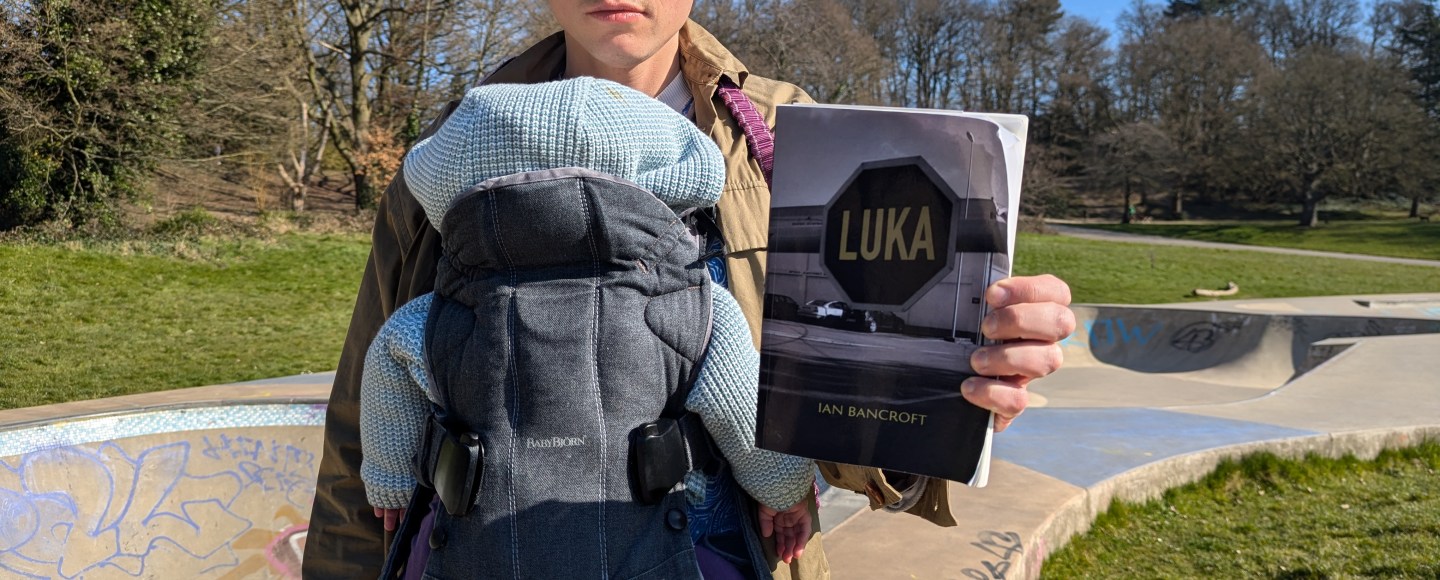

Notes, thoughts, comments on a brutal novel inspired by real world conflicts in the former-Yugoslavia…
–///–
Ian Bancroft is someone I have followed on social media for so long that I don’t know if he’s someone I ever knew in real life or just someone whose wine writing I have found interesting in the past…
There is a part of me that feels a familiarity with his name that wafts towards memories of pre-adolescent amateur theatre in my dump of a hometown, but reading Bancroft’s bio at the end of this book, LUKA: A Novel (2024), he either started diplomacy very young, rounded up some timings, or – and this is most likely – I’m just confused and Ian Bancroft is not someone I knew in the West Midlands as a child. (Ultimately, this doesn’t matter at all, does it..?)
LUKA is a medium length-plus (certainly it isn’t a quick read) discursive novel about the repercussions of war and sectarianism. On its cover blurb it describes itself as “inspired by” real histories and real conflicts, and unless many details I knew about those histories was wrong, then it’s a novel using really history far more as inspiration than as documentary source.
The histories and the conflicts evoked in this text – and the slight differences (almost manufactured) between groups of people living in proximate, near-identical locations with near-identical cultures yet either side of historic boundaries – may be slightly refracted from true stories of former Yugoslavia, but Bancroft’s creation absolutely is demonstrative of the ways in which civil war, civil conflicts and sectarianism can expand and create great passion and emotion and sudden combative ideas of community and exclusion, which can be exploited to sinisterly violent ends…
–///–
LUKA kicks off towards its middle, when the violence that it describes moves from the background to the foreground, and the horrors and realities of living under threat of sniper fire and landmines and shelling feel very realistic and very engaging.
However, there is a lack of clear chronological coherence to the multi-generational text that left me quite confused for the first chunk of the novel, a confusion that remained until I consciously decided to give up on trying to understand the timelines and the timings of Bancroft’s novel…
Once I had stopped trying to see cause and effect, to understand how much time (moving forward or backward) had passed between chapters, I was able to enjoy – enjoy is possibly the wrong word, because LUKA is quite heavy – engage with the text in the way (I believe) it was intended…
–///–
If I’m being generous or optimistic, then I would probably say that this narrative and chronological confusion (moving back and forth through time or, at least, seeming to) is an intentional attempt to evoke generational trauma and the ways in which war and genocide and violence impact and damage how individuals and societies are able to historicise themselves…
And it may well be the case that this structure is intentionally muddy, and the sense of misplaced time is how the book is meant to be read. The fact that, yes, as soon as I stopped trying to work out and rationalise the histories being [re]told here, I found the book more engaging.
Though, I must admit, that for that first chunk, I did find myself distracted not only by the movements in time, but also by presuming everything was based on “true” history, and not being able to recognise and comprehend the settings, both in terms of time and geography…
I’ve read quite a few books about the history of the Balkans (including, of course, Rebecca West’s Black Lamb and Grey Falcon – the closest book England has to Proust (I haven’t read Anthony Powell)), and I’ve visited that part of the world and travelled around, so though I’m not an expert by any means, I’m not a complete naive, and I think perhaps it was this Dunning Kruger effect type lack of meaningful expertise that put me in the position where I was falsely trying to presume a historical realism that wasn’t there, and had I known nothing about the conflicts and the locations in question, then I wouldn’t have lost a portion of this book due to my confused psychological attempts to rationalise and compartmentalise the times and truths of what I was reading…
–///–
So, yes, once I had given up on trying to tack the events of this novel onto a timeline I half-remembered from a book I read half a decade ago, I did begin to find that it really opened up…
And with its relentless depiction of violence and cruelty and sectarianism and the collapse in and out of civil war and the ways in which stark and unforgiving heinousness arises in moments of chaos, Bancroft’s prose does find its rhythm…
–///–
So, no, this isn’t a straightforward novel, and I think the fact that its subtitle “A Novel” appears at the head of almost every single page does do more damage than good.
Ultimately, this is most enjoyable if considered as a collection of short fiction, of vignettes, and the ways in which it links together is more Winesburg, Ohio than something more novelistic, telling a singular story…
Four of the main characters (who initially seem to exist in different times and in different generations, though at other moments overlap) are all referred to only by a single italicised letter followed by a full stop, spelling out the name: L.U.K.A. These aren’t the only central individuals, though, and I never quite understood what the intended effect of this false anonymisation was…
LUKA is a work of fiction, so these aren’t real people whose real lives and real words and real acts are being hidden, though maybe trying to make the text feel like it’s been censored is the purpose?
Unfortunately, I just found this device a bit confusing, and often had to flick back to try and figure out, for example, which character was L. and which was K.…
When, I had to check, in the history of this fictional location was this person young? When were they active? Which of the conflicts did their greatest tragedy occur within? How much time has passed? How old are they now?
Throughout, there is no firm clarification of when we are… Dates aren’t used at any point, and there are no clues to be found in changing/developing technologies or international political landscapes…
So, yes, this does feel intentional in a sorta “depiction of a long 20th century” kinda thing, this does mean that when generational differences are meant to be apparent, the lack of a clear timeline becomes disorienting without feeling controlled…
If you are trying to remain oriented within the broad stroke political narratives of Bancroft’s fictional location, I don’t think you’re going to be able to do it, certainly not with a single reading…
But I choose to believe one is not supposed to.
If you embrace the idea that war is chaos (especially sectarian civil war), LUKA can be read as a work depicting that and dramatising that literally, formally and narratively…
It can therefore be argued that there is cohesion and intentionality…
–///–
LUKA: A Novel does the same thing that Alex Garland’s Civil War (2024) does (and that film pissed off a lot of people for this reason) and doesn’t explicitly have “goodies” and “baddies” as oppositional military factions… What we see is chaos…
–///–
With any fractured narrative, a reader or a viewer is enticed to empathise more with the people they spend more time with, narratively… Ethically, humanely, there’s no real justification for doing this, but people do it…
–///–
There are war profiteers here and people who operate brothels staffed by trafficked and tortured kidnapped women who are (broadly speaking) on “the same side” (or members of the same extended family as) most of the protagonists, so it’s not a clear-cut or a kind scenario or situation that is being depicted in this novel…
And I think that is the point…
The violence and the cruelty and the arbitrary nature of who and what is murdered and who or what suffers torture…
It has a randomness to it, and the people who perpetrate horrors almost seem to be caught up within forces out of their own control…
Post-traumatic stress disorder is something that the perpetrators of extreme violence – as well as the victims of it – can feel, and though it’s obviously harder to empathise with someone who has committed terrible acts feeling extreme remorse afterwards, the fact of the matter is that a lot of the people who do commit active violence in war-torn areas are not people who have chosen themselves to enact that violence, as in they haven’t ordered that violence, right, though of course they’ve chosen not to resist committing the act, so, yeah, I’m not saying people should be forgiven heinous crimes if they were following instructions as they did it, but I do also think that there is truth to the idea that a person who is brainwashed and manipulated into perpetuating extreme violence is a victim of sorts, too, even if they’re not as much of a victim as someone who has been a victim of torture and genocide. Something important has been lost, there, too…
–///–
So, yes, LUKA is a very heavy novel… it very much does depict with brusque unsentimentality the realities, the iniquities and the horrors of warfare, especially sectarian violence…
Is there hope to be found? Maybe, though maybe not…
–///–
LUKA: A Novel is unsentimental, it depicts clear cruelties and violences, however, narratively, sometimes there does seem to be a bit too much coincidence…
Yes, obviously, in a civil war setting, friends and neighbours and cousins fight, and there are connections between participants on either side, but it does feel as if the world depicted in this novel is a little too small…
But, then again, this may be deliberate, too!
The closeness of violence, the closeness of cruelty and the thin line between civility and barbarism is what Bancroft seems to be evoking here, so by making the torturers and the tortured as connected and as close as he does, perhaps he is clarifying a position, removing potential ambiguity from a reading of the novel…
–///–
The novel that I’ve read immediately after LUKA – which I’ll post about soon, I’m sure – similarly bounces around through time and locations with numerous strangely-linked characters (it’s more to do with reincarnation than civil War), but every single chapter opens with a simple statement of location and time…
I do feel Bancroft’s novel would have benefited from this… that, or a note at the beginning stating directly that this is far and away not about any particular place in formal reality…
There’s a section late in the novel that talks about an ancient bridge being destroyed in war and then built again afterwards, like in Mostar, a place where I have been. That location isn’t named in the text, but it did (again) make me wonder if, maybe, everything else was “true”, but containing far more detail and specificity than anything I’d read about myself…
I’m not an expert on anything, and as I mentioned above, I do worry that knowing slightly more than nothing may have put me in a position where I was not able to fully enjoy LUKA, because I was too busy and distracted trying to place my limited knowledge onto a novel that is written with far more awareness and knowledge than I have…
–///–
So, yes, overall, LUKA is a very interesting read, and I did find it super engaging, especially in its middle section, when it did feel more like “stories”, rather than “chapters”.
The last few chapters do coalesce around a single narrative, and I found this less satisfying than the middle 100 pages, during which the book would bounce from place to person to place to person without any real connection other than proximity and relational coincidence… but that doesn’t mean that it’s not good, y’know?
There’s also a conspicuously high number of typos, which maybe does contribute to the idea that this isn’t quite the best possible version of LUKA…
All in all, yes, it is an interesting read. Bancroft also has a collection of stories, which I may look up soon, too, as it is in the parts of this novel that feel most like vignettes that this text does work best.

Thank you so much for reading TriumphoftheNow.com! If you like what you’ve read, please subscribe, share and order one of my books. If you love what you’ve read, why not order me something frivolous and noisy from this Amazon wishlist or make a quick donation via my ko-fi page?
I’m currently focusing on parenting and creative practice, so small donations are appreciated now more than ever!
scott manley hadley aka SOLID BALD live
Here’s a video of me recently performing at the prestigious (it has a Wikipedia page) comedy night, Quantum Leopard. Listen to how much fun the crowd is having. You could have that much fun, too!
Forthcoming gigs include the following – there may/will be others:
17th March 2026, 7pm: Slap & Giggle @ Coin Laundry, Clerkenwell
24th March 2026, 7.30pm: Lolipops, Southwark
26th March 2026, 7.30pm: Comedy @ Cosmic, Plymouth
9th April 2026, 7pm: Sunset Comedy, Chalk Farm
15th April 2026, time tbd: BALD PERSONALITY DISORDER 40min-ish WIP at Shirker’s Rest, New Cross (more details soon!)
27th June 2026: Twinkles Cabaret, London
9th August – 14th August: BALD PERSONALITY DISORDER at The Street, Edinburgh, part of PBH’s Free Fringe
Discover more from Triumph Of The Now
Subscribe to get the latest posts sent to your email.

 Triumph Of The Now
Pingback: A Dream Wants Waking By Lydia Kwa – Triumph Of The Now