

Pierce Day – author of A Phone of the Artist as a Young Man – responds to a series of questions I sent after reading his novel.
My FOUR PART response to reading the novel begins here.
The book can be ordered here from Metalabel
–///–
SMH: Your novel, A Phone of the Artist as a Young Man, is a hugely ambitious and enthusiastic project, which I would say is ultimately about the ways in which an [over(?)] reliance on technology as interpersonal mediator has eroded trust, community, humanity and essentially all interpersonal relationships. What would you consider to be the novel’s main themes/messages/narratives?
PD: The theme is the smartphone; the only problem is when I tried to think about what a smartphone is, I was consumed by a relentless panic. If it’s an object, why can’t I leave the house without it? If it’s jewelry, why can I stream movies on it? If it’s a TV, why can I (hypothetically) snort lines off it? If it’s a town square, why do I pay for entry? If it’s a communication device, why do I feel so alienated by it? If it’s a mirror, why don’t I trust what I see? If it’s a hitherto undiscovered metaphysical category, why can I throw it off a bridge?
I think the best way to think about my book is as a highly elaborate advertisement for the iPhone.
SMH: I was a little surprised that the book is all text, unlike the screen of a phone. I’m curious as to the decision to match modernism-cum-postmodernism with 21st-century narratives of technological isolation/digital loneliness. Why did you feel this form (which ossicalates from stream-of-concsiousness to dialogues to a riff on terms & conditions to excerpts from missives) suited a narrative of the digital age? Could you have expressed your ideas and narrative in any other way/s?
a. Were there ideas for differently styled chapters/sections/segments that you rejected? If so, what were they are? Why did they not make the cut?
PD: I think this is an insightful observation about a key point of distinction between my book relative to others, including but not limited to, childrens’ books. Ultimately as a writer I have distaste for the reputation of image. It’s barely 200 years old and is treated as crown prince of meaning. Because this book is a textual counterattack on image, it was necessary I think, to demonstrate the elasticity of language in a way that has perhaps been forgotten. That being said, somewhere in my book I visualise something in morse code which could be viewed as the insertion of an image should pointillism be considered in relation to the pixel. No doubt our hardest working tertiary linguists will inform me of the appropriate ruling here.
SMH: In conversation with others while reading your book, I described it as “Gen Z modernism”. Is this a formal description you would agree with and, if not, how would you like it to be categorised? Metamodernism? Postmetamodernism? Or would you not see it as modernist at all? Or are labels a bit too Gen X to even be relevant?
PD: Fortunately to me, this seems the purview of the critic.
SMH: Something that struck me while reading the book – which is filled with cultural and (in particular) literary references – is that, beyond some dismissals of a few internationally acclaimed writers of popular “literary fiction”, there doesn’t seem to be much respect or interest stated for anyone writing more recently than the big hitter modernists (James Joyce, Virginia Woolf etc). Was this an intentional referencing choice given the form of the novel, or do you as a writer believe that literature had definitively peaked by the fall of the Weimar Republic? If the latter, please explain why. If the former, which more recent writers do you rate?
PD: Every day for the past 10 years I have read the prose of my contemporaries. Across all forums platforms boards, private and public, I have analysed emulated and reacted to the nuances in platform styles and narrative methods. For example, I consider @dril to be the foremost writer of our age, alongside the anonymous partakers in reddit’s “AITA”, Azealia Banks and of course any greentexter. I think this daily training on the words of 100-500 contemporary writers has given me an acute eye for what best represents itself in that truly modern literary prize: algorithmically selected popularity in the last 24 hours. The problem here is that you limit prose to published works whereas I approach a tweet as seriously as Proust. This is how I interchange so seamlessly between canonistic works and contemporary language unlike the traditionalist who is trapped by his own reverence for (really fear of) the past and the contemporary who is overwhelmed by the banality of booktok. Incidentally, you omit to mention the text’s substantial engagement with Hannah Arendt, Janet Frame, Simone De Beauvoir, Whina Cooper, Sylvia Plath, Alejandra Pizarnik, Luce Igiray, Valerie Solonas, Patricia Grace, Camille Paglia, J.K. Rowling, Sadie Plant, Elena Ferrante (admittedly, I have heard rumours that this is a man writing under a women’s name), Patricia Lockwood, Eleanor Catton, Lorde, Charli XCX, Talia Marshall (all post-1950s writers). The point being that my eyes have not left a single contemporary go unread allowing me to forge a narrative that procreatively builds upon the past by having a distinctly modern subject matter. Indeed, when viewed in this light by sheer volume of authors, I’d argue I’m the most well read man to have walked the earth and I’m only 26; don’t you think it would be nice to let the ancients have a go?
SMH: Do you believe there are any essential literary texts anyone writing should read? Please give a reason for any you suggest.
PD: Pierce Day’s cracking read, “A Phone of the Artist as a Young Man (2024)” comes to mind.
SMH: Warhol, your protagonist, seems to be lonely and unhappy and maladjusted. How do you feel about him? Is he based on someone you know or mostly fictional? How do you want/expect/intend a reader to respond to Warhol?
PD: I find him oddly charming with that Dionysiac sensibility of his. He betrays a reassuring wink, coveted by many men walking among us I have been told, when he beds your wife. He is no scoundrel or great fool, just a touch desirous. He will sit you down in the morning and suggest you make him coffee. You can see it in his eyes that the words you borrow, the morals you scream, the causes you post amuse him. Whether you’re some scientific pariah or hopeless pop psychologist or incelibate asthmatic, he clocks your beliefs in 10 words or less and then forgets your name. Now do I consider him guilty of a crime? Of course; insanity (which unfortunately he shares with the Ingenious Gentleman Don Quixote of La Mancha and the insatiable Madame Bovary). But nevertheless, his hand eye coordination is immaculate, his laugh comes accompanied by tears, his letters can be found in your girlfriend’s bottom draw (his handwriting microscopically ornate), his shirts litter the flats of Wellington, his phrases repeated by smaller minds as if their own, his sexual performance hardly effortless, his glare sour, his aesthetics incomprehensible, his heart searching. Though his commitment to truth is a little tedious in its precarity, and his cologne cheap, not forgetting the yellowness of his teeth nor abasement of his conversation, Warhol endures. He is neither good nor bad but earnest. I consider him quite sweet.
SMH: AI is mentioned in the text repeatedly and, in Chapter 17, there are passages that are credited to generative AI. Did you use AI to produce these passages or were they written as if AI? And did you use AI elsewhere?
a. If not here, would you use it elsewhere in a literary project?
b. What do you feel are the ethics of AI being used within (or instead of) a creative practice?
c. The chapter with the in-text use of ChatGPT is the most emotionally charged section of the novel, as the protagonist seeks the language and form of forgiveness, rather than forgiveness itself. Do you see this as a grim prediction of the future (i.e. if all communication is via a screen does it matter if there’s a person at the other end), or a device to show the disconnect of Warhol?
PD: This will no doubt stain the topical thrust of every literary conversation I must endure from now until I greet sweet Yorrick in my lush tuxedo, because some techno-optimistic gimp and his Apple watch-laden arm raises itself upon the grand Joycean epiphany that a writer must be as impressed as they are with the rank withered and strangely erectile deficient prose of that de facto miniclip-infused Rubik’s cubonic Altmanian rent collector. Why would I need something to write like Shakespeare when I can do it already?
I used Ai when a character was talking to Ai (passages are NOT written by Ai). This is marked, and oddly this technique seems most neglected by the universities I have periphery glances over, by assigning the Ai model — in my case CHAT GPT — with quotation marks. Tell me honestly whether a privately owned data harvesting piece of anti-humanist Big Tech technology could write a book sodomising these capitalist pigs?
If it comes to it, I will have my editor release my chatlogs upon guarantee of a dinner with Ms Sydney Sweeney, an advance of $500,000 NZD and courtside tickets to this years NBA Finals. If a longstanding patron (à la Ms Harriet Shaw Weaver) could be found amongst the book’s admirers, then the offer is supplemented by the work’s schema, my last cigarette, a weekly voice note, preliminary materials on a theory of Rimbaud’s fateful embrace of commerce, a wet kiss and my annotated copy of The Talmud.
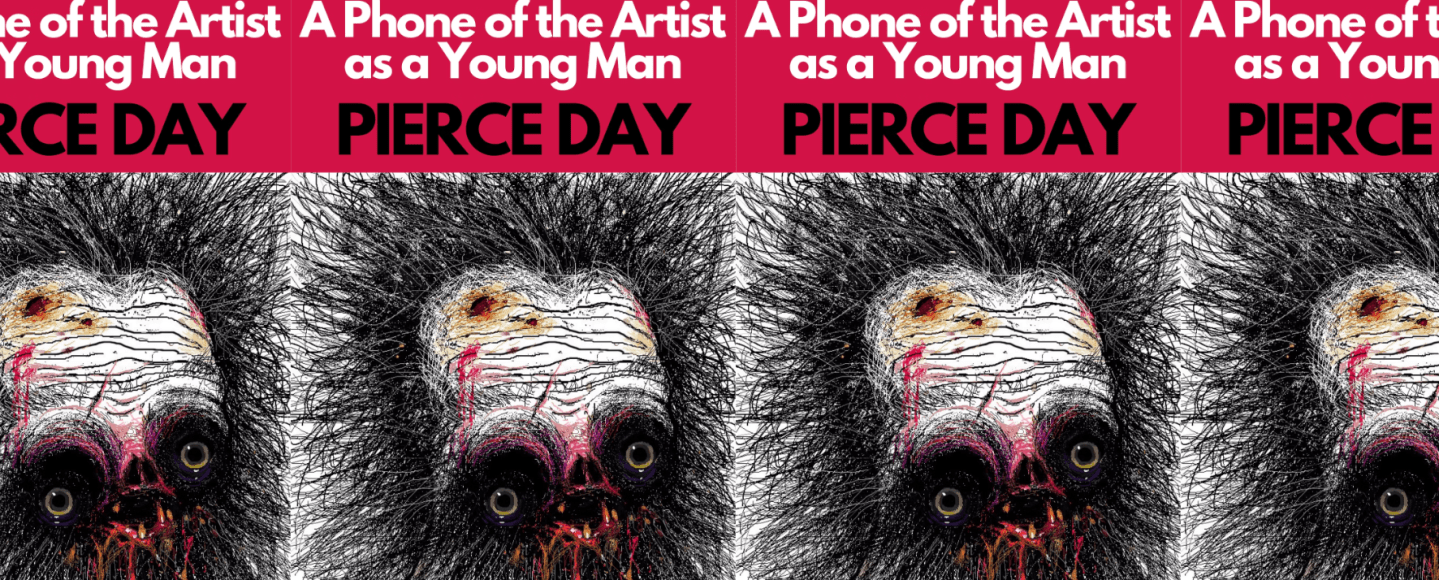
SMH: The cover image is very striking, though the artist is uncredited. Where did you find this image and is the anonymousness a request by the artist or is it genuinely an unclaimed piece of digital visual art? If the latter, are there any ethical concerns – in your opinion – with using anonymous artwork on a book cover? And would those ethical concerns be dependent on/tied to the commercial success of the book?
PD: Found it on 4chan.
SMH: On p. 280 the narrator-slash-author – in what seems to be a fourth-wall breaking moment – states “It is the worst time in human hisotry [sic] to be an artist and technocapitalism is thre eason [sic] for that. Technology is harrowing the mind.” Is this something you believe? Why?
a. Following up and in reference to that passage, what is the meaning behind the creative choice to include misspellings/typos in the book? I presume it is deliberate, especially as – if using a phone or most word-processing software – these would have been autocorrected to correct spelling. When I typed out that quotation, for example, I had to go back and re-type the errors, as Google Docs had removed them [as if] on my behalf. Is this an intentional demonstration that the text is not the product of a generative LLM?
b. What do we lose with autocorrected spellings and grammatical errors?
PD: I have no idea what I believe; this has been a plague, indeed a global pandemic, upon my mind from the very moment I sketched out some critical revisions of The Happy Prince in my bassinet. From what I remember of my early years, I had a precocious ability to write sacrilegious catechisms to my female classmates with veal and grammatical perfection. Indeed, an awfully rudimentary looking but nonetheless jingoistic sort of nymphonic — here I must draw attention to the fact that autocorrect desires I write “nymphomaniac” when I have in fact just created a neologism drawing from the lip-like brotherhood of “symphonic” and “nymphet” — babe once complemented the rigour of my Virgilian declensions (with Virgil it is a matter of sycophancy to win an Emperor’s favour) in comparison to my Ovidian soup (with Ovid declensions trace their alignment to the pelvis). “Caecilius est in horto,” as I believe some will appreciate.
SMH: For me, the most successful chapter of the novel was Chapter 12, which bounces between descriptions of infamous photographic images of horror/warfare and the dialogue of some people playing an online multiplayer shooter. It’s a neat, engaging and tight piece on the desensitisation caused by mass availability of horrific online images. How do you feel about the horrors you have – whether deliberately or by accident – seen online?
PD: There is not an image I have not seen, but taking a leaf from Monsieur Christ, I have elected to assume this role for the benefit and sins of mankind.
SMH: How do you want a reader to feel when (and after) reading this novel?
PD: Perhaps they sing its pages in the street, even read it to one of those widows one finds along a summer road. Certainly the publication of the book has caused me much more harm than good. I have been declared a leper in certain circles where a book is sometimes found on a coffee table. One of my chief critics has patently refused payment to me for the book. I am hardly Shylock but what kind of dunce feels the content of the book warrants theft in addition to baseless critique? If the reader finds themselves touched, perhaps they would circulate some finance my way (just last week I pawned my Canva subscription). If they find themselves touched further south, post it everywhere people post things. Ransack your local literary journal demanding a critical response. Spam it in a thousand group chats. Make the cover your profile picture. Steal quotes. Send me a note even (there are men who claim my respect who have not so much as sent a “good job”, I’d give them my life for a “haha” react). I would simply just make one further request of my kinsthem: don’t leave a goodreads review. That site is the very last strip of wax on Jeff Bezos’ illustrious left testicle. In saying that, do you know how difficult it is to find the thought of Frantz Fanon on just one shelf of London’s multi-story Waterstones? In this respect, Jeff has me covered.
SMH: Do you see the novel as an artistic manifesto?
PD: There’s a paragraph smack bang in the middle of page 15 which says exactly what the novel is.
SMH: Did writing a book about technology (and therefore thinking about our relationships with our phones) change the way you interact with technology? If yes, how? And why?
PD: Here, I must risk a husk of vulnerability commonly identified as the remedy for the socially diagnosed “male loneliness epidemic”: I’m currently on day 13 of setting my phone to grey-scale. This is a self-surgical experiment linked to my imminent death. Not Ernest Shackleton, not the guy in that Angelina Jolie movie who lifted a piece of wood over his head, not even one diasporic director can lay claim to the suffering I endure. It has become so serious that I see grey in trees before me, a butterfly lost his armoured hat within my view, even the wonderfully ornate colour wheel that extends through the rapturous canvases of Dublin’s inner sanctum sanctorum can withstand the gauze of grey that I puncture (puncture: verb punctured; puncturing ˈpəŋk-chə-riŋ ˈpəŋk-shriŋ transitive verb: to pierce with or as if with a pointed instrument or object) the earth. I think I will endure it out of pleasure.
SMH: The book is very funny, not only in its skewerings of contemporary human behaviours. How important do you think humour is in literature?
PD: Once I remarked to a former co-worker that I had ventured a laugh at one of my own Microsoft Teams chat messages (As an aside, I believe I wrangled a salary increase through my Teams chat presence alone. More young professionals should heed my advice, you will not get paid well for your gifs. Incidentally, I have the modest outlines of self-help stage production tentatively tilted “Reply All” loosely set to Autechre’s 7-track narrative epic “AE_Live2016/2018”). She chortled then chuckled then even rollocked and then quizzed me with the conviviality of a spacebar, “you laugh at your own jokes? That’s embarrassing! You can’t laugh at your own jokes.” Astounded, in deep fear, even potentially with one foot in Charon’s boat, I replied, “But Jennifer, how would one possibly know if one were funny if one had not laughed at one’s jokes?” She said she’d never done it herself. Unfortunately, I was to learn years later she was found murdered by a weatherman in a crime of passion.
SMH: What are the last three books you’ve read for pleasure (interpret that how you want)/by choice? Why did you choose these?
PD: I have never ejaculated on a physical book if that’s what your insinuating, but if I were to:
Karl Marx, Capital Vol. I (1866)
Karl Marx, Capital Vol. II (1885)
Karl Marx, Capital Vol. III (1894)
SMH: One of the later chapters is full of references to New Zealand creative/entertainment/political culture, and I recognised essentially no names save for those of The Flight of the Conchords (who were at their international peak when I was an impressionable provincial undergraduate). What would I have gained had I read that chapter and hit up Wikipedia for every other name included there? As a writer, would you expect an overseas reader to do that research? Would you hope they would?
PD: Have you, my good Englishman, any inclination for the subtleties and nuances of 13th Century Florentine politics?
SMH: Are there any ways in which New Zealand – geographically much further from its nearest neighbours than most other countries – has a unique relationship to communications technology?
PD: This is a phenomenally attentive question that I can raise an answer to based strictly on empirical observation: the internet is slower. And I think, as far as what is left of “the Left”, this may be our greatest source of strength.
SMH: Do you create work in any forms other than fiction (e.g. film/music/poetry/sculpture) etc)?
PD: If there are any painting teachers based in Dublin who would take me on as an apprentice I would turn up to every single session for 2 years straight. I am voraciously obsessed with learning how to paint but have no money what with my rent being 1300 euros per month (excl. expenses). I also make reels.
SMH: How long did you spend working on this book?
PD: 5 years of notebooks all of which were used in some form, 6 months to write, 6 further months to edit (or more accurately, 6 months to be denied and ghosted by publishers). On this, there is not a soul outside my blood who can lay claim to assisting me in any practical form. The entire nation of Aotearoa has failed me in this regard. I bear no grudge at all, currently I look over the James Joyce Bridge.
SMH: Would you write a text as big/complex as this again? Why/why not? And what factors would sway you either way?
PD: I err to the feminine point of view in that size is a red herring of lathered kayfabe rolled up in fugazi. All advice to writers fixates on making a book under 200 pages. Part of this hellish artform is learning how to ignore advice. I am cooking something of incredible scope hardly attempted before very likely to fail arrogant beyond belief the remit of the insane an endeavour of an idiot and quite rightly, as my derelict email outbox is proof of, entirely assured of truth. The more I explain it, the less friends I see. The more I think about it, the more friends I see. The size will be massive, that I promise you. The problem is I have not the practical ability to even sit down and write. I am desperate for some kind of advance or financial support to repay the faith given to me by my family in enduring me write A Phone. I am astounded that not a single literary person has reached out to me about something that has been bought by 200 physical people and downloaded 1000 times. There is not a literary person alive who will not find my notification in their inbox (perhaps, by now, spam).
If this sounds like pittance, wrack your brains for the man of 26 who bastardises a title of James Joyce, uses the Western canon as a fleshlight and writes in verse, prose and his own created language the device held by every modern soul on this earth yet defined by none. Bring before me the man who re-enacts (not discusses) Hamlet in a Zoom presentation, point to the woman who has unleashed four waves of feminist theory in polyphonic polemic, locate for me the Kiwi who has slotted my country’s national epic (regrettably, not in dactylic hexameter) inside one mere chapter, roll out the mind that has written a court judgment adjudicating the murder of the law, cut the camera to the author of a systematic Spinozan critique of climate indifference, print out the painter of a revolution, lift up the poet of the most honest love story of our times: in short, tap the shoulder of the he/shethey/themI’m/Him bold enough to claim to render in their own hands “the entire age of image”. In your very own words you cite my work as: “a hugely ambitious and enthusiastic project, which I would say is ultimately about the ways in which an [over(?)] reliance on technology as interpersonal mediator has eroded trust, community, humanity and essentially all interpersonal relationships”: What exactly is more urgent than this?
Democracy?
I have not even been given the opportunity to suck cocks, let alone the right publisher’s cock. Either this is proof that I am a terrible writer and the entire industry of literature is uniformly correct in rejecting even a coffee with me about my work or the work is something to be leveraged upon my death when I can be praised as a genius because I am unable to speak. There is no doubt in my mind that what I have written is worth a coffee. Alas, the market rules this world.
Thank you, Scott.
My FOUR PART response to reading the novel begins here.
The book can be ordered here from Metalabel
Discover more from Triumph Of The Now
Subscribe to get the latest posts sent to your email.

 Triumph Of The Now
0 comments on “FEATURE INTERVIEW: Pierce Day, author of A Phone of the Artist as a Young Man”