

I’m really backed up with incomplete posts. Iff everything goes to plan today (i.e. WiFi and batteries hold out) I’ll be writing, editing and scheduling six posts1. I’ve got some interviews to format, I’ve got some emails to respond to, and I’ve got thoughts and memories of four different novels to scrawl down on this on-going document of my life and love [of literature].
It may look like I’ve had a terrible run of books recently… reading things that are overdone, underdone, are plot-only trash or things that aren’t really very interesting… And in some respects, yes, that is true…
But the reasons why I’ve gotten behind in collating thoughts here isn’t because I’m comatose and numb and lacking in the oomph needed to put fingers to keyboard, but because I’ve been doing other things.
I bought a very cheap, very small, guitar so that I can continue adding music (well, music-like sounds) into my performance practice… I’ve attempted to develop and write material for performance that isn’t blunt autobiographical self-mocking noodling… I’ve worked several times (including a work day that – if you include travel to and from the venue (which I do) – lasted 22 hours)… I’ve been to the cinema with the baby a couple of times… I’ve stayed on top of admin (right now, that’s a lie, but I also intend to catch up on that today, as I have approx eight hours of train travel with no dog and no baby to distract me (though a couple of (hopefully excellent) books) and laundry…. I’ve walked the dog… I’ve kept the baby alive… I’ve done some exercise… I’ve sung some songs… I’ve read some books… I’ve eaten some nutritious meals (and also eaten some that weren’t)… I’ve had pigeons fly into my home in the middle of the night… I’ve tried to stay hydrated in the beating English sun… I’ve moisturised… I’ve pretty much stayed on top of WhatsApp messages… I’ve showered PRETTY MUCH every day…
In short, I’ve been living.
Which is absolutely unacceptable, as this blog is meant to be the most important thing in my life.
I’m not neglecting it on purpose!
I promise!
I’ll catch up.
I’ll never leave.
I’ll always be here, until I, the internet, or the direct debits that pay for the WordPress subscription are burned in fire and wither into ash.
Yes.
Here we go again.
–///–
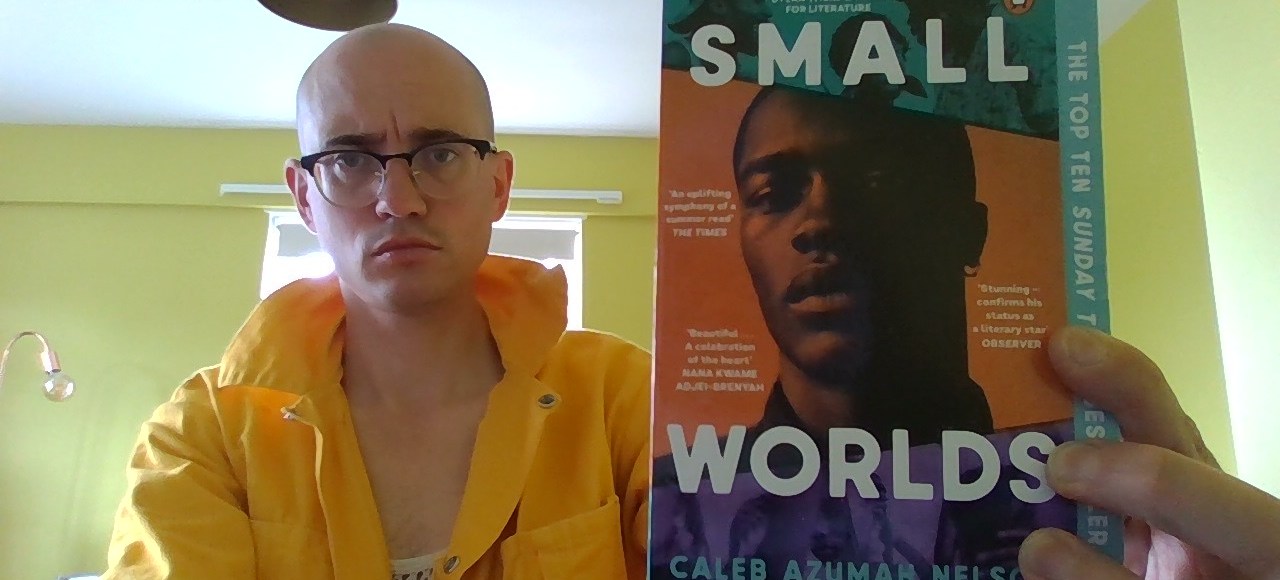
I read Open Water a couple of years ago and thoroughly enjoyed it. This novel, the second from Caleb Azumah Nelson, is much more ambitious, but all that ambition leads to less clarity and a novel that – though excellent and beautiful and moving with a powerful frequency – ultimately isn’t quite as satisfying a read…
Small Worlds takes place over a couple of Summers that are supposedly in the early 2010s, and although the political and sociocultural background events that are mentioned match with the realities of that time, the novel utterly fails to acknowledge or even mention the blunt reality of the reliance on online spaces and online interactions that had already proliferated by then. This is a decade and a half ago with the internet presence of three decades ago…
–///–
I got my first smartphone in September 2010, and though I only had it for a couple of weeks before it was violently mugged off me about twenty metres from the packed smoking area of an Essex Road pub, I was neither the earliest nor the final person I knew to get one.
Obviously, for people a few years younger than me and leaving school rather than university that Summer (as are the characters in Small Worlds), the compulsion to sign up for a multi year contract for a smartphone might well have seemed short sighted or impractical, so the lack of iPhones in every character’s hand isn’t inherently a fault. But the implication that social media on laptops, on family desktops, etc, wasn’t already rampant and unavoidable feels a little… err… revisionist.
What Small Worlds does, then, is create the exact kind of near-idealised version of early 2010s England/London that was long hollered back to during the chaos of the Brexit referendum and its (arguably ongoing) aftermath…
The idea that there was once a perfect England where people could live and love and be happy and enjoy themselves and others and it was epitomised by the London Olympics with its tributes to the NHS and the nation’s diversity…
Of course, in reality, the cracks that are increasingly exploited by the far right had already existed for decades, and though the realities of gentrification do appear in the novel (a Ghanaian expat community-oriented food shop in Peckham closes down due to predatory landlords increasing rents), there is also a certain economic freedom that pervades the text that, yes, does feel like how youth feels (there’s always money for rent and parties, if not for studying or saving or anything else that might last), but also feels jarring when it is contrasted with the serious economic precarity spoken about in the novel by the generation of immigrants who arrived into the country a few decades before the bulk of the novel is set…
–///–
NOTE: spoilers ahead.
The protagonist is a Peckham born and bred trumpet player and a lover, briefly a business student (profit equals revenue minus cost) and then a chef, whose long-term teenage crush and best friend becomes a girlfriend in a spectacular and magical post high school summer filled with music and romance and beach trips and friendship, before everyone separates and heads out of London to uni (or doesn’t) when September arrives. His parents both moved to London from Ghana as young adults, and have lived there ever since.
The protagonist doesn’t stick the course, falls out with his disappointed, inconsistently traditionalist father (who is inconsistently traditionalist in a way that feels like a rounded, complex, character, rather than like something under- or partially-written) and trains as a chef at a West African restaurant back in Peckham. The second half of the novel (set the following Summer) becomes, then, as much about food as the first half was about music, with an intense learning of the flavours and ingredients of diaspora dishes and recipes leading to a growing understanding of personal and wider community identity.
Before he can repair his relationship with his father, the guy begins planning a trip back to Ghana with his mother, who unexpectedly dies of a heart attack. His older brother – who is initially introduced as being a bit of a waster but at no point ever seems to be – takes responsibility for dealing with the grieving and domestically incompetent father, until he and his young family decide to take a holiday, at which point the main guy moves back into the family home (this is after he has taken the trip to Ghana he planned to take with his mother and come back to London with all of the records that his father had left in storage in a friend’s garage before he emigrated several decades ago) and, through the dad’s record collection, reconnects with the father, who then gets to narrate an extended flashback (by a very long way the longest chapter in the book, taking up somewhere towards a sixth of the text) about his youth in Ghana, meeting his wife, moving to London, his hopes and dreams for a new city, his disappoints and worst moments and joys and desires.
This section – which is, ultimately, a potent (if not necessarily the most unique) short story about the realities and complexities of the immediacy of the immigrant experience – feels the most coherent section within the book, and makes all the rest of it, perhaps, feel like mere contemporary filler around the 1980s and 1990s set novel that Nelson actually wanted to write…
–///–
Small Worlds, then, doesn’t feel like a novel set in 2010 and 2011, because even though there are references to songs and albums and political events that happened at that moment in time, it is very much a novel set in a pre-internet ubiquity that, quite frankly, is not a true reflection of (how I remember) that time.
The families and the characters in this novel are not people living in poverty, are not people without disposable income or interest in the wider world, yet the absence of the internet as a major life factor is, quite frankly, not something that feels believable for even non-affluent Londoners just a decade and a half ago.
I grew up in a similar (almost certainly poorer, certainly less cultured/educated!) socioeconomic bracket to most of the characters in this book, and I had home internet access from – if I’m remembering correctly – 1999. In 2010/2011, the internet wasn’t something reserved only for the idle rich, or nerds and perverts – it was something that people used every day!
We were downloading TV shows in 2004! We were streaming things in 2007! Spotify was 2008! Facebook was a hot new thing when I was going to university open days in 2005/2006, which is years and years before this novel is set.
The novel lights up when it reaches the extended flashback near its end, because it feels like that’s what the text has been straining for the whole way through.
I’m not saying every novel needs to be about the internet (certainly, believe me, a book can be solely about the internet and not really have much to say), but I think a novel about entering adulthood in the gap between the financial crash and the London Olympics, to pretend it wasn’t a part of life feels… fantastical.
And maybe it wasn’t for these particular characters…
Maybe the internet wasn’t as important to young people in London as it was to losers like me who “grew up” in parts of the world where there wasn’t much to do, but to not even be vocally reacting against the internet in their lack of online ubiquity feels off, somehow, to me..
That said, though, doesn’t mean to say that the novel isn’t full of spectacular and beautiful writing!
The music scenes can almost be heard, the food scenes can almost be tasted, the sex scenes can almost be touched, the travel (be it to places in Ghana or around London, Margate, Brighton) can almost be seen…
Nelson’s prose is flowing and poetic yet clear, and he uses repetition of phrases and images throughout in a way that is weaving and playful and pleasurable, though this – in combination with a bit of a tendency towards the purple when things get intense – does mean that I often thought this might be a work that would be best enjoyed listened to, rather than read…
Small Worlds is lyrical, it is incantatory, it’s beautiful, yes, but it’s never subtle and it’s never terse/concise…
I enjoyed it a lot, yes, but I did often feel that, regardless of it being undeniably beautiful and enjoyable on an episode by episode basis, it didn’t feel like there was much of a coherence to it as novel…
A collection of shorter pieces linked by characters and settings, yes, though (then again) isn’t that what many novels are, ultimately..?
What I’m trying to say it that it didn’t feel like a book that was consistently about the same thing, and felt less like it was layering theme and meaning rather than ticking them off, going through them2.
Food and music and cultural memory, yes, are all in the book throughout, but plenty of other topics feel like they get a chapter and then the book moves on. This makes Small Worlds feel almost a bit like The Sopranos – articulate but unsubtle with a “theme of the week” (here it’s a “theme of a chapter”). This, I suppose, is fine, but it does feel more like a way to structure a collection of discrete pieces, rather than a supposedly singular work that lasts under 260 pages…
Overall, yes, I liked Small Worlds a lot, but I didn’t read it quickly and that was because of the tendency I’ve just described – it feels like a thought and a narrative is concluded when each section or chapter ends, with the repetitions functioning like riffs or themes you might hear in jazz…
Of all the music mentioned in the text, it is jazz as a genre that feels most lived in, here, rather than the more contemporary music… The chronological setting just doesn’t hold up.
It is a novel out of time, I suppose…
And, again, that isn’t bad, but explicitly naming a time and then avoiding something as critical as early Web 2.0 feels unignorable.
It’s like setting the novel in Peckham but getting all the street names or the station names or the bar names wrong…
Maybe, if you’d never been there, you wouldn’t know any better.
But I was there, I was youthful then (I’m only three years older than these characters) and I was in some of the venues, at some of the parties, that the book mentions.
And we were all on our fucking phones all the time at all of them!!!
Also, the novel has a really weird relationship with the sizes of objects – people wander round with double basses as if they’re as manoeuvrable as a guitar, and massive collections of vinyls seem to fit in boxes that are both voluminous and the size of a backpack.
Time, too, feels odd, but I think this (especially in hindsight) is just a pretty fair reflection of how time feels when you’re 19… Though I don’t think the Summers did feel like they lasted forever by that age, but maybe I was just more miserable than most from a younger age…
–///–
Small Worlds is good, it’s often great, I liked it. But it’s not something that filled me with uncritical excitement from cover to cover, though what, really, does..?
- Note from the future: it didn’t go to plan. ↩︎
- I’m possibly aware of this because, foolishly, I applied for a work in progress spot for the Lambeth Fringe in October with a synopsis of a non-existent show that sounds like an absolutely phenomenal piece of performance/storytelling/weird comedy, and it’s been accepted for a slot. (I’ll announce it properly at a later point).
I’m now very panicked about how to hit all of the themes and topics I mentioned in the proposal I sent in without simply reading the proposal during the show and claiming that by mentioning the themes while reading it, the proposal has validated itself. Hopefully that isn’t what will end up happening, but this does kinda feel like what Small Worlds is doing, sometimes – ticking off themes from a list… ↩︎

Thank you so much for reading TriumphoftheNow.com! If you like what you’ve read, please subscribe, share and order one of my books. If you love what you’ve read, why not order me something frivolous and noisy from this Amazon wishlist or make a quick donation via my ko-fi page?
I’m currently focusing on parenting and creative practice, so small donations are appreciated now more than ever!
scott manley hadley aka SOLID BALD live
Here’s a video of me recently performing at the prestigious (it has a Wikipedia page) comedy night, Quantum Leopard. Listen to how much fun the crowd is having. You could have that much fun, too!
Forthcoming gigs include the following – there may/will be others:
17th March 2026, 7pm: Slap & Giggle @ Coin Laundry, Clerkenwell
24th March 2026, 7.30pm: Lolipops, Southwark
26th March 2026, 7.30pm: Comedy @ Cosmic, Plymouth
9th April 2026, 7pm: Sunset Comedy, Chalk Farm
15th April 2026, time tbd: BALD PERSONALITY DISORDER 40min-ish WIP at Shirker’s Rest, New Cross (more details soon!)
27th June 2026: Twinkles Cabaret, London
9th August – 14th August: BALD PERSONALITY DISORDER at The Street, Edinburgh, part of PBH’s Free Fringe
Discover more from Triumph Of The Now
Subscribe to get the latest posts sent to your email.

 Triumph Of The Now
0 comments on “Small Worlds by Caleb Azumah Nelson”