
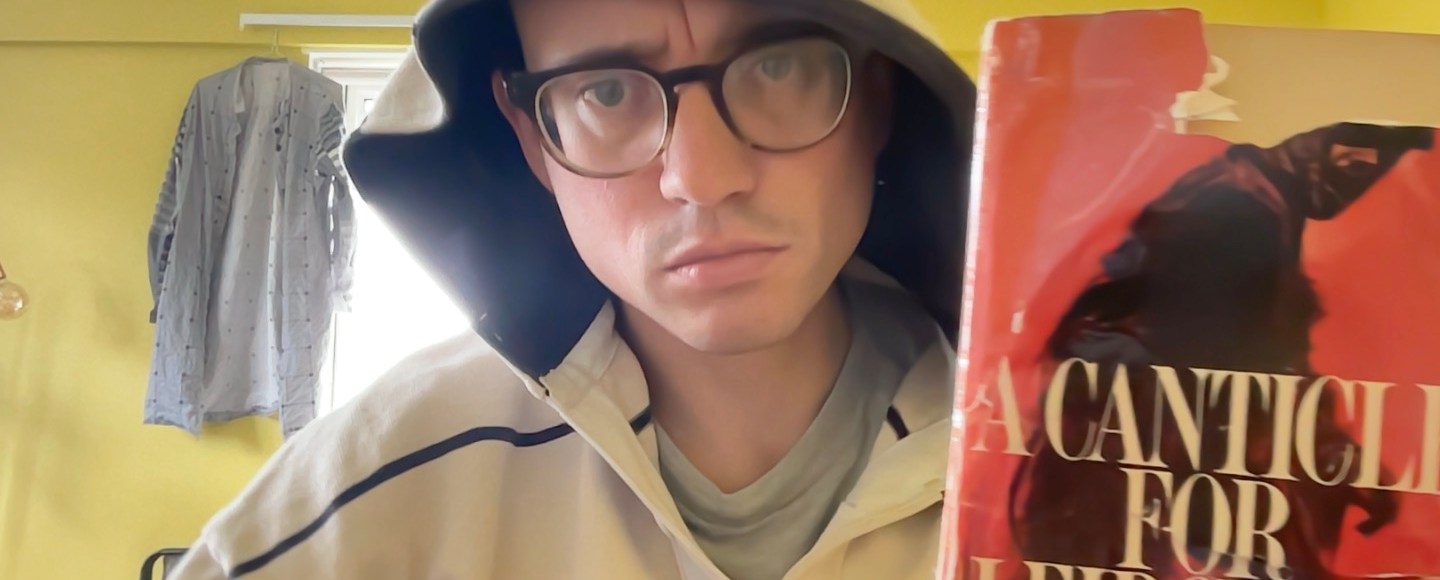

After I finished reading this novel – essentially The Name of The Rose meets The Road (“The Name of The Road”, if you will) – I did a brief bit of Googling, and was both unsurprised, yet still disappointed, to discover that this tripartite novel was cobbled together from three previously distinct shorter pieces.
The reason why I was unsurprised is because the novel contains three parts that are all set hundreds of years apart from each other with no shared characters1, and the reason why I was disappointed was because it’s interesting for a novel to have been intentionally structured and built from the ground up like this, whereas it’s not very interesting for novellas to be recycled and hammered into shape as if a new cohesive whole…
Even though, yes, the effect works, when aware of this truth, one suddenly feels that… rather than having enjoyed a novel with firm foundations and strong roots, one has instead been doing the literary equivalent of travelling at speed in a car made from three different vehicles welded together somewhere in the middle.
Sure, what you don’t know can’t hurt you2, but with literature as with love3, sometimes that idiom doesn’t hold true…
–///–
I don’t know what a Canticle is.
I kinda supposed that by the end of this novel, I’d know what a Canticle is.
That didn’t happen.
–///–
The novel is in three sections.
The first is set in a clear dystopia following global nuclear apocalypse, in a period where all written (and often physical) evidence from the previous society is treated with contempt.
A group of monks, following in the footsteps of their orders’ founder, Leibowitz, try to keep traditions and texts alive.
Slowly, the world around them is catching up to the idea that preservation of knowledge and rediscovery of technology might not be a bad thing…
Our main protagonist at the start is a young novice monk who, while doing a fast in the desert, stumbles upon a nuclear bunker containing what seems to be handwritten texts from Leibowitz himself, as well as the skull of what may well be Leibowitz’s wife, whose ambiguously recorded death date has been an impediment in getting Leibowitz canonised by what remains of the church…
Decades pass and internal Catholic machinations spread, until eventually it looks like everything is coming up Leibowitz, and the no-longer-young, no-longer-novice monk is summoned to New Rome (somewhere east of the abbey, which is somewhere West of the East bits of North America) to testify about the things he found many years ago.
During the years in between, he has spent almost all of his free time creating an illuminated and decorative copy of one of the diagrams he found in the bunker, and on his way to New Rome this is stolen from him, though the original – which he is also carrying – is left behind by the bandits as it seems worthless, despite being of far more value in the literate world.
The trip to New Rome is a success, the pre-[becoming a monk] death of Leibowitz’ wife is taken as a fact and he will thus become a Saint.
The no-longer-young, no-longer-novice monk sets off back towards the abbey, with a load of gold gifted to him by the Pope in the hope he can buy back his illuminated document. On arriving at the spot where the bandits robbed him before, though, he sits down and relaxes, but before his bandit appears, two cannibals shoot him dead and set to eating his no-longer-young, no-longer-novice corpse. Part One abruptly ends.
I was absolutely astounded. I was in no way prepared for this to happen.
I was invested in the character of this monk. I wanted to see him learn from and interpret and understand the documents (circuit diagrams, a shopping (or foraging?) list) and start making this post-apocalyptic future into a better one. But, no, this didn’t happen. He dies.
The reader is then sent hundreds of years into the future, and from the scattered humanity we had before, we now have a world more similar to a late medieval period, with large empires coalescing and smaller, freer, tribes and groups being swallowed in a pre- (well, post ours but pre-theirs) industrial Great Game.
The monastery is being visited by the cousin and chief scientist/philosopher of one of these rising powers, and one of the monks seems to have re-invented electricity generation. Machinations play and swing as war and empires collide, and then, a hundred pages in, things kick off and many people die, but the monastery remains and all looks to be good.
And then we are hundreds of years in the future again, but this time we’re back to basically the same as the world was in the 1960s. Trucks, cars, planes, power, international trade and – crucially – the threat of nuclear war…
This section feels both far less and far more timely than the post-apocalytic sections, and is probably the part that most feels retrofitted into the Leibowitz storyline.
Here we have lots about euthanasia and the ethics of this, especially in the face of radiation poisoning, nuclear fallout and the (increasingly likely) threat of total nuclear destruction, this time for a second time…
This section also has star-travelling colonisation ships and the attempt to off-world the Catholic Church in the face of incoming death.
It’s not light at all, and certainly a shocking way to end the book, returning back to the moment of apocalypse (a second apocalypse), though I do think the way that Miller envisions a second industrial age of humanity as almost identical to our society is a deeply pessimistic act… Their technologies and systems and governance and ideologies are the same, and, alas, maybe this is what will eventually rise from the ashes once our terrible society has ground and burned and cremated itself, but I really hope not… It’s very much a writerly act of “capitalist realism“, innit, the idea that the society we have now is inevitable…
–///–
So, yes, it’s kinda three novellas rather than one novel, and though there are themes that recur throughout, I don’t know if the separate stories in their earlier, not connected, versions, may not have been more successful… Or maybe not?
–///–
It’s a deeply readable text, though I do think that the most enjoyable section by a long way is that first one, which very much is The Road meets The Name of the Rose, with the second section (similar but just a liiiiittttle more developed) also engaging and enjoyable, though it didn’t necessarily feel quite as fresh as the first section… Somewhat more of a fantasy vibe, I suppose, like the second book in Canopus in Argus: Archives… So that is a trope in speculative fiction, sure. Yes. It absolutely is.
Did I enjoy A Canticle for Leibowitz? Yes.
Did I find A Canticle for Leibowitz serious, evocative, terrifying, imaginative, engaging? Yes, very much so.
Would I read more Miller? I mean, maybe yes, but I don’t think he published much else, and certainly nothing else with this level of attention.
But, yes yes yes, good.
Useful.
Meaningful.
Nuclear.
- Other than whispers and rumours alluding to the peripheral presence of a man who cannot die, doomed to walk the Earth eternal… ↩︎
- I haven’t heard anyone say that phrase in a long time, but it has a very specific remembrance for me. In my very first term of University, I had my romantic illusions of futurity shattered when a young woman who I’d made out with a few times told me – when we were essentially on our first proper date with the frisson of privacy incoming, that she had a boyfriend already but “what he doesn’t know won’t hurt him” and seemed keen to hook up with me anyway. Ever repressed, ever the idealist, I drifted away from that connection immediately, and then she found someone who lived in the flat across the hall (in my University accommodation) who was more than happy to be her local lover while she kept the long distance boyfriend going. I’m reminded of this, of past romantic adventures, as a couple of days ago on a South London train (while travelling with my charming lover, beautiful baby and my [adjective pending final draft] father-in-law) I ran into a woman I went on a handful of dates with in high school, who was very very pregnant. ↩︎
- See the previous footnote. ↩︎

Thank you so much for reading TriumphoftheNow.com! If you like what you’ve read, please subscribe, share and order one of my books. If you love what you’ve read, why not order me something frivolous and noisy from this Amazon wishlist or make a quick donation via my ko-fi page?
I’m currently focusing on parenting and creative practice, so small donations are appreciated now more than ever!
scott manley hadley aka SOLID BALD live
Here’s a video of me recently performing at the prestigious (it has a Wikipedia page) comedy night, Quantum Leopard. Listen to how much fun the crowd is having. You could have that much fun, too!
Forthcoming gigs include the following – there may/will be others:
17th March 2026, 7pm: Slap & Giggle @ Coin Laundry, Clerkenwell
24th March 2026, 7.30pm: Lolipops, Southwark
26th March 2026, 7.30pm: Comedy @ Cosmic, Plymouth
9th April 2026, 7pm: Sunset Comedy, Chalk Farm
15th April 2026, time tbd: BALD PERSONALITY DISORDER 40min-ish WIP at Shirker’s Rest, New Cross (more details soon!)
27th June 2026: Twinkles Cabaret, London
9th August – 14th August: BALD PERSONALITY DISORDER at The Street, Edinburgh, part of PBH’s Free Fringe
Discover more from Triumph Of The Now
Subscribe to get the latest posts sent to your email.

 Triumph Of The Now
0 comments on “A Canticle for Leibowitz by Walter M. Miller Jr.”