
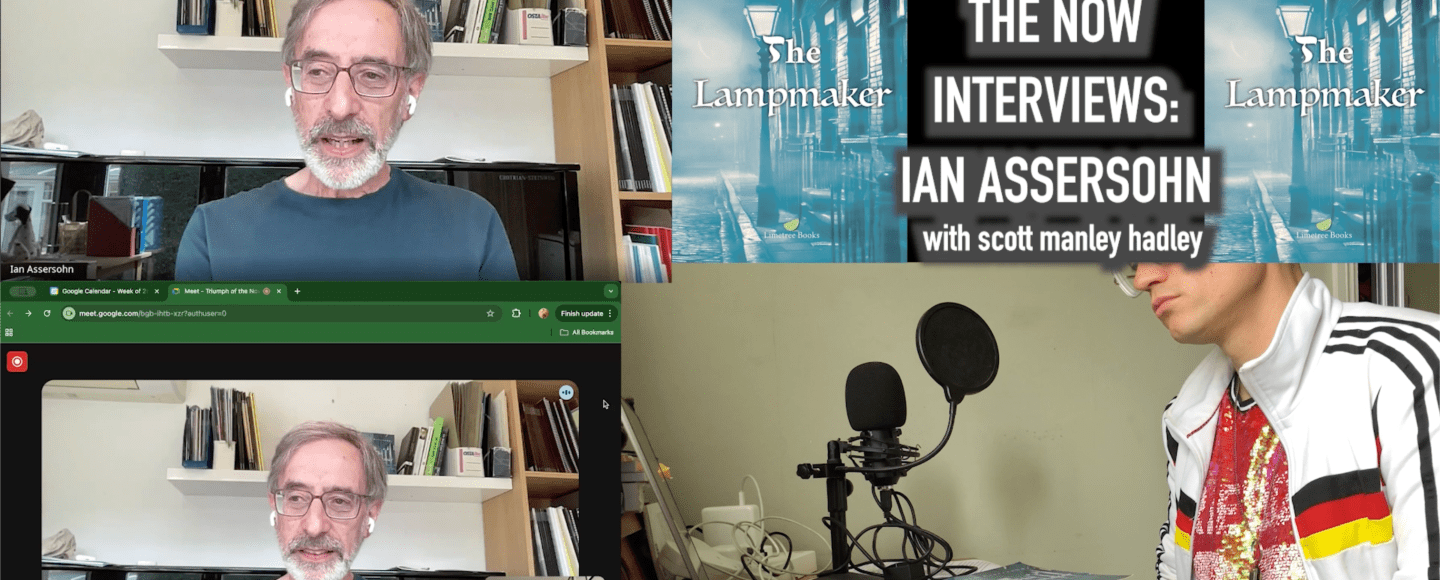

I recently recorded an interview with Ian Assersohn about his new novel, The Lampmaker. Below are my interview notes! We didn’t get to everything I flagged as a topic, and ended up discussing a few other ideas, too!
- Please introduce yourself and the novel!
- I enjoyed the acknowledgements at the end of the book that included some of the books and websites you used for historical research, as well as mentioning that – particularly when it came to the biography of your ancestor – you used a lot of imagination.
- Did you start the project expecting to find more details than you eventually did?
- How did you use the knowledge and information you gained?
- Did you learn things that surprised you?
- Did you see the research/study as part of understanding the background of the book, or did the research take place before you decided on the narrative you wanted to tell?
- I liked the use of real historic events alongside the action of the central protagonists – how did you decide which events would make an appearance and which wouldn’t?
- The novel is split into three sections, the initial part – covering the childhood of Rafael and Yossel, his brother – is in Tukums, a small town, then the second section is in Riga, followed by a third section in London (Whitechapel specifically) where the boys settle. Have you travelled to any of the locations in the novel and did you make any special trips as part of your research?
- I enjoyed the hopeful overall tone of the book, the way in which the boys are able to find stability in work, spiritual and family life in London by the end of the story. How important do you think it is for people to read and hear stories that end well?
- The main reason why the protagonists move from place to place is due to restrictive and explicitly anti-Semitic laws being passed in what was then Russia. The London of your novel – though not without some elements of this – is seen as, overall, a more tolerant and open society. In your knowledge, how reflective of reality at this time was this? And do you have any ideas as to why this may have been the case?
- There is tragedy within the book – there are deaths due to epidemics, suicides due to wartime trauma, people injured and maimed for life due to accidents, and also the very real violence of pogroms. Do you think life was harder for everyone in the 19th century? How have things changed and what effect do you think these changes have had?
- The structure of the novel is neat and simple and direct, with a brief Prologue set later in life and reflecting on the personal history the novel is about to explore. Did you consider including more of these scenes, i.e. Rafael looking back on his life and maybe narrating it himself, or did you decide early on the book would have more of an omniscient, third person narrator?
- What was your process for writing the novel? Did you start at the beginning and go from there, or did you write scenes as the ideas came to you?
- How long did you spend working on the book? (Why did you decide to write/finish this novel now?)
- How different do you find writing/literature as a discipline to music? Is there an overlap in your approach and expectations, or do you see them as distinct forms?
- Outside of research and editing of The Lampmaker, what else do you like to read?
- Do you still have any items at home that your grandfather produced?
- Art is a key interest of Rafael’s in the novel, and it is through this interest that he meets the woman he will eventually marry. How important do you think access to the arts (including visual arts) is?
- Rafael is the subject of a portrait that becomes a famous work of art, in part due to the young, tragic, death of the artist. Was this portrait of your grandfather real or a fictional device? If not real, are there any particular paintings or painters you were thinking of when you created it?
- Who is your favourite character in the novel and why?
- Rafael’s first romance in the novel is with Rosa, the artist who paints his portrait. Their relationship never really develops, largely because she is dishonest with him about the fact that she has converted to Christianity. Do you think – this secret aside – their relationship would have been a successful one?
- Do you have plans to write any more novels? What would they explore if so?
- As a composer, have you ever written music for narrative purposes? Could the plot of this novel work for an opera or a suite of narrative songs?
- If you were to tell this story of your grandfather in another form, what would you change and why?
- You mention in the acknowledgements that some of your family members might disagree with some of the details you’ve imagined of your grandfather’s life – have they read the novel yet and, if so, have you had any conversations about it? What did they think and were there any details they responded particularly strongly to?
See the interview here:

Thank you so much for reading TriumphoftheNow.com! If you like what you’ve read, please subscribe, share and order one of my books. If you love what you’ve read, why not order me something frivolous and noisy from this Amazon wishlist or make a quick donation via my ko-fi page?
I’m currently focusing on parenting and creative practice, so small donations are appreciated now more than ever!
scott manley hadley aka SOLID BALD live
Here’s a video of me recently performing at the prestigious (it has a Wikipedia page) comedy night, Quantum Leopard. Listen to how much fun the crowd is having. You could have that much fun, too!
Forthcoming gigs include the following – there may/will be others:
17th March 2026, 7pm: Slap & Giggle @ Coin Laundry, Clerkenwell
24th March 2026, 7.30pm: Lolipops, Southwark
26th March 2026, 7.30pm: Comedy @ Cosmic, Plymouth
9th April 2026, 7pm: Sunset Comedy, Chalk Farm
15th April 2026, time tbd: BALD PERSONALITY DISORDER 40min-ish WIP at Shirker’s Rest, New Cross (more details soon!)
27th June 2026: Twinkles Cabaret, London
9th August – 14th August: BALD PERSONALITY DISORDER at The Street, Edinburgh, part of PBH’s Free Fringe
Discover more from Triumph Of The Now
Subscribe to get the latest posts sent to your email.

 Triumph Of The Now
0 comments on “IAN ASSERSOHN: NOTES ON THE LAMPMAKER INTERVIEW”