
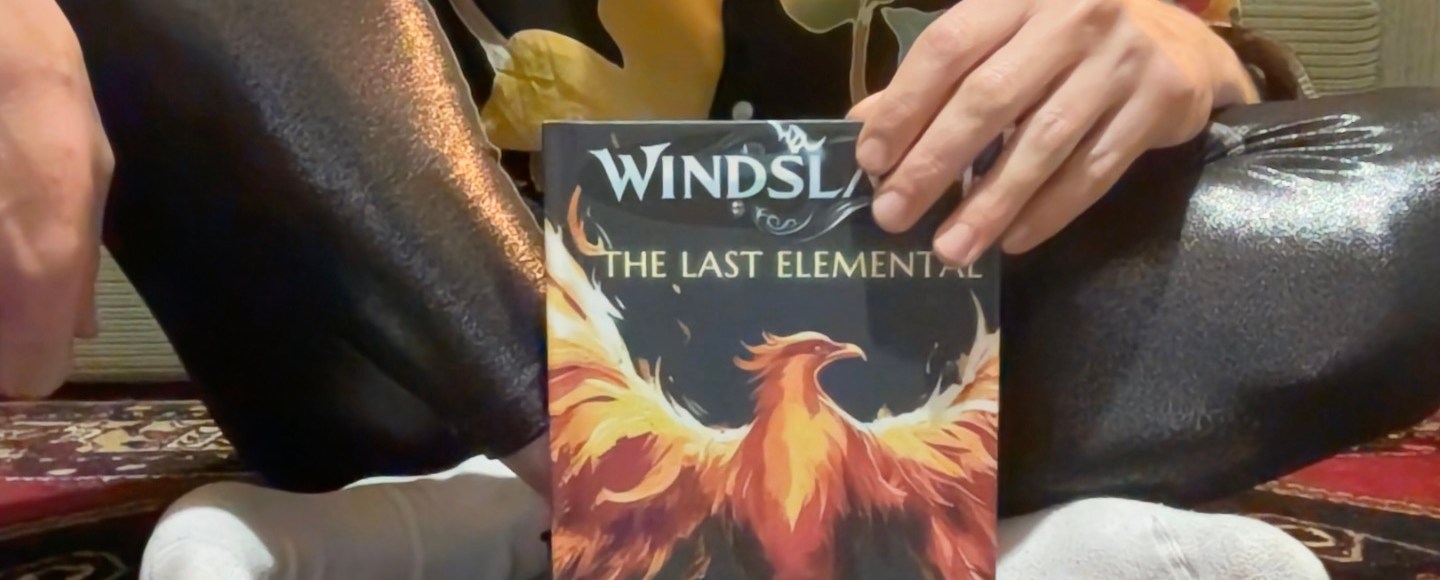

Unfortunately, it would be quite easy to dismiss Windslash: The Last Elemental, a recent indie fantasy novel written by Chris Bennett, as it is not a text lacking in what I perceived to be flaws.
But… I don’t believe that would serve much of a purpose, as this isn’t a novel aimed at my readerly demographic1, so the key things I thought of as problems are probably not things the intended readership would mind…
And that’s fine! Not everything is for everyone. And this one, probably, wasn’t for me.
–///–
Crucially, on this blog2, what matters to me when commenting on a book is its intention and the ways in which this is – or isn’t – achieved.
For me, failure or success doesn’t arise from a book’s inherent qualities, but rather from the space (or, ideally, lack of it) between what the book is seeking to do and what the book is doing.
i.e. – for me – it is much easier to forgive a work like Windslash: The Last Elemental its repetitions, its narrative gaps and its misfiring characterisations, than it would be to forgive those same failings in a book claiming to be (for example) “The Great American Novel”. Chris Bennett’s novel is something that can absolutely be enjoyed for what it is.
This is, alas, probably the worst and most English opinion that I hold: that it is better to not try and not succeed than it is to try and to fail.
In England, we do not aim at the stars hoping to hit the moon – we aim at the gutter hoping to hit the gutter, and mock and critique and scream at those who try to aim at anything else (unless they unequivocally achieve it on the first go).
Yes, it is a perniciousness that permits the continuance of a rigid and ever-more untenable yet bureaucratically-maintained class system: the only people permitted to try are those who are guaranteed success…
To try and to lose is seen as so shameful, so unforgivable… and this benefits no one save those who already have the things and the status they want: if bumpkin plebs like scott manley hadley see the pursuit of professionalised art and happiness as not for them, the threat we pose is neutralised…
If we give up our youthful enthusiasms for change, then we lose, and so does the world…
So it’s bad, really, it’s a bad urge, to judge something with aspirations and intentions and claims of greatness more harshly than to judge something without them and, of course, it’s an urge and an instinct I see and am aware of, yet it’s so fucking baked in that pretending it isn’t there, that denying having been culturally conditioned to have this attitude, is unproductive for us all. (I suppose.)
That said, for me Windslash: The Last Elemental was an often-frustrating read, one that without doubt has some pleasures and fun within it, sure, yet in its totality it reads as something that contains so much repetition that much of the book felt superfluous.
Then again, the repetition may very well be an intentional choice and something standard in this type of novel!
–///–
The story is that of a young (though age is never mentioned and over 20 years are covered during the course of the novel) man named Timaeus, who lives on the Ancient mythical and magical island of Atlantis.
Sinister forces are trying to unleash an ancient evil, but they’re waiting to kick off until Timaeus has completed his magical training, because he’s so good at wielding magic and power that the blood of the mythical beasts he periodically kills can be collected by the villains and used to supercharge their planned invasion.
Timaeus is taught how to use magic related to all four of the trad elements (air, water, fire and earth) and he is unique in his world in being able to do this – all of the other soldier/magicians (“Elementals”) are limited to the use of just one element in their magic, though no explanation is ever given as to why he is able to do this and/or why no one else ever tries to do so…
Most of the novel covers Timaeus’ training. He learns element by element, with each portion taking three years, followed by a fight with a mythical beast to collect a magical stone to increase his power, then a fight with another trainee of the element. This happens four times, and – aside from the names of the challengers and the mythical beasts – unfolds in an almost identical way, with images and phrases and possibly whole sentences regularly recurring…
–///–
The brief introduction to the novel discusses the author being initially inspired by a trading card game he used to play with friends, and then the first chapter reads like a set of rules for a game.
This first chapter is pure exposition, feeling more like notes for the novel we’re about to read than plot itself.
–///–
The title refers to Timaeus by his nickname “Windslash”, which is a name given to him by the leader of the evil magicians (“Dark Elementals”) during one of their encounters, and – to me – it seems strange to accept a nickname from someone who hates you and wants you and your entire way of life to be destroyed. Hey ho!
The other half of the title, though, “The Last Elemental” is an even stranger choice, as until about eight pages before the end of the novel, Timaeus lives in a world, on his Atlantis, where every other person he interacts with is an “Elemental”, and it’s only when the evil forces attack and massacre literally everyone on the island (all but one of their own dying in the crossfire) that Timaeus becomes the last of anything…
The final chapter is a brief mythological history of Ancient Greece turning into a true[r] history of that part of the world through to the present day, with a final paragraph or two that sees Timaeus and the evil man who gave him his nickname being found (magically preserved in a magical crystal) on a beach by a dog walker, setting up a sequel where Timaeus lives and fights in the present day.
I imagine the intention is that the follow-up will feature a lot of Austin Powers3 type “fish out of water” humour, but this might be difficult to achieve, as Timaeus is quite a flat character. He is someone whose life is centred around studying, training and fighting, and most (but not all) of the fights the reader sees him take part in are in controlled training bouts, rather than fights for his life.
In Windslash: The Last Elemental, the reader never sees what Timaeus does in the evenings, we never know what he does for fun, what he likes to eat, how he likes to relax, what he does with his friends, how he parties, who he dates, who he falls in love with and how he lives. He is, in many ways, an automaton, focused only on developing himself as a fighting magician, intending to be a super-Elemental long before he becomes a final one…
This, then, is a novel covering the period of a person’s life that most commonly gets explored in the bildungsroman, yet there is no “coming of age” happening here (and absolutely no coming4).
The most important parts of studying full time are often not the time spent learning, rather the time around it…5
But where are the descriptions of the nightlife in the dorms of the Atlantis fighting schools?
Where are the romances and the heartbreaks and the petty rivalries and broken friendships and aging out of each other?
Where is the sadness and the ennui and the complexity of youth?
Where is the questioning about the ethics of developing magical powers akin to modern automatic firearms?
Why is so much effort in this society being put into training magician-soldiers when peace has endured for centuries?
Or is there a whole world outside of the magic fighting schools that just hasn’t been mentioned?
I don’t know, but I do know that with the novel’s ending – snapping the setting of the tale forward 10,000 years – these are questions that the author will not be answering.
These are, of course, intentional authorial choices, and a bildungsroman set in an ancient magical training school isn’t the novel Bennett set out to write!
Windslash: The Last Elemental is a novel that is, all told, a series of magical battles fought between an increasingly powerful soldier against others who don’t ever really seem to gain the upper hand… I might be wrong, but I don’t think Timaeus loses a single battle he fights in the entire book, and even when he nearly does, someone always steps in to help him, leaving him undefeated and never having to question or explore the limits (or potential limits) of his own powers6…
I suppose, though, a novel where the threat level is low and the emotional journeys are small and the depictions of social and romantic lives are absent is what some people want!
And though, what I (scott manley hadley aka SOLID BALD) like to read the most is texts that look at the horrors and the depths of misery of average human lives, many people don’t!
Something that is repetitive, unthreatening, uncomplex and – to be fair, fun enough and engaging enough – is about right!
–///–
I did read Windslash: The Last Elemental cover to cover, and though the repetition of phrasing was frustrating and the first chapter should not have made it to the final version of the text, I did find it engaging and exciting…
I did want to know what the villains had planned and I did want to see what Timaeus and his peers and colleagues would do to counter them…
But I kept wishing for the magical battles to stop and for Bennett to take us deeper into his Atlantis…
Years are summarised in sentences in all the wrong places (for me), and scenes that feel like reprints of earlier ones proliferate…
Yet… maybe some people do like that… maybe this is how some readers like their books!
So, I must accept, I’m not the intended reader…
I didn’t have a terrible time, sure, but it felt like a deeper novel was loitering on the edges…
If you like magical battles, then this might be for you!
If you like magical bildungsroman, then look elsewhere…
- Too many degrees but from mid-level universities. And mentally ill. ↩︎
- Particularly as time goes on and TriumphOfTheNow.com becomes less a document of recurring psychological collapses and more a document detailing the life of a functional, if maybe not thriving (but certainly doing fine) new(ish) parent and “increasingly less amateur amateur comedian“. ↩︎
- For younger readers, Austin Powers was a 1990s American-produced but Canadian-performed “comedy character” poking fun at the English. It was considered so offensive that many English people rioted outside the American Embassy here in London. The Canadians, like they always do, shrugged off their complicity. ↩︎
- I saw the first episode of Pluribus today and – maybe against the intention of the show – I think I need to open up my bookshelves to some romantasy… ↩︎
- I mean, I say that, but most people I know from my university days are unfulfilled and unsuccessful OR totally LinkedIn-pilled, so maybe my anecdotal opinion there is without basis… (Add me on LinkedIn if you want!) ↩︎
- Not Austin Powers. ↩︎

Thank you so much for reading TriumphoftheNow.com! If you like what you’ve read, please subscribe, share and order one of my books. If you love what you’ve read, why not order me something frivolous and noisy from this Amazon wishlist or make a quick donation via my ko-fi page?
I’m currently focusing on parenting and creative practice, so small donations are appreciated now more than ever!
scott manley hadley aka SOLID BALD live
Here’s a video of me recently performing at the prestigious (it has a Wikipedia page) comedy night, Quantum Leopard. Listen to how much fun the crowd is having. You could have that much fun, too!
Forthcoming gigs include the following – there may/will be others:
9th April 2026, 7pm: Sunset Comedy, Chalk Farm
27th June 2026: Twinkles Cabaret, London
Discover more from Triumph Of The Now
Subscribe to get the latest posts sent to your email.

 Triumph Of The Now
0 comments on “Windslash: The Last Elemental by Chris Bennett”