
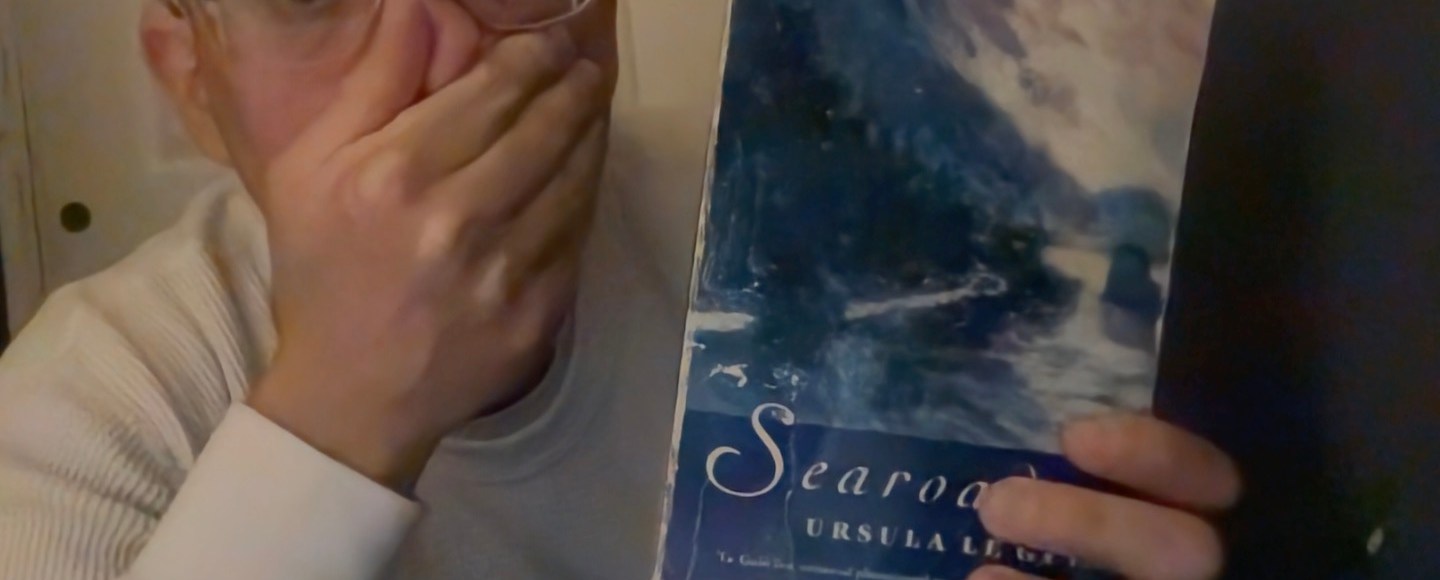

Disappointed and disgruntled following the overwhelming disappointment of Philip Pullman’s The Rose Field, I decided to read something next that I was certain wouldn’t let me down.
And, oh my god, did I make a wise choice.
Searoad: Chronicles of Klatsand is a 1991 Ursula [K] Le Guin book that contains two maps, ten previously-published short stories, a novella and a single piece of prose poetry. The narratives of all these realist pieces are linked through location (and occasionally characters walk through the background of someone else’s tale), which is a small (and fictional) coastal resort town in Oregon (Western USA).1
If that sounds to you like a messy, uninteresting, collage doomed to failure, I’m very happy to let you know that this isn’t how it unfolds.
Searoad: Chronicles of Klatsand is a glorious, deeply moving, serious, sad, melancholic, human (humane?) masterpiece.
Searoad is probably one of the best things I’ve ever read.
This is the kind of book, yes, that an entire career could rest on.
That this is a minor, barely known Le Guin book can only be explained by one of two things: either her oeuvre in its totality is so potent that yet another great book can get lost by the wayside as she stacks up significant contributions to literature elsewhere… Or – and I think this is most likely to be the reason – this isn’t a genre text, and – for that – it’s an outlier in her work and thus forgotten.
There are no monsters or space ships or aliens or rockets in here.
There’s no intergalactic travel or wizards and shapeshifters, no magical powers and no apocalypse…
This isn’t a book about a world ending or a world beginning, it is instead a series of short, devastating, deeply evocative and deeply moving tales about small lives…
Lives cut short by disease or cruelty, lives containing abuse and disappointment and regret, but lives, too, containing joy and romance and family and lust and love and community…
These are real lives, real stories, about real people (none of whom ever existed, because it’s fictional).
This is a parade of ceaseless (fictional) reality… it is dirty realism, literary realism, it is neat and clear and direct literary fiction.
Lives that have been broken and lives that have been saved.
Moments from lives, glimpses into lives, and almost all of these glimpses contain such depth of characterisation and narrative that it’s possible to extrapolate out entire fucking lives…
I wept, over and over and over again.
In a few pages, Le Guin made me care more deeply about fictional individuals than I’ve ever cared about most people I’ve ever met in real life.2
The novella (which ends the book) is a serious, dark, sad piece about the ways in which several generations of women are all – or all seem to be – fucked over by a hostile world, yet in a very brief chronology of the overall lives of these women that is the final chapter to the novella, we see that the pain and the misery included in the novel was a tiny fraction of their personhoods, with successes, achievements and meaning found in the (again, fictional) moments of their lives not dramatised on the previous pages by Le Guin…
It’s this shifting of hurt and comfort throughout that makes these narratives shine. We read about people running away to the small coastal town from terrible lives before, as well as people seeking the comfort of the constant tide as a balm.
Klatsand (that’s the name of the town) is escape to and escape from, it is a place where one can build a life or hide from one. Things are slower, but they don’t impact any less.
We see families and individuals across years, decades, a century (in that final novella) and we see the ways in which a moment can impact the totality of a life.
Le Guin has crafted this book using blunt, direct, uncomplex language, in the tradition of Raymond Carver, of Ernest Hemingway… There’s nothing hard to read here, on the page, but such a depth of emotional complexity and psychological insight that it’s very difficult to sit through without having to pause to collect oneself.
Searoad does what (I believe) any great piece of literature should do: it makes a person reflect and emote and empathise and engage with the lives and the realities of others. No, these are not “true” stories about “real” people, but they are meaningfully realist pieces, evoking people and situations and realities that aren’t fantasies, that aren’t trite, that aren’t dull and that aren’t valueless.
I loved it, I adored it, and I can see myself reading it again, which is something I almost never feel.
Yes!
- Think Winesburg, Ohio for the late eighties/early 1990s… ↩︎
- Though maybe that says more about me than Searoad… ↩︎

Thank you so much for reading TriumphoftheNow.com! If you like what you’ve read, please subscribe, share and order one of my books. If you love what you’ve read, why not order me something frivolous and noisy from this Amazon wishlist or make a quick donation via my ko-fi page?
I’m currently focusing on parenting and creative practice, so small donations are appreciated now more than ever!
scott manley hadley aka SOLID BALD live
Here’s a video of me recently performing at the prestigious (it has a Wikipedia page) comedy night, Quantum Leopard. Listen to how much fun the crowd is having. You could have that much fun, too!
Forthcoming gigs include the following – there may/will be others:
21st January 2026, 1pm: Dr Mew’s Sci-Fi Cabaret, Etcetera Theatre, Camden
18th February 2026, 7.30pm: Laughable, Wanstead Library
26th February 2026: Mirth Control, Bexhill-on-Sea
12th March 2026: BALD PERSONALITY DISORDER 30 MIN WIP at Glasgow International Comedy Festival
26th March 2026, 7.30pm: Comedy @ Cosmic, Plymouth
Various Dates, May 2026: BALD PERSONALITY DISORDER FULL LENGTH WIP at the BRIGHTON FRINGE
Discover more from Triumph Of The Now
Subscribe to get the latest posts sent to your email.

 Triumph Of The Now
0 comments on “Searoad: Chronicles of Klatsand by Ursula Le Guin”