
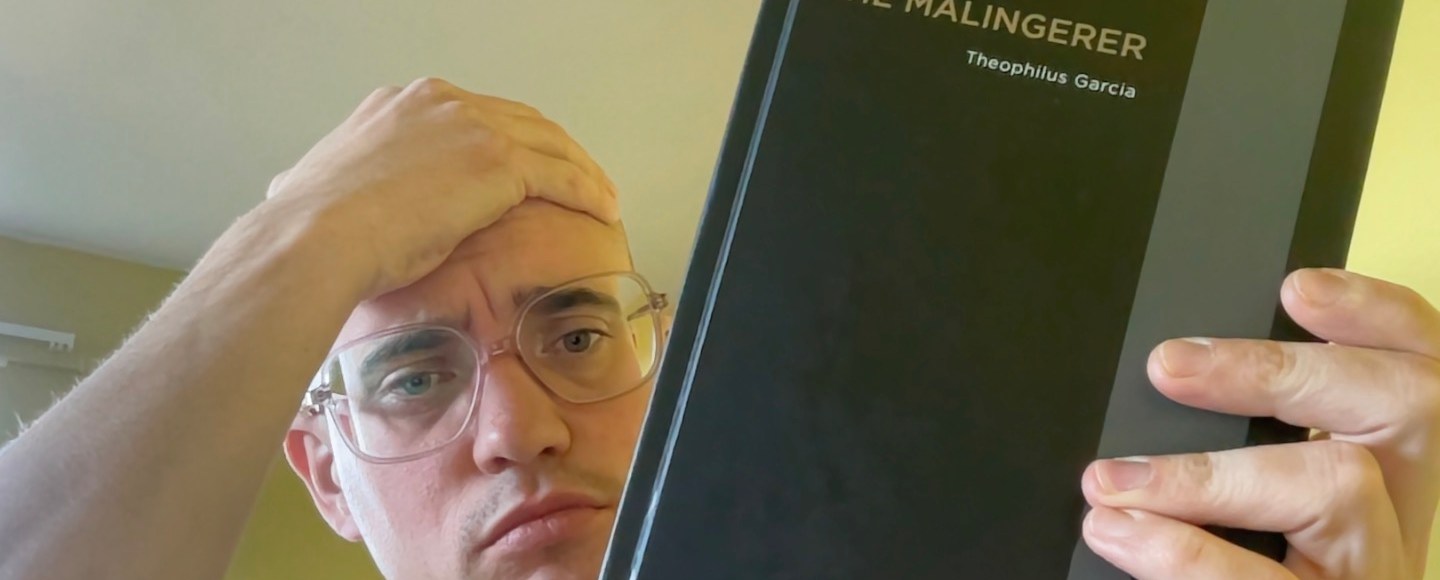

I receive and read a fair few self-published books – for example, the previous post was about one, too – as, no matter how frequently I find frustrations with books released to the world in this manner,I do not fundamentally believe the only place for good literature is big publishing houses.
I think that indie fiction – from the “established” indie presses that are very much mainstream through to those that rose and fell during the indie booms of the 2000s-2010s, plus the micro-presses that have been continuing for decades, and through to individual writers, artists, poets, creators, choosing to offer their work in page and text/image form to the public on a direct author-to-reader pipeline – is something super important.
Only a child (or someone with the critical engagement of one) would try to argue that big budget Hollywood blockbusters are inherently and always better than rough-around-the-edges cinema, yet one often does encounter the same argument being made for literature.
If Penguin Random House don’t want it, people argue, it’s because it’s probably shit. Which just simply isn’t true, is it?
I’ve read some super interesting self-published books – from the earnest and overblown, yet overflowing with enthusiasm and potential, work of younger writers, to the split-narrative novels that are half-shit but half-brilliant, to the odd diatribes and score-settling of the older folks writing with a “needless to say, I had the last laugh” tone that simply doesn’t hold up to much scrutiny when TriumphOfTheNow.com is the sole digital footprint of a work… Or maybe it does!
Maybe me (scott manley hadley) reading a book – someone who isn’t friend, isn’t family, isn’t co-erced junior co-worker… maybe me, far away and strange and online is enough of an audience for that…
To feel seen, to be read, to be witnessed, just for a moment…
I like the idea of self-published literature. And, yes, there are some great examples of great works published in that manner.
But what – and I am yet to think of a single counter example – tends to link all of these books is usually one thing, which Theophilus Garcia’s 2024 novella The Malingerer does not do. They’re all (I’m generalising) too long.
The only thing self-published books tend to have in common is that they could all do with at least one general, cutting edit.
But not The Malingerer.
This is a text that takes under an hour to read (likely quicker if your life is even freer of distractions than mine is), and in that time offers a potted, fictionalised(?), history of the CIA’s engagement in American foreign affairs from the perspective of a single, irregular, agent, and then ends, questions unanswered, meanings and expected readings unclear.
The story opens and closes with two middle-aged brothers – one a priest, one a “family man” – who were both no longer in regular contact with their father, finding out that he has died.
The priest has spoken to their dad slightly more often, proselytising and evangelising to the dying older man, while the other brother formally broke with the guy, calling him – specifically – a killer, amongst other strong terms.
When the old guy dies, he leaves behind a manuscript, which the men sit down to read together1. This is their old man’s life story, and the bulk of the novel.
We do return to the men for a moment at the end, with the non-priest seeming to have been converted into religiosity during the course of their reading. It’s difficult to know if Garcia is trying to be pro-Catholic here and that the story is meant to imply the lads are right to see judgement in a god’s hands etc, or if the reader is meant to read this as a naive decision to pass the buck of moral judgement (meaningful consequence and mature ethical engagement with the world) onto the keepers of the next life…
Which is fine! Ambiguity is fine!
So, yes, The Malingerer is for sure an interesting read.
Written as if a confessional, the central 90% of the novel appears in the literary historical vein of Saint Augustine, of Rousseau, of scott manley hadley’s the pleasure of regret…
As humans, particularly those of us raised in the corrupt Christian nations of the “West”, we yearn to confess. And confession often functions as a brag, as a statement of witnessing, as an acknowledgement of self.
“Because I did this, because I was there, I was real… I existed, for a moment.”
The way the central figure becomes a CIA pawn is the least satisfying plot device in the novel (his father – a spy – takes him on a trip prior to the outbreak of World War Two to go and negotiate with Nazis to find ways for America and Germany to both get along, though when his father dies (possibly assassinated as he dies after shagging a hot German Nazi’s hot German and half-Jewish wife) he takes on his job), but once the guy is “in”, he’s then in, and everything else goes smoothly.
Garcia continues on from the big war, through to the Cuban Revolution, the Bay of Pigs, the assassination of Kennedy, the assassination of the other Kennedy brother, the assassination of Martin Luther King, the Korean War, the Vietnam War, the repression of student protestors, the Iranian Revolution, etc, with the man getting slightly less directly involved as time goes on and his main contact – CIA director (for a bit) Allen Dulles (who I thought was an airport rather than a man, though apparently that is named after Allen’s brother, also a politician) – moves in and out of political favour. Oh, and the guy shacks up with a super hot sexy former honeytrap spy who gives up her career entirely to parent the two brothers we see at either end of the novel, neither of whom seem more fun to hang out with than being a sexy spy.
And then he’s kinda old and that’s kinda the end of the novel.
And – yes, I can’t believe I’m saying this – I would have liked a bit more.
There’s a nice amount of detail about the guy’s first missions in Nazi Germany, but as the novella goes on, there is less focus, less time spent, on each mission, and though this does reflect the way the passage of time feels as one ages (relentless, spinning, too fast, yet somehow not fast enough), I would have liked for Garcia to take things a bit more slowly. Paint more with his words.
In part then, yes, it’s a dramatisation of some conspiracy theories (especially related to 1960s political assassinations), but also of some shady but established-fact manoeuvrings of the 20th century American government.
The Malingerer is about corruption and pandering to the corrupt, about risk to life being permitted and encouraged and meaningless when weighed against the business and domestic power interests of the American elite.
It’s a book that really does hit some interesting themes. It’s engaging and could well be provocative to someone with unrealistic imaginings of American political history, yet by combining fact, conjecture and possibility, Garcia absolutely succeeds in creating a text that is readable, playful and fun without feeling like a diatribe.
Is there serious weight to be given to some of the discussion of societal duty vs personal duty, of personal morality vs political responsibility, of the sanctity of “life” vs the sanctity of “society”, of whether means justify or corrupt ends and whether ends justify or corrupt means2? Kinda. Yeah. There’s enough.
I enjoyed it.
I read it quickly and, yes, I think the framing narrative tries to imply a preferred moral reading of the text that is unclear (is the presumed reader a Catholic expected to see the priest’s comments as more valuable than the less-forgiving former hippie now centrist dad-type brother? are both meant to be viewed as somehow off? are no particular readings presumed?) and so adds little but distraction from the central text’s ideas and explorations, but – for sure – I have no regrets in reading it.
Then again, maybe I would have regrets if the moral conclusions were clearer, because as it may well be that this is a political text trying to share political points that I might not agree with…
Either way, it’s an enjoyable and engaging read!
Order The Malingerer online here
- In itself a strange image, tbh, which I struggled to move past in my head as I read: the idea of two people, one in a cassock, sat on a sofa together slowly reading, page by page, the same printed document from the same stack of paper… ↩︎
- Because sometimes good things happen for bad reasons and sometimes bad things happen for [arguably] good reasons and sometimes, yes, sometimes, bad things happen for bad reasons. ↩︎

Thank you so much for reading TriumphoftheNow.com! If you like what you’ve read, please subscribe, share and order one of my books. If you love what you’ve read, why not order me something frivolous and noisy from this Amazon wishlist or make a quick donation via my ko-fi page?
I’m currently focusing on parenting and creative practice, so small donations are appreciated now more than ever!
scott manley hadley aka SOLID BALD live
Here’s a video of me recently performing at the prestigious (it has a Wikipedia page) comedy night, Quantum Leopard. Listen to how much fun the crowd is having. You could have that much fun, too!
Forthcoming gigs include the following – there may/will be others:
24th March 2026, 7.30pm: Lolipops, Southwark
26th March 2026, 7.30pm: Comedy @ Cosmic, Plymouth
9th April 2026, 7pm: Sunset Comedy, Chalk Farm
15th April 2026, time tbd: BALD PERSONALITY DISORDER 40min-ish WIP at Shirker’s Rest, New Cross (more details soon!)
27th June 2026: Twinkles Cabaret, London
9th August – 14th August: BALD PERSONALITY DISORDER at The Street, Edinburgh, part of PBH’s Free Fringe
Discover more from Triumph Of The Now
Subscribe to get the latest posts sent to your email.

 Triumph Of The Now
0 comments on “The Malingerer by Theophilus Garcia”