
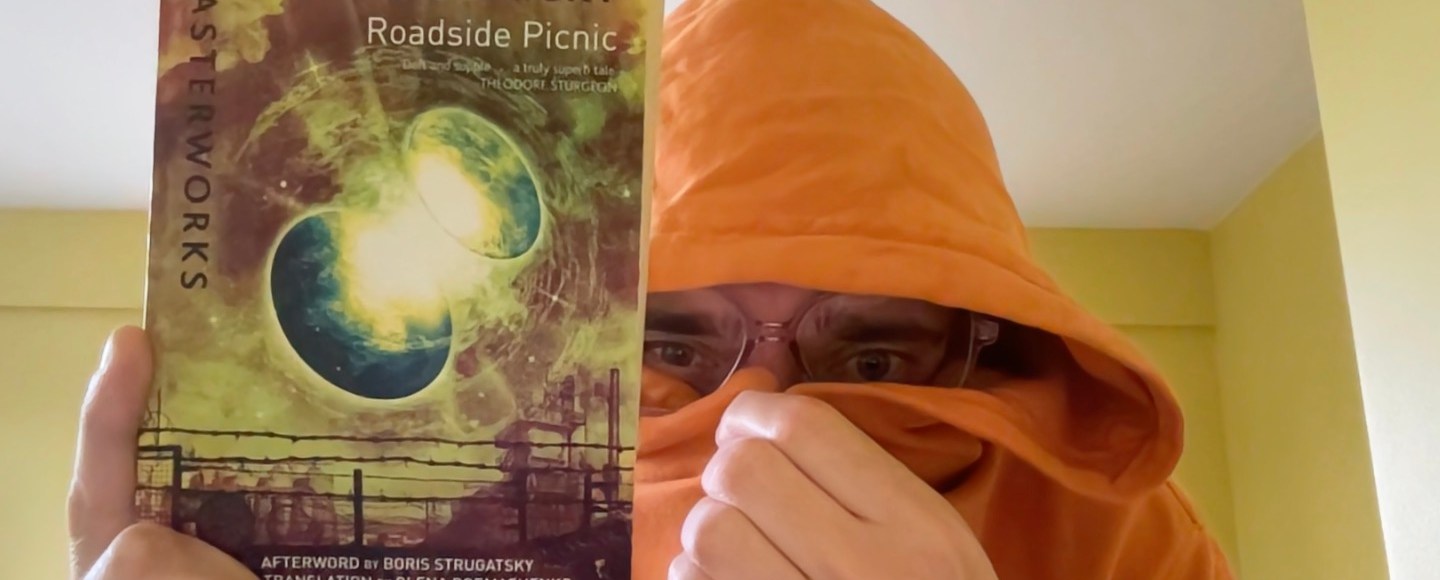

I’ve never seen Andrei Tarkovsky’s film Stalker. I’ve read a book about it, sure, but I’ve never seen it. And it’s meant to be one of the best films.
This – Roadside Picnic by Arkady & Boris Strugatsky – is the basis of that iconic movie. And, yes, it’s also rather good.
I mean, that’s an understatement, really: Roadside Picnic is a deeply involving, sometimes terrifying, sometimes bleak and human and very serious reflection on humanity, on life, on hopelessness, on greed, on corruption and, almost, on the pointlessness of anything.
If you’ve read any of Jeff VanderMeer’s Area X/Southern Reach books (or seen the Alex Garland directed adaption of Annihilation), then you’ll likely be familiar with the overall vibe, to the point where I think reading VanderMeer’s series would feel very different if you did so after encountering this. Perhaps VanderMeer presumes his readers are familiar with this novel (or the Tarkovsky film) and that riffing is meant to be a shared pleasure, whereas for me this book – at least for its first half – reminded me of the feelings I had as a teenager watching the real versions of films that The Simpsons had satirised/spoofed in Treehouse of Horror. A strange, uncanny-valley type familiarity. Which is, incidentally, how the inside of the Zone feels in Roadside Picnic. Things aren’t how they used to be. Things aren’t what they were. But things have not entirely changed. No. No they haven’t.
–///–
The premise – for you strangers – is that aliens have visited Earth, at some point in the late 20th century. And then – before we could speak to them, interact with them, learn from them, or any of that, they were gone again, leaving behind a handful of strange spots, the “Zones”, where they landed and then left.
In these Zones, nothing is as it seems, and nothing is as it was.
There is alien technology left behind, alien disease, alien waste, and also strange gravity concentrations, and strange concentrations of heat, and the ability – not through radiation – to affect and alter the DNA of any future children of the people who wander through the Zone…
Access to the Zones are heavily controlled, wherever in the world they are, yet people still manage to sneak in, exploring and looting and selling onto the black market (and then onto both legitimate and illegitimate (usually sinister) science and research institutions) the items they find inside. These people are known as “stalkers”.
There are identical alien items that have been found in all of the Zones, items that are common in some and rare in others, and there are also, always, rumours of things more complex and more important than items a solo human can carry…
The action of this novel is set in and around a zone [presumably] in North America, and the stalker we spend most time with is named “Red”.
Red has heard rumours of a Golden Sphere inside the Zone that grants anyone who finds it whatever they wish for. He ignores these rumours as a young man, while “stalking” on the side while working for the government agency managing access to the Zone… Later on, he “stalks” independently, after he has had a child born who looks like no other child in the world, then, even later, he walks into the Zone with someone he doesn’t trust (who – rumour says – only exists due to a wish granted by the Golden Sphere), to try to make a wish… To try to have a wish granted. And that, yes, is where the novel ends…
The central philosophical thread of the novel is that the aliens either didn’t notice humanity, or noticed us but saw us as utterly irrelevant to their lives.
The title of the novel refers to the theory of one Nobel Prize winning (though maybe someone else just gave him theirs?) scientist, that the aliens’ stop-off on Earth was just a “roadside picnic” for them. They pulled over in their spaceships, had some snacks and maybe a frolic, and then sailed off, leaving behind the equivalent of empty sandwich wrappers, crumbs, bottle caps and maybe, just maybe, a used condom or two.
While most of the world seek to find meaning in the visit of the aliens and use in the items they left behind (as years pass in the present of the novel, human technology does begin to integrate with alien tech, though never with any understanding of how the alien items work, just a clear knowledge that they seem to for now), Red and the other Stalkers he know move towards a more cynical, yet selfish, understanding: it doesn’t matter, it doesn’t matter at all, nothing matters except the moment, except the changes and the benefits and the losses and the risks that they all personally take as they navigate through and around their Zones.
It’s a novel that’s exciting, thought-provoking, expansive, imaginative and tense.
It’s engaging and pacy, yet also slow and meditative… Evocative descriptions, playful yet sad imaginings of things that likely never will exist…
I liked it a lot, I really did. Expect a little mini-review of Stalker to pop up on my Letterboxd account soon…
–///–
All this said, Roadside Picnic is here presented with an uncharacteristically written-for-money-feeling Foreword by Ursula Le Guin and a barely readable afterword by the Strugatsky who lived longest, detailing the struggles he and his brother had getting the book published, which seems to disagree with the publication history as indicated at the start of the book.
Presumably his essay is meant to describe the struggles they had getting their “ideal version” of the novel published, which isn’t really the same as it not getting published at all, though the text behaves as if it is.
The novel itself is in a rather workmanlike, recent (2012) translation that may or may not be reflective of the original Russian, but certainly isn’t really reflective of the reverence the text is held in. Thankfully, the ideas and the images transcend the often-clunky prose, but it does feel a bit less literary than one would expect from a piece of fiction with this level of literary and sociopolitical provenance…
–///–
A powerful, haunting book about haunting, really, and about the slow loss of hope and optimism that greets anyone as they age and don’t find themselves getting happier…
Well worth a read…

Thank you so much for reading TriumphoftheNow.com! If you like what you’ve read, please subscribe, share and order one of my books. If you love what you’ve read, why not order me something frivolous and noisy from this Amazon wishlist or make a quick donation via my ko-fi page?
I’m currently focusing on parenting and creative practice, so small donations are appreciated now more than ever!
scott manley hadley aka SOLID BALD live
Here’s a video of me recently performing at the prestigious (it has a Wikipedia page) comedy night, Quantum Leopard. Listen to how much fun the crowd is having. You could have that much fun, too!
Forthcoming gigs include the following – there may/will be others:
9th April 2026, 7pm: Sunset Comedy, Chalk Farm
27th June 2026: Twinkles Cabaret, London
Discover more from Triumph Of The Now
Subscribe to get the latest posts sent to your email.

 Triumph Of The Now
Pingback: IMPERSONAL INTERVIEWS: Benjamin Schmitt, author of Satan’s School for Girls and Other Works. – Triumph Of The Now