
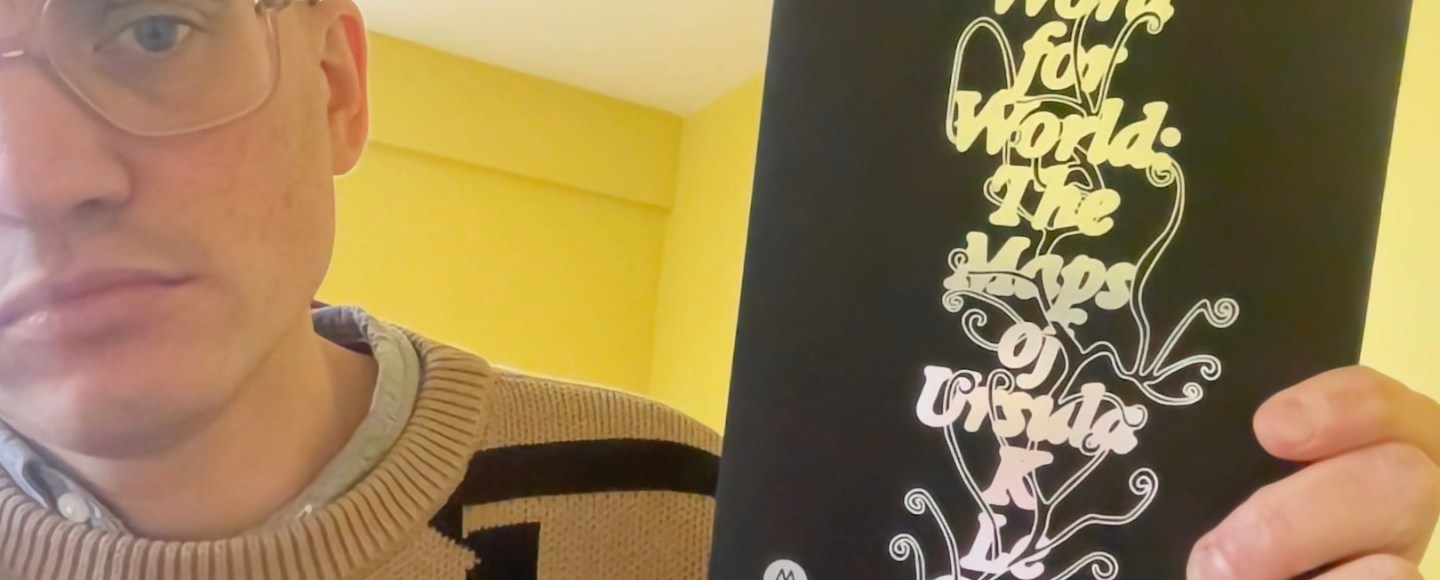

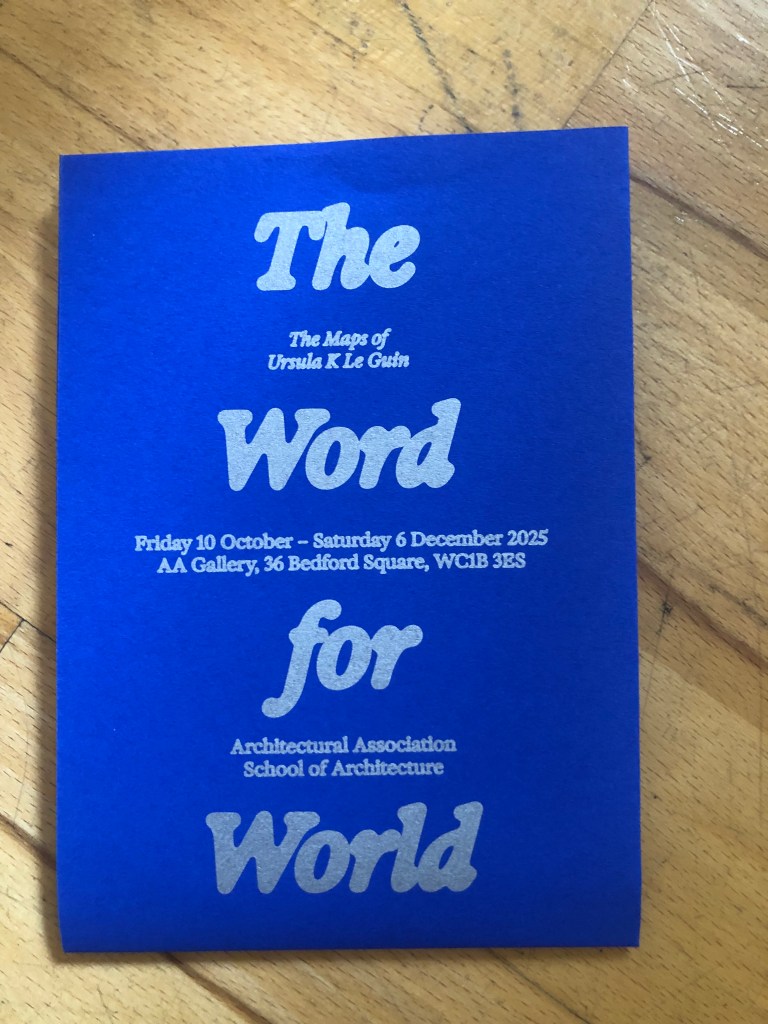
The Word for World: The Maps of Ursula K Le Guin is a publication that was created as the takeaway part of an exhibition that took place at the Architectural Association (an Architecture school) in Central London last year, though I believe/presume/expect it will tour. It’s an exhibition of fictional maps drawn by Ursula K. Le Guin, displayed alongside some nice little excerpts from her books and short pieces of writing contextualising her work. And that’s it.
The exhibition took up a single room on the ground floor of what (I presume) would once have been a fancy townhouse, but is now an Architectural school, a couple of blocks northeast from Tottenham Court Road station.
The maps were all displayed hanging from the ceiling, in themed rows, across the centre of the room, with colour schemes of the papers they were printed on matching the walls.
Around the outside were some watercolours and other sketches produced by Le Guin, as well as some nice (and less nice) physical copies of the books she published some of these maps in.
It was simple and clear, and beautifully put together.
The maps were all, roughly, at eye level, and not much bigger or smaller than one imagines they would have been when Le Guin sat down and drew them by hand. Her handwriting on each is clear, and the lines – on the versions that never made it to publication with both initial pencil and later pen visible on the prints – textured and far more tactile than something robotic.
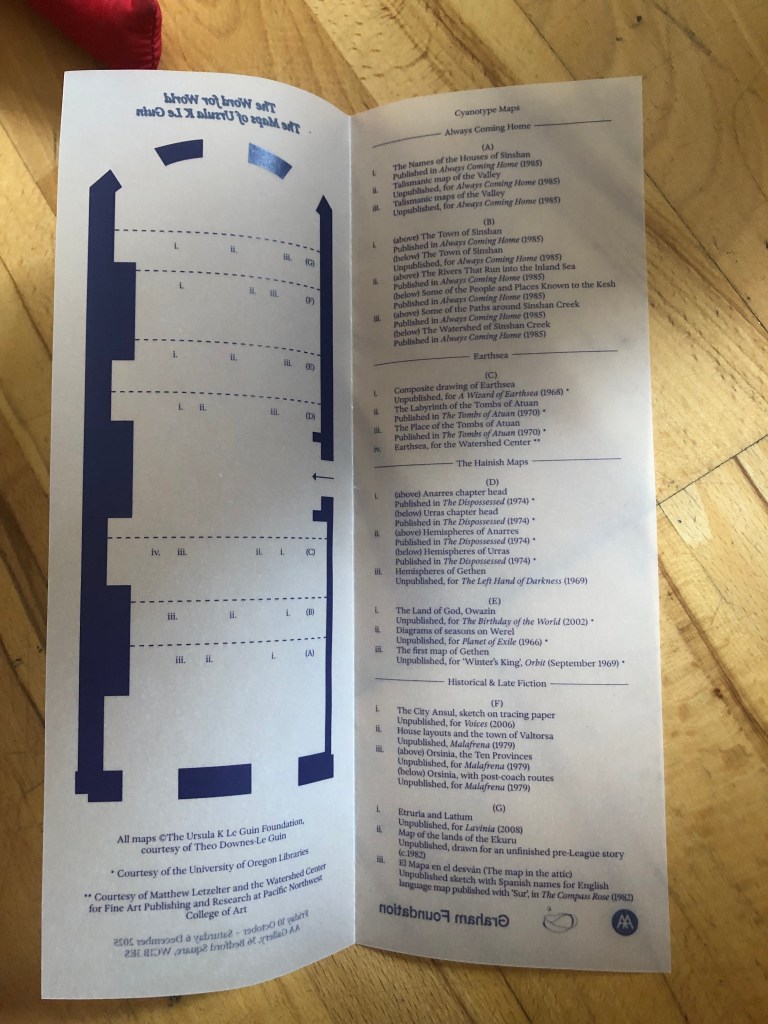
These are maps presented as creative objects, maps used as creative tools, and in the exhibition’s beautiful presentation, it was very easy to walk through the various story worlds of Le Guin’s imaginings and be transported back to stories one has already read and remembers well, into stories one has read about but never read1, all of them being places that never existed, yet – for Le Guin – clearly, firmly, did.
It’s a testament to both the power of clear and potent curatorial design, to Le Guin’s imagination, and also to Le Guin’s process itself. And, also, her intentional and textural philosophical reckoning with and explorations of colonialism and how the powers of naming items – correctly or incorrectly – gives power, which means that there is no hypocrisy here.
Le Guin understood and knew what a “map” meant and what maps mean, and it’s possible, important, really, to see these visual respresentations of the worlds and cities and planetary systems she created as a deep part of her imaginings.
This is world-building as world-representation…
Le Guin is using geography and map-knowledge as a way to work into fictional histories, and fictional history-making.
All of the maps that she’s made here are maps that are, textually, maps made by a certain group or individual within her text.
Maps change with time as societies and civilisations change; maps change with time as the people who make the maps change their priorities…
There are maps that orient themselves around polar axes, but also maps that orient themselves around the flow of rivers or other water courses.
The maps reflect not only the geography of the places she is creating, but the societies she is creating too…
How she chooses to visually represent a place is a choice, too, about how it is peopled.
How do people live here and how do the people who live here think of their home and their land? It all connects…
If that exhibition does tour, or re-appear in London, I’d highly recommend you go check it out.
–///–
The book of the exhibition is a beautifully-presented companion piece too, including high quality images all of Le Guin’s maps from the exhibition (and possibly a handful that weren’t included, though that might just be the gap of a couple of months between my visit and my reading having let me forget some – I was there with my toddler so wasn’t 100% focused on the exhibition 100% of the time I was there).
Sadly, none of Le Guin’s watercolours are reproduced in the book, but there is an intriguing collection of short pieces of variform writing – poems, interviews, a recipe, essays – that expand on and explore (with greater and lesser levels of focus) the themes raised by the exhibition.
Although all of the pieces are interesting, some of them seem quite tenuously connected to the exhibition itself, especially when there’s only really one example of each type of writing…
A different fantasy writer talks about (and reprints) maps they have included in their own fantasy novels, other writers reflect on the ways that Le Guin influenced their own work and/or life, some poems and texts explore place and personhood and meaning and ideologies of map-making, but they’re all quite short, so the pieces that begin to walk towards more complex or wider discussions tend to back away from that a bit, and the pieces that do end up feeling coherent and whole tend to be the ones that are the least ambitious.
And this is all fine, yes, and it’s a beautifully presented book and great to have these maps of Le Guin collated, but I couldn’t help feeling when I finished reading the book that though it had a similar brevity to the beautifully-curated one-room exhibition, it didn’t quite feel like it had the same fixity of focus.
I suppose, actually, what I would have been very very happy with would have been a digressive book accompanying the exhibition that was three times the length of this.
More interviews with more writers about their use of maps…
More discussion of indigenous activist groups and their use of map-making within activism…
More poems that run away from the central theme without spinning back…
More images, more of Le Guin’s own writing about place, more of a sense of something bigger growing out from the exhibition into the text…
So yes, I liked it, but I wanted more of it all.
I enjoyed this book a lot, and many of the pieces in here have given me some very exciting-sounding other books and ideas for me to explore, and maybe that’s the point of this, then, a springboard from Le Guin outwards, rather than one going inwards. The book not as book or commentary, but as mix-tape, as vibe, as riff. And in that respect, I suppose it does succeed.
Maybe I’m being greedy, then, wanting more when less is offered…
There was nothing in here that was boring or uninteresting, but there was also nothing in here that flew out of the page into the mind with any more power than the maps of Le Guin’s included within it.
And, thus, I suppose that’s the thing I found a little disappointing: when the exhibition was so good and tight, and the maps themselves so spell-binding, maybe the book to go with it should have just been the maps themselves: if it wasn’t going to become an essentialised and expansive collection of reflection and inspiration, maybe it should have simply been the maps themselves?
I loved the exhibition. And I liked the book. And I’d recommend getting the book to support exhibitions and creatives like this, absolutely, but the book felt more like a boxset of teasers for other things, rather than a thing in itself.
But ignore that and definitely do go buy a copy via this link.
For me, it’s worth being frustrated by to get to think about Earthsea for a bit on a weekday…
- It was here where I remembered Searoad: Chronicles of Klatsand, and went home and dug out the buried, unread, copy I had of it to read on my December holiday. And I fucking loved it, adored it, cover-to-cover. Le Guin is great. ↩︎

Thank you so much for reading TriumphoftheNow.com! If you like what you’ve read, please subscribe, share and order one of my books. If you love what you’ve read, why not order me something frivolous and noisy from this Amazon wishlist or make a quick donation via my ko-fi page?
I’m currently focusing on parenting and creative practice, so small donations are appreciated now more than ever!
scott manley hadley aka SOLID BALD live
Here’s a video of me recently performing at the prestigious (it has a Wikipedia page) comedy night, Quantum Leopard. Listen to how much fun the crowd is having. You could have that much fun, too!
Forthcoming gigs include the following – there may/will be others:
9th April 2026, 7pm: Sunset Comedy, Chalk Farm
27th June 2026: Twinkles Cabaret, London
Discover more from Triumph Of The Now
Subscribe to get the latest posts sent to your email.

 Triumph Of The Now
0 comments on “The Word for World: The Maps of Ursula K Le Guin, edited by So Mayer and Sarah Shin”