
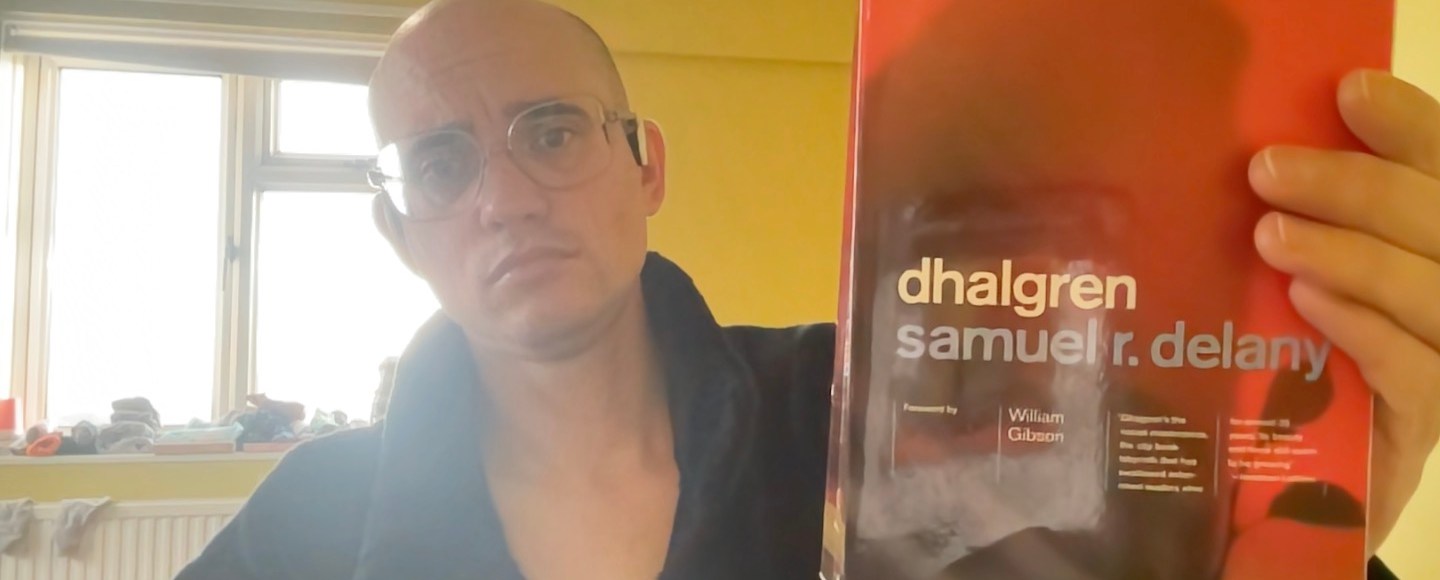

Dhalgren by Samuel R. Delany first published in 1975
PART ONE: Blunt Reflections
Ok, so I’m going to split this post into two sections. The first will consist of my fresh, uncomplex, immediate reactions to the 800 page novel I’ve recently finished after a few weeks of reading, while the second (probably shorter, but let’s see) section will look at the novel once I’ve spent a bit of time looking at “real” reviews and articles about it, in the hope that other people’s responses will either corroborate my ideas, or massively fill out and fill in the perceived mysteries and inconsistencies that I (perhaps incorrectly) felt the novel ended while embedded within…
Yes, my final personal thoughts on finishing Dhalgren was that this was a novel, a hell of a novel, that revelled in and ended with numerous huge ambiguities.
That this is a novel, yes, full of rich characterisation, complex and deep world-building, 800 pages of variously strange and unnerving and emotional and intellectual and funny and serious and engaging and articulate and silly and dense and playful and dark narratives, yet never cohering around – or even towards – any clear explanation[s] or answer[s] about any of the narrative’s deepest mysteries.
And I think that’s how it was meant to be. That was what I understood to be the intentional effect: it doesn’t matter, really, too much, exactly what has happened or why and where it has happened and who the people it has happened to are… None of this matters, really. No, what matters a tiny bit, maybe, is how what happens happens.
Is how it is described and dramatised by the author making it happen, but also, too, the way it feels to the people that it happens to. Yes. Yes. I think that’s one of the elements that is probably meant to matter…
–///–
The novel opens with an young man who has forgotten his name having sex with a woman he’s just met, who then turns into a tree. He finds some strange jewellery, puts it on and then continues, onward, into the city of Bellona. The tree incident isn’t directly mentioned again in the novel until about 780 pages later, when the protagonist begs a person working as an improperly-trained psychotherapist to help him convince himself that this experience of a witnessed transformation was a dream, not an experience, as this either means that a) he lives in a rational world and he has lost the ability to parse between reality and fantasy to the point where he should be – maybe needs to be – institutionalised until he is safe to wander free, or b) the world as he expects to be able to understand it doesn’t exist, cannot exist, and it is not his mind but the reality he worries about perceiving that is sick, that has changed, that is ultimately unknowable…
Beyond that, we get multiple ending-adjacent scenes out of a clear chronology, and between the two we have hundreds and hundreds of pages about this non-place, this real place, this partial place, this something place…
Hundreds and hundreds of pages telling us what it is, what it might be, and the various people who have come to this city, or who have remained in this city, since something irrevocable and strange and unexplained happened to it….
Is Bellona, then, a city in the middle of America that sits there still, somehow accessible only over a bridge that is almost-always shrouded in mist..?
Is it another dimension?
Is it a fae place?
A real place?
Is it only in the mind of The Kid (as the protagonist comes to be known)? Or is it only in the mind of Samuel R. Delany and is trying to find the limits and the boundaries of the city a fool’s task, unworthy of this gorgeous, lyrical, wantonly enjoyable novel?
–///–
Time seems to slip and ebb and flow in Bellona…
Most of the city’s population, following the “incident”, have left, and most – but not all – of those who chose to stay have embraced anarchy and freedom and all that comes with it. Those interested in life off the beaten track have started to wander in, too, as rumours circulate in the outside world…
There is strange technology in Bellona, too: hand-mounted bladed weapons known as “orchids”, the jewellery mentioned above (“optical chains”) and strange battery-powered pendants that can hide the wearer in a far bigger than life-sized projection of an animal… There are fabrics that can change colour by remote control…
On a macro-scale, too, there are new things: There are new celestial objects in the sky… a rival sun, sometimes, a rival moon most of the time when the mists and smoke part enough to see…
There is still running water and electricity in some buildings, though many others are precarious and falling apart… Some seem to burn but then be back, some seem to be in the continual process of a never-done destruction…
There is a newspaper and a poetry press, too, there are new religions and there are celebrities… There are gangs and there are communes and there are parties and there’s a lot a lot a lot of sex (though maybe not that much, one character suggests, given how little else there is to do…)
Identities shift and are hidden, who has written what in [what seems to be] the sole notebook that exists in the city seems to be introduced as a mystery, yet isn’t one that the narrative focuses on… People are named and off-page for hundreds of pages then briefly introduced and then never mentioned again… People are central central central for pages and pages and pages and then gone…
There’s a harrowing and deeply moving accident in a lift shaft…
There’s a lot of complex explorations around sex (the act), gender, race, class and education throughout…
Is it all metaphor for something else?
Are the secrets people keep in the novel – and hold after the final page has been turned – secrets that are explained if one reads the book more closely than I did?
For me, the ambiguity was the point. What is ambiguous is where Bellona is, is what is real and what is the [mis]understanding of The Kid or other people…
All is confusion, some of the time, and some things are some confusion all of the time…
It’s a novel that is full of mysteries/mystery, where identities and motives and personhood is very often hidden, often from the individuals themselves…
Most of what Delany writes here is from the close third person perspective of The Kid, save for the final 150 pages or so, which are probably the first person perspective of The Kid, but are couched within a little bit of metatextual commentary that casts doubt on the authenticity of that… Other people could have written some of it… It all could have been appropriated and fictionalised, perhaps, though it probably isn’t. It probably is The Kid. But we don’t know. We don’t know.
And we don’t get to know anything.
We don’t get to know why the city was evacuated, what is happening to it now, we don’t get to know if The Kid is truly mad or if time dances differently to other people than it does to him…
We don’t get to know who, if anyone, leaves the city or survives in the city at the end, if there even is “an end” and not a tight loop back to where it begins?
Who is happy? Who is in pain? Who is satisfied? Who is satiated?
Beautiful, complex ambiguities, narrativewise, yet clear, literary, characterful, impactful meaning throughout. A masterpiece. A joy. A miasma. A smorgasbord.
I loved it. I will almost certainly come back, if I live long enough to do that…
–///–
PART TWO: NUANCED, RESEARCHED, KNOWLEDGEABLE REFLECTIONS
Ok, well, unfortunately, I’m going to have to indefinitely postpone Part Two because there is a disappointingly light quantity of materials on Dhalgren easily and swiftly available online and I don’t have time to go to a library or figure out how to access JSTOR or similar repositories of online essays.
I also can’t quickly figure out which of Samuel Delany many non-fiction books contain writing on this book, so I can’t even get one of those en route to my readerly hands.
So, then, a simple request: if you know of anywhere I can read articulate and detailed writing ABOUT Dhalgren, then please do let me know in the comments below. If you happen to know where/if there’s a Delany interview[s] or essay[s] on this book, where I can find long-form discussions of it, I’d be very interested. One day, hopefully, I’ll have time to go and sit in the British Library (or a similar institution in a different city) and read some journals. So a reading list would be great.
I read through the Wikipedia page, obviously, but I’m not going to patronise you (or myself) by regurgitating that…
–///–
Dhalgren is a potent, powerful, serious, playful, novel. I loved it. I expect to love it again when I – eventually – return to it.
Oh, there’s a moment at one point where The Kid repeats an anecdote from his life that appears, almost identically, as an episode in Delany’s life mentioned in The Motion of Light in Water. I liked that. Yes.
Really good stuff. Wooo.

Thank you so much for reading TriumphoftheNow.com! If you like what you’ve read, please subscribe, share and order one of my books. If you love what you’ve read, why not order me something frivolous and noisy from this Amazon wishlist or make a quick donation via my ko-fi page?
I’m currently focusing on parenting and creative practice, so small donations are appreciated now more than ever!
scott manley hadley aka SOLID BALD live
Here’s a video of me recently performing at the prestigious (it has a Wikipedia page) comedy night, Quantum Leopard. Listen to how much fun the crowd is having. You could have that much fun, too!
Forthcoming gigs include the following – there may/will be others:
17th March 2026, 7pm: Slap & Giggle @ Coin Laundry, Clerkenwell
24th March 2026, 7.30pm: Lolipops, Southwark
26th March 2026, 7.30pm: Comedy @ Cosmic, Plymouth
9th April 2026, 7pm: Sunset Comedy, Chalk Farm
15th April 2026, time tbd: BALD PERSONALITY DISORDER 40min-ish WIP at Shirker’s Rest, New Cross (more details soon!)
27th June 2026: Twinkles Cabaret, London
9th August – 14th August: BALD PERSONALITY DISORDER at The Street, Edinburgh, part of PBH’s Free Fringe
Discover more from Triumph Of The Now
Subscribe to get the latest posts sent to your email.

 Triumph Of The Now
0 comments on “Dhalgren by Samuel R.Delany”