
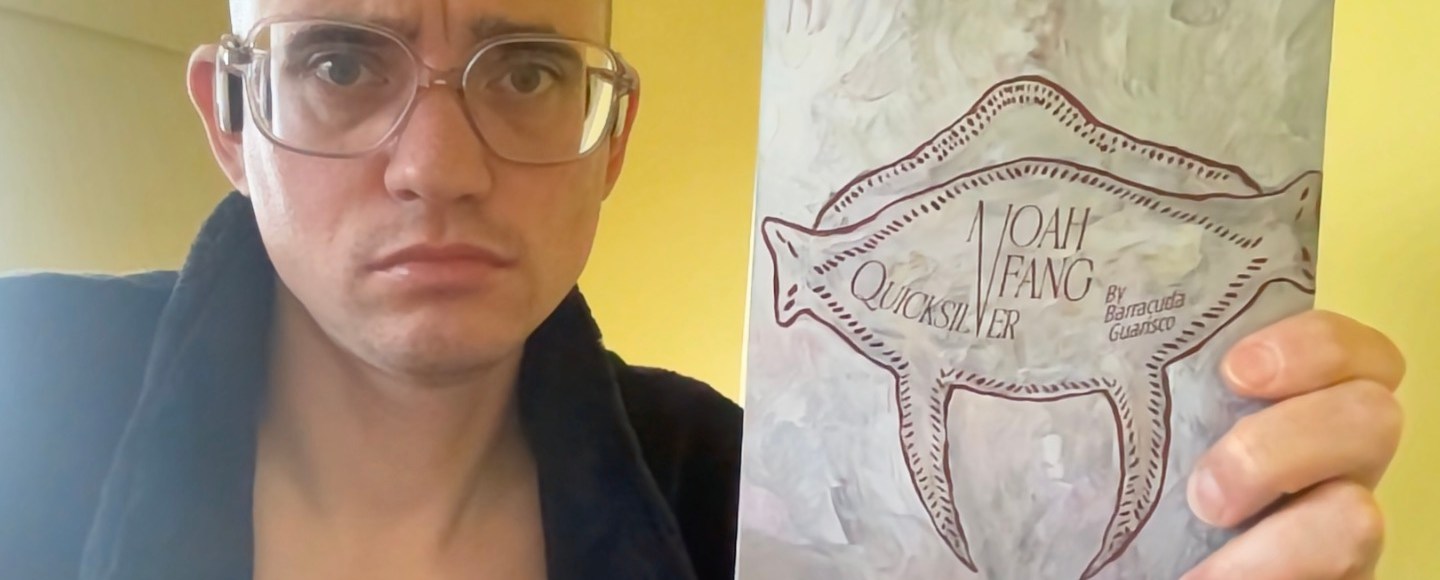

Noah Fang Quicksilver may well be the first book I’ve ever encountered that has described itself as the author’s last, when the author has been alive enough to promote it.
Written by the “polyonymous” Barracuda Guarisco (elsewhere known as Kris Hall, C. C. Hannett and possibly other names not revealed in the author bio), Noah Fang Quicksilver announces itself as “autofiction, buddy”, and it does so with the book’s narrative often falling at polar opposite ends of the scale between truth and fiction, though what exists right in the middle probably is the hardest to spot, which – perhaps – is the point.
The eponymous Noah Fang Quicksilver is a poet and an editor and a former publisher, many of whose experiences and prior achievements/successes/activities mirror or match those (that I’m aware of) of the book’s writer.
But there are some pretty key differences between the character and the writer… For example, Quicksilver has arrived at the level of indie lit semi-notoriety that he has for one simple reason: he invoked a magical giant beetle that he performed human sacrifices for (just using people from the poetry community, no civilians, don’t worry) that granted him poetic powers as reward.
The beetle grew bigger and bigger and hungrier and hungrier for blood and murder until Quicksilver tired of it, killed the beetle and hollowed out its carapace, which he now uses as a gore-scented office to write his verse in.
Oh, and he’s also doing an interdimensional poetry tour, though – some aliens and ray guns aside – this mostly seems to take him through dimensions broadly similar to our own.
This is, of course, the stuff that is patently fiction (I, perhaps naively, presume).
As much as it would be nice if true, there aren’t buses that will hop you between dimensions running in the continental United States, and there are no beetles you can sacrifice for in order to climb the slippery ladder (is it a ladder?) of the poetry world.
What is far more at the “auto” end of the scale is the discussion of the poetry scenes – offline and online – that Guarisco offers here.
This a book with some quite in-depth and reflective conversations to be had about not only the creative urge, but the urge to share what one creates, especially in the contemporary age of online only and self/very small scale independent publishing. For example, “Getting published used to be the hardest part, now it’s getting anyone to care.” As someone who has had a poetry collection, a chapbook and two hybrid essays works published by independent presses (two of which have since shut down) and self/small scale indie-published an anthology, a co-written collection and a spoof psychological horror, I know exactly what Guarisco here means. It’s not as hard as it once was to get your work into a book-form, but it very much is hard to get those book-forms to really work for you, y’know, to get read or noticed or lead to something bigger and better the next time… Yes. I understood.
Elsewhere, the poetic voice (Quicksilver’s? Guarisco’s? Hall’s?) comments, again on promotion and visibility: “Writing the book, you feel delusional. / Submitting the book, you feel delusional. / Promoting the book, you feel the most delusional.” And that’s it, right, that the hard bit isn’t doing the writing, it’s persisting at doing the writing beyond the point where other people give up, or de-prioritise artistic and creative work.
I’m typing this on a train and left my copy at home with some quotations typed in before I departed, but there was a moment I didn’t note down where the narrator voices it being less standard, in your 30s rather than your 20s, to aspire towards poetry and to sideline remunerative work.
Whichever of the book’s voices this came from, it was one I recognised. For me – more and more miserable as life felt further and further away from anything with any meaning I cared about – it seems essential, to sacrifice material stability for the creative outlets, rather than to sacrifice creative outlets for material stability. Quicksilver says, on working: “I am holding out for something bearable / That won’t disrupt my current happiness” and this is just so hard to find, yet so important, especially if circumstances lead you to living somewhere with a higher cost of living than the benefits those costs buy.
I am not a person when I work, is how it feels for me, and (maybe) for Quicksilver: if what is valuable to you as a person is what you write and what you communicate and what you share with others, then time spent working meaningless mundane “bullshit jobs” (which most of them are) is dead time. I feel a lot in common with Quicksilver, though if this book is meant to be a warning or a dismissal or a condemnation of the literary urge (is Guarisco genuinely going to give up writing and is that to go and get an office job and a mortgage and some hire purchase white goods and a new model car and do sports betting instead of reading, as we’re all meant to?), then I have perhaps misread it. As this is autofiction, though, I don’t think I have catastrophically misinterpreted. This book – to my understanding – is about what Guarisco feels about the literary career they have had to date. Highs, lows, all of it. I just don’t think the interdimensional travel and beetle sacrifice is literal, but I do think that some of the writing about the indie lit scene is.
“When I was a publisher, / It seemed everyone paid attention / To what I was saying and doing / When I stopped publishing, / The attention went with it” is a set of lines presented as almost a poem within itself in the text. And this does, alas, speak of the self-involved attitudes of lots of people who aspire to being described by others as writers. Lots of them don’t read, don’t want to read, don’t think about or talk about books, yet want other people to think about and talk about theirs. It is these people, mostly, that Quicksilver was feeding to his beetle, and you can absolutely see why a former publisher might be able to justify that act to themselves… As poets, as writers, are we all just consumables for the next writer? Or even, now, are our words and our works just mere source texts for AI scraping? We’re no longer just meat for future poets, our words – not us – are now the meat for future non-poets, pushing us all further from that sense of meaning and connection that we all yearn to feel…
We yearn for it, yet we do sometimes remember that it maybe doesn’t matter so much, “The stakes are so low you feel / You can get away with anything” writes the voice of this collection. High stakes and low stakes and no stakes at all. It is everything and nothing, literature, poetry. Yes, yes it is.
And the voice has a lover, a partner, who is also a poet, and this verse I thought was romantic and intriguing and playful: “We don’t care too much for the poets / Each other likes / But we like what each other writes”… It made me question if, if, if…
–///–
Noah Fang Quicksilver is a short text, yes, but it’s densely imaginative and discursive about the entire experience of being involved in poetry…
This book is discussions of efforts to grow ones reach, it is discussions about the optics and logistics of running poetry open mic nights, it is about the difficulties of selling physical copies of physical books and how much even harder than that it is to get people to read the physical books you’ve sold them…
It’s about rumours and rivalries and politeness and, of course, the playful exploration of the ways in which people fight, claw, kill and stomp their ways around and through the corners and corridors of indie literature with the wild, unsustainable, hope, that somehow, maybe, a mass readership will suddenly arrive at the end and make everything before acceptable and forgiveable and, mostly, justifiable…
Is poetry worth killing for?
Will killing make your poetry better? Your audiences deeper and cooler and more engaged?
No.
But does almost every single poet convince themselves, at some point, that maybe it is?
I’d say, yes.
Anyone who writes or creates (especially in an indie setting) for the long term as an adult has, likely, sacrificed something (though probably not the literal lives and bodies of other, ambitious but meeker, poets) in pursuit of that goal.
The poets that I like most lean towards over-exposure of themselves and their personal lives, lessening the freedom to form human bonds with any one who doesn’t value public shamelessness…
The poets that I like less lean towards complexity and artfulness and ambiguity, and lose connectedness through their pursuit of perfect modes of expression, never settling and never abandoning the rigorous pursuit of literature. I respect it and understand the urge, even if it doesn’t electrify me…
Both of these types of poet prioritise poetry, writing, over all else.
Instead of spending our free time and private moments doing sports betting or whatever it is everyone else is doing all the time they’re not streaming vertical videos on their phones (things that bring people together through building a shared normality, a shared normalcy of action and habit), we instead spend our time writing words, words, words to ourselves and to our imagined (to greater and lesser extent) audiences.
We care more about how our work is perceived and received than we care about most other things. And that cuts us off. Cuts us off.
Misery, shock, disappointment, instability, lots of time alone, all of this stuff is great for the poet, fills us with ideas and the freedom to wield them.
Nothing kills a poet sooner than emotional stability, and that’s true for the confessional poets and the intellectual poets and the poets that are somewhere between the two…
Poets are hungry. Poets have to be hungry (not necessarily literally) or sad, or horny, or angry, or stressed, or something, yes.
I’m not talking about the starving artist type figure loosely rotting in squalor, no. A person can have interesting things to say from a comfortable chair, sure, but, really, once the urgent need to communicate something has been lost, it’s hard to replace, it’s hard to replicate, it’s hard to rebuild. Yes.
A poet that hasn’t sacrificed something for their art probably isn’t really a poet … They’re just someone who is writing poet, which simply isn’t the same thing.
Noah Fang Quicksilver is a poet, though, and so too is Barracuda Guarisco. This book, absolutely, has ideas and emotions and wit flying through it across every page. This isn’t the work of a mind that has run out of the friction needed to spark the poetic sticks… It is instead the work of a mind firing on reflexivity and concentration and ideas.
This is a book of ideas, of jokes, of stories, of big truths and big lies, from the fictional and the real lives of several people. Well, several names at least.
(((There’s some really interesting stuff about masking in public spaces that I’d have loved to discuss in more detail (but I think this response is long enough), which is something I’ve barely seen discussed anywhere, really. “I wear a mask to hide, if anything / It makes me stand out” […] “We promote wellness, she said / The mask reminds people of illness / / & stopped the interview right there”.)))
It’s a text that is serious and silly, articulate and digressive and tight and fun. There’s jokes – “You say you have a new book coming out; / Coming out of where?”, there’s horror, there are combinations of the two, “My first mistake was taking myself too seriously / My second mistakes was leaving behind any witnesses”, but mostly there is just an engaging book length text looking at how it feels to act and live in pursuit of one particular thing, when you’re never certain – never certain – whether that thing even cares about you at all.
A good book, an important book, a deeply interesting book and appropriate book to be read by anyone who has any interest in or knowledge of the realities of the non-ivory-towers poetry world. And for anyone who likes interdimensional travel, aliens, bloodsuckers, magical beetles and all that other stuff.
I enjoyed it a lot.
More info available via this link.

Thank you so much for reading TriumphoftheNow.com! If you like what you’ve read, please subscribe, share and order one of my books. If you love what you’ve read, why not order me something frivolous and noisy from this Amazon wishlist or make a quick donation via my ko-fi page?
I’m currently focusing on parenting and creative practice, so small donations are appreciated now more than ever!
scott manley hadley aka SOLID BALD live
Here’s a video of me recently performing at the prestigious (it has a Wikipedia page) comedy night, Quantum Leopard. Listen to how much fun the crowd is having. You could have that much fun, too!
Forthcoming gigs include the following – there may/will be others:
17th March 2026, 7pm: Slap & Giggle @ Coin Laundry, Clerkenwell
24th March 2026, 7.30pm: Lolipops, Southwark
26th March 2026, 7.30pm: Comedy @ Cosmic, Plymouth
9th April 2026, 7pm: Sunset Comedy, Chalk Farm
15th April 2026, time tbd: BALD PERSONALITY DISORDER 40min-ish WIP at Shirker’s Rest, New Cross (more details soon!)
27th June 2026: Twinkles Cabaret, London
9th August – 14th August: BALD PERSONALITY DISORDER at The Street, Edinburgh, part of PBH’s Free Fringe
Discover more from Triumph Of The Now
Subscribe to get the latest posts sent to your email.

 Triumph Of The Now
0 comments on “Noah Fang Quicksilver by Barracuda Guarisco”