
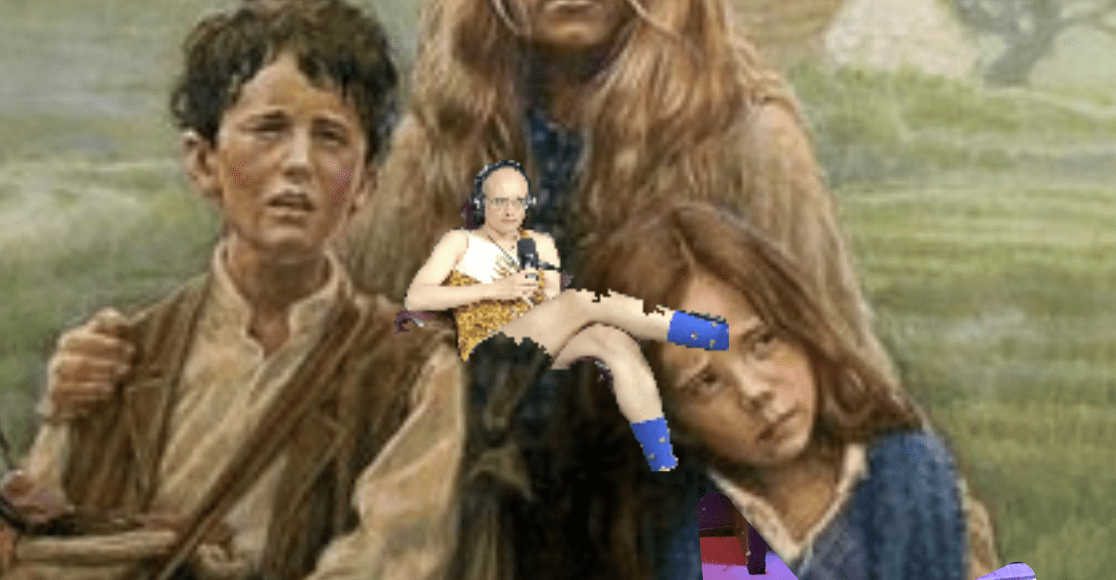

An Irish friend lent me a copy of Under The Hawthorn Tree to read. And it was tough.
I hadn’t heard of it before, but this is a novel that is on the curriculum for the top end of primary school in schools across the island of Ireland, so I don’t mean it was tough linguistically...
My [Irish] friend suggested this book may be one of the reasons why animosity towards the Brits, the English (of which I am unfortunate and unwilling member of, this nation of history’s villains), persists in Ireland. Not because of lies, not because of tricks and deceit, but because the majority of people in Ireland understand exactly how appallingly and inhumanely their ancestors were treated by the colonial oppressors from the island to the East, and most people in the UK remain – often gleefully and wilfully – ignorant of this.
The truth of colonial histories is something that most people in the UK repeatedly and regularly refuse to engage with, understand and acknowledge in the most basic possible sense.
I was recently chatting to some South Americans (I know where they’re from in more detail but it’s irrelevant) and they asked me if I was educated in the UK, to which I replied “I went to school here, but I wasn’t educated here”. This is very much how I feel the English education system functions, particularly w/r/t history.
The Irish famine of the mid 19th century isn’t something that one remains unaware of during the course of an English education, but it is not referred to as The Great Famine or the Irish Famine, no, it continues to be referred to, patronisingly, as the Potato Famine.
That said, the scale of death and (what amounts to) enforced migration isn’t necessarily downplayed (i.e. the population of the island of Ireland has not yet recovered to where it was prior to the Famine), but the culpability of the English absolutely is.
For this Irish famine, the Great Famine of 1845-49, didn’t happen as a result of no food, no crops, being successfully grown on the island of Ireland for several years in a row, no. There was a disease that spread through the potato crop, yes, the potato “blight”, but the way the story is told in England (at least it was in the 1990s) is that this was the only crop being grown, and that the Irish – due to their failure to diversify their agricultural practices – essentially brought the famine on themselves, yet in reality this is incredibly far from the truth.
What had actually happened over the course of the first half of the 19th century, was that mass industrialisation and urbanisation in the United Kingdom meant that there were far fewer people working the land on this island, though just as many people hungry for food as before. The solution to this – not posited, of course, by the agricultural workers involved – was that a huge amount of this needed food was farmed, grown, harvested and exported from the island of Ireland.
The potato grew very well and very easily there, too, and as an easy and carby crop, this ended up being the staple food permitted by landowners for the cultivation and consumption of the people there who worked the land. A potato-centred diet was forced upon the Irish, and – especially during the years of the Famine – strictly enforced, by force.
During the years in which the Famine persisted, the English continued to export large amounts of food. Grains and dairy products, fresh meat and many vegetables, continued to be successfully and [reasonably] sustainably farmed, but they were not shared and distributed amongst the people suffering famine, no, they were instead boxed up and shifted across the Irish sea to be consumed by people who weren’t starving, who weren’t short of food at all.
Now, of course, it’s of note to clarify that the vast majority of the English people who ended up eating this food were the urban poor, were the factory workers and slum-dwelling working class. These were not the people who chose to take the food from the Irish, and it is of course the elites, the factory owners, the farm owners, the international merchants and so on, government, too, who permitted this to take place for long enough for the population of Ireland to be fully reduced by about 50% (half of that to migration, and half to starvation, malnutrition and disease).
That said, this was well over a century and a half ago, so ignorance about the reality of the Famine at this point isn’t really acceptable, but at the time – prior to mass media, literacy and prior to media literacy (which we are, arguably, now living the other side of) – back in England it was pretty much only the people who took the food away, not the people who ate it, who knew what was happening.
And that’s the truth of what happened. But Under The Hawthorn Tree is a fiction.
It’s a novel from 1990, written for and starring children, which looks into all of the above in great detail.
Written with a clear and direct type of prose that genuinely reminded me of Hemingway (was he just writing stories for adults using sentence structures suited to children?), the novel is structured around a cross country journey set one Summer during the Famine years.
The children who travel are siblings, out of food and semi-/possibly orphaned (their dad has “gone off to work” and their mother has “gone off to find him”) and they are walking across the country, hoping to find family members who they have never met in their entire lives who they hope will take them in and give them food… These members of their extended family are their great aunts, people who their mother has spoken about at length in stories she has told her children of her own youth, decades earlier.
Prior to the journey, the father had left his wife and her four children behind, the youngest – an infant – dies in the first or second chapter of the novel, and this really sets the tone of the book. It is following this tragedy that the mother also moves on, almost certainly to spare herself the inevitable sight of three more of her children dying.
Although, yes, the three surviving children do manage to find some kind of safety and stability by the novel’s end, during their journey they encounter all sorts of natural and human threats and dangers. There is sickness and infection, there are animal attacks, there are untrustworthy adults, there is rain and lightning and wildfire, there is a lack of clean drinking water, there is a lack of heat and shelter and, of course, always, always, always, there is the hunger, which persists…
–///–
Under The Hawthorn Tree is a serious and a stark novel, which never feels scandalous or shocking, it only ever feels realistically dark.
At one point the children have to kill a rabid dog. At another point they have to drink the drained blood from a cow in order to sustain themselves.
They kill, skin and eat rats, they forage and eat berries that they find growing by the roadside… These are desperate acts as the result of desperate need…
What the novel is about, what the novel conveys, is that this desperate need was desperately un-needed. The great Irish Famine was the result of policy, it was not an inevitability. Food existed, food was present, and continued to be exported during the worst of this crisis. It was and remained an unforgivable act, a crime against humanity of murder, cruelty and genocide on a mass scale.
The English, led by Winston Churchill (a war criminal (by any meaningful definition of that phrase)) a century later, would practice almost identical policies in Bengal, killing even more people.
The Great Famine, the Bengal famine, Hiroshima, Nagasaki, these are all gross acts of genocide, of extreme human violence, whose perpetrators have never been castigated and criminalised in the way in which they should be/have been.
These are unforgivable acts, and this as backdrop may sound like a hard sell for a novel written for children and, yes, emotions are high and heightened and intense throughout, but Conlon-McKenna pulls it all together in a manner that manages to, sure, be an educational text, but also a deeply human and also very readable one.
This is a short text (of course, it’s a novel for children), but the hour or so that it takes an adult to read is a deeply intense one. And one, to be honest, I don’t think I will quickly forget.
There is a reason why books like this aren’t easily found in the libraries of English primary schools.
The United Kingdom – in my opinion – will never develop as a mature post-capitalist, post-colonial state, until we have a rigorous and deeply engaged exploration and understanding of our own histories.
Some people understand that the Empire was bad, but there is still a fucking statue of Winston Churchill outside parliament, and there are almost certainly statues of people involved in the decision-making that led to the Irish famine in and around Westminster and elsewhere in the country too.
We have not reckoned with the past in this country, with the crimes that have gone unpunished.
I worry that this will never happen, and the country will continue to fracture as denial and ignorance continue to be lauded, normalised and maintained by an increasingly fractured and shit education system…
You cannot walk away from the scenes of hideous crimes with bloodied hands and expect no repercussions.
Silence is not understanding, is not forgiveness, or a lack of culpability, it is a permission to continue failing to take responsibility.
Books like this should be in schools all over the world.
We cannot build a better world without understanding why the one we live in at the moment is so shit, and how it got here.
We cannot continue to be surrounded by joyful, bloated, exuberant, ignorance and I don’t know how we will ever be able to combat that.
But we have to try, I think. We have to try.

Thank you so much for reading TriumphoftheNow.com! If you like what you’ve read, please subscribe, share and order one of my books. If you love what you’ve read, why not order me something frivolous and noisy from this Amazon wishlist or make a quick donation via my ko-fi page?
I’m currently focusing on parenting and creative practice, so small donations are appreciated now more than ever!
scott manley hadley aka SOLID BALD live
Here’s a video of me recently performing at the prestigious (it has a Wikipedia page) comedy night, Quantum Leopard. Listen to how much fun the crowd is having. You could have that much fun, too!
Forthcoming gigs include the following – there may/will be others:
9th April 2026, 7pm: Sunset Comedy, Chalk Farm
27th June 2026: Twinkles Cabaret, London
9th August – 14th August: BALD PERSONALITY DISORDER at The Street, Edinburgh, part of PBH’s Free Fringe
Discover more from Triumph Of The Now
Subscribe to get the latest posts sent to your email.

 Triumph Of The Now
0 comments on “Under The Hawthorn Tree by Marita Conlon-McKenna”