


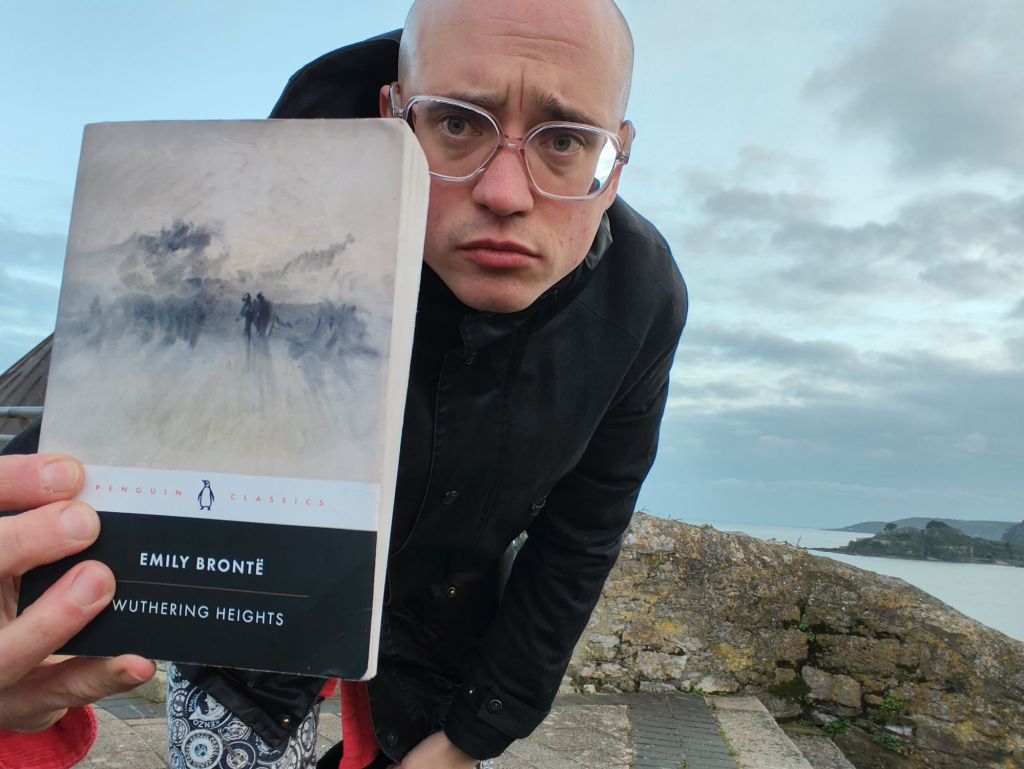
I have read Wuthering Heights by Emily Brontë before, yes, though 20 years ago…
At that time, as a provincial bumpkin living somewhere barely more hospitable than the windy, windy1 moors, it was a novel whose power hit me for sure.
For sure.
For sure.
For sure.2
I wrote a song about it, and though I definitely recorded a “polished” version of it at some point back then, that’s probably lost in the aether, melted into air, or (at best) on the hard drive of a computer that hasn’t been switched on since 2009.
What I do have, though, is this recovered version that I found last year on a “live” cassette tape my younger self recorded in the early Summer of 20083:
Oh, the depressing, sad, upsetting sound of youthful earnestness and hope…
But reassurring to remember that, yes, the future once felt like something to run into, open armed…
And-
And and and-
Yes, it is easy to read Wuthering Heights and come away with a sense of great emotional attachment to it as a work of fiction, and to the characters it contains.
There is so much to it, yet, also, so much missing.
It is in its ambiguities, perhaps, that its magic lies, but it is also in its own sense of its own realities that power lies, too…
Like Heart of Darkness (which would come half a century later), the narrator of the novel (Lockwood) is not really the person whose story we are hearing. And the person who recounts a story to the initial narrator, then (Nelly Dean), isn’t really telling a story about herself either, though she features within it as a significant secondary party.
Nelly Dean is recounting the “famous” story, and often (though not always) this is refracted through other people’s voices, too, because although Nelly Dean saw and witnessed a lot (and meddled and influenced and caused tensions herself – she was not a passive witness but an active factor on several occasions), she did not see everything first hand that she recounts to Lockwood.
The reader, then, isn’t reading a story simply defined as “Emily Brontë’s romance of Heathcliff and Catherine”, no, what we are reading is “Emily Brontë’s romance of Heathcliff and Catherine as told by various minor characters to Nelly Dean who tells it to Lockwood who tells it to us”.
The narratorial voice is not the authorial voice, and the story is – within the context of the text – [arguably] about as far away from the author’s voice as any narrative has ever been. This is a novel that tells a story and tells a story about telling stories.
All speech and actions from the protagonists are told through multiple tertiary voices, within the premise of the novel, rendering it all (ultimately) gossip.
It’s all hearsay.
It’s all rumour and opinion and all shaded not only by the motives and personalities who are acting and doing the actions, but by the people who repeat, copy, and discuss those actions. It is layers within layers within layers.
Within the novel, what is truly true is always at a remove.
We see that almost all characters seem to believe in ghosts, yet all seem to dismissively and harshly judge anyone else who implies that they are a person who believes in ghosts.
Everyone is passionate, everyone is in love, but no one seems to be explicitly horny, though I’d argue that it’s also possible to interpret the narrative that exists as being narrated repressively, and maybe not necessarily telling a story that was meant to be seen as so.
Lockwood (repressed) by way of Nelly Dean (repressed) may well not have noticed the frissons of fucking that took place, or they are [both] perhaps in denial of palpable frissons, which though not quite the same, may well result in the same misaligned retellings of narratives… eschewing honest and direct exploration of the motives and actions taking place out on the moors, through fear/discomfort of wrestling with the bodily wrestling that may have taken place…
Emily Brontë was, though, writing and publishing for a repressed audience, and the introduction to this Penguin Classics edition discusses how Emily’s sister Charlotte (of Jane Eyre fame) did the edits for the second edition of Wuthering Heights and made it more repressed, less passionate, less fun. Subsequent republications of the text are almost universally based on the first edition, not the second… Time, as they say, heals all…4
–///–
PLOT SUMMARY
Heathcliff and first Cathy (his Cathy, who everyone else calls Catherine) are raised as semi-siblings (though I would argue that a blunt interpretation of the text would concede they’re likely (or possible, at least) half-siblings: certainly to my understanding of the world (and human actions and motives), the most likely explanation for a man who regularly visits a port city “on business” coming home from one trip with a small child he feels compelled to raise, is that the child is the child of his own loins or, if not definitely so, then the child of someone who he has been fucking and thus has cajoled him into a sense of social responsibility even if it isn’t a biological one. (Like in Les Miserables, parenting someone else’s child can be seen as an act of devotion, an act of love, an act equivalent to and deserving of romantic/sexual pursuit.))
Cathy has a daughter with a man she marries who isn’t Heathcliff and names her Catherine, and everyone calls her Cathy (except for Heathcliff, who calls her Catherine).
Cathy’s husband’s sister is very easily seduced [into marriage] by Heathcliff and then realises he has no interest in her and runs away to give birth to their sickly child, who she gives as a forename her own pre-marital surname.
Almost two decades later, Healthcliff’s son and his Cathy’s Catherine and his Cathy’s nephew all end up living with him after everyone else has died, and then more people die, leaving only the two younger people from the novel’s second generation of characters who are most like the initial Cathy and Heathcliff, and they kinda live happily ever after, with rumours abounding that, beyond death, Heathcliff and Cathy exist, too, as ghosts skittering about on the moors and, finally, together and free and loving (as ghosts).
I, yes… I loved it.
–///–
I was wary to come back to this, tbh, as it was a book I’d remembered enjoying at school, but had also remembered it as being difficult, which it isn’t, really, and where it is “wordy” it’s generally doing so for comic effect, mocking the narrative and language as offered by Mr Lockwood, who is an arrogant, self-important, socially awkward man who likes big words.
Emily Brontë is using language in a very interesting way, swinging from the over-educated prose of the initial narrator, to the solid literate servant patter of Nelly Dean, and the slightly more rustic dialect of those less refined than her, and nuanced versions of language in the mouths of the assorted people lying between Dean and Lockwood on the mid-Victorian social scale.
It’s a playful novel, yes, whose idea of truth oscillates and swings around its own stories. Is Heathcliff a monster? Is he a charming, erudite, hard-working person full of love and care yet treated cruelly by a judgemental world? Was Cathy kind to him or cruel, too? Is Nelly Dean the cause of the most significant miseries the characters face, or does her meddling permit some brief moments of fleeting care and cohesion?
Are these people ever happy? Are these people ever truly in love? Is it all super incestuous and is that something that matters? I’ve got family ties to East Anglia, so I don’t feel like I’m in a position to judge5 on that front, but I didn’t get the feeling from the novel that the genetic proximity of these “kissing cousins” was ever meant to be read as something Emily Brontë and her narrators were expecting a reader to sneer at.
By the end of the novel, I’d warmed to Heathcliff a lot, and felt that – certainly in the way he is presented by Nelly Dean – he was very relatable. I thought about it more, and realised that the ways in which Heathcliff seemed most recognisable to me were the same as the ways in which my personality aligns with some/several/many of the symptoms of Borderline Personality Disorder.
I did a quick Google, and there exists a whole ream of essays and casual blog publications stating that they, too, believe that if Heathcliff as a fictional character is accurately presented by the gossip of Dean and Lockwood in this novel, then he could be a BPD person, too.
Now, of course, this is not a psychological term or toolkit that was in use during the period in which Brontë was writing this novel, so this is not an intentional Easter egg6. But, yes, to love and care about loving and not care about so many things, and to be treated differently and inconsistently and muddled about and confused about who and what you are, both to yourself and to other people, it all is, yes, it is all very familiar.
I’m currently working on a “comedy” show where I talk about my Borderline Personality Disorder diagnosis, so it has been once again on my mind. And Heathcliff, yes, I found myself feeling more and more sympathetic to him as the text went on, as he became more isolated, more alone, more confused and more uncertain about who and how he was.
Was this why I loved the novel? That strange sense of recognition? Would the pleasure of regret (my somewhat acclaimed 2020 essay collection) read as a contemporary Wuthering Heights in its gossip-y self-indulgence? Christ, I don’t know.
Anyway.
I think I could loosely think about and talk about this novel at length. I highlighted passages as I went through and I was going to quote them and discuss in detail, but I just don’t want to do that right now.
I’m having a pretty ropey Spring, tbh, with many things feeling out of my control and I’m floundering and pretty adrift. Reading Wuthering Heights was a risky thing to do…
It’s sad, and melancholic, but it’s so beautiful, too.
It’s a triumph and a trip and a playful, complex, work, which can be read and re-read in several different, conflicting, ways.
It is no surprise it has been adapted into beautiful, powerful songs (by teenage scott manley hadley as well as Kate Bush), and into tens of film and television versions.
It’s a joy, a searing and serious, joy.
Yes, there’s pain and regret and repression and shame and no real happiness for anyone. And, yes, that’s hard to read when life is so full of that, too.
But there’s a reason why this is in the canon and there’s a reason why this is something people come back to. It’s because it’s strong. It’s because it hurts. It feels. And it pulls you in.
Like a ghost clawing at a window, we re-read Wuthering Heights and we come home…
Thank you, Emily.
Phenomenal.
- Please, please, please, I hope you’re pronouncing that as intended (i.e. as pronounced by Kate Bush in her song that inspired this novel). ↩︎
- I have been saying “for sure” a lot recently, too much, I know. It is the influence of cohabiting with a Canadian for almost a decade (some of that time in Canada) and though a snobbier, more bumpkiny, more provincial, me might lean towards judgement and disavowal of such linguistic slippage, I actually think to chastise the self for vocal patterns that have become innate is a waste, a waste, of time. There are so many things to fairly judge the self about, that this barely seems relevant. ↩︎
- listen to the entire tape below (some of my teenage “comedy songs” have not aged well, btw, but I stand by no opinions or statements I have ever spake previously 🙏🙏🙏).
↩︎ - I’m also a very repressed person, but not when it comes to literature. ↩︎
- I have solely reproduced to date, though, with a person whose family ties go back MINIMUM of I think about five generations on opposite sides of the Atlantic, so by the standards of the Victorian era even if it turned out we shared an ancestor that immediate generation before in the mists of late 19th century Europe, it’s absolutely acceptable for us to breed. I don’t imagine we do share ancestors that close back, but i also don’t have any interest in excavating family trees. I think the dead should be left alone. I would hate to be remembered after I’m dead. ↩︎
- That’s a clue as to when I’m typing this blog post (Easter). ↩︎

Thank you so much for reading TriumphoftheNow.com! If you like what you’ve read, please subscribe, share and order one of my books. If you love what you’ve read, why not order me something frivolous and noisy from this Amazon wishlist or make a quick donation via my ko-fi page?
I’m currently focusing on parenting and creative practice, so small donations are appreciated now more than ever!
scott manley hadley aka SOLID BALD live
Here’s a video of me recently performing at the prestigious (it has a Wikipedia page) comedy night, Quantum Leopard. Listen to how much fun the crowd is having. You could have that much fun, too!
Forthcoming gigs include the following – there may/will be others:
9th April 2026, 7pm: Sunset Comedy, Chalk Farm
27th June 2026: Twinkles Cabaret, London
Discover more from Triumph Of The Now
Subscribe to get the latest posts sent to your email.

 Triumph Of The Now
0 comments on “Wuthering Heights by Emily Brontë”