
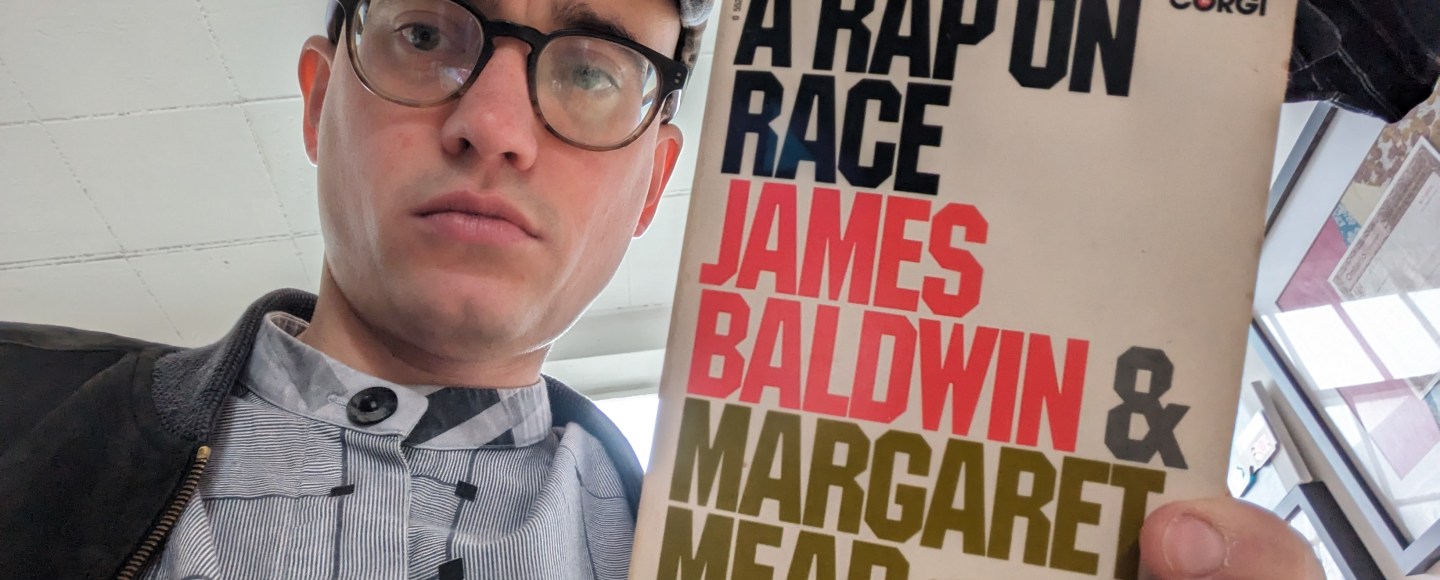

Ok, hands up: I don’t know who Margaret Mead is, other than the fact that she’s an anthropologist. I came to A Rap On Race purely for the Baldwin.
The Baldwin.
The Baldwin.
–///–
I’m James Baldwin and I like to rhyme, / Let me tell you all about The Fire Next Time
–///–
Don’t be misled by the title – this is not a rap.
In fact, the word “rap” meaning something other than what the word “rap” ordinarily means to the 21st century reader (i.e. hip-hop lyrics (like you’d find in e.g. my 2021 book hip-hop-o-crit)) doesn’t feature in this book at all, which surprised me.
It is presumed that anyone picking up this volume knows what a “rap” is. It is not something that can be learned by context clues from the text contained within…
We are using rap to mean something other than a rap, but it isn’t clear to me exactly what that is…
Because this is a transcript of a conversation. Did “a rap” used to mean a chat? When? For how long? When did it stop meaning this? Did it – did it – ever??
This is a transcript of three conversations that took place over the course of somewhere between 24 and 48 hours in NYC one Summer forty-five(ish) years ago, though each one followed on in topic and theme so it’s really only one chat. One rap.
The conversation[s] were between Margaret Mead (a white anthropologist who had spent significant time working and living in “New Guinea”, among other places) and James Baldwin, the world-famous novelist, essayist, activist and celebrity.
No one else interjects or comments – though there are technicians in the room overseeing the recording and presumably other people, too – and no mention is made at the end of each section as to why they’re pausing (“Sorry, Jimmy, I’ve got to get to dinner” etc), though there is usually a comment or two about what they’ve each been thinking about/doing in the gaps between the chats.
And that’s it.
Just two people, two thinkers and writers, chatting about race and American and global geopolitics in the mid-1970s…
They discuss theories and communism, the Cold War and hot wars, literacy and education, travel and responsibilities, history, contemporary situations and the repetitive and unchanging risks of centralisation[s] of human power…
Mead is very academicised, while Baldwin is – of course – much an autodidact…
Mead is very reasoned to the point of being near-repetitive (almost politician-like in an unwillingness to step away from her pre-agreed line), while Baldwin has a tendency towards slight contractions or ideological revisions based on what seems to be the most emotionally effective/poetic thing to say at a particular time, something which Mead becomes increasingly frustrated with (and less tolerant of) over the course of the book… And absolutely something that I would (and do) do, too. It’s very relatable.
This is, too, completely consistent with Baldwin generally: he is not someone who is, ultimately or ever, tied up by trying to argue something just because he has previously stated it.
Any opinion – and sometimes even any fact – he presents is not necessarily something he will reassert moments later when asked to do so…
It’s good, it’s human… It feels more honest, more spontaneous, less rehearsed, freer, looser…. It’s also more entertaining.
Baldwin sometimes agrees with Mead and then argues the opposite point, or persuades Mead to concede something to him then begins to argue in opposition once she does so…
It’s perhaps more obvious in stark print than maybe it would be in an interview or televised discussion situation, but it’s very clear here than the oratorical techniques/vibes/intentions of the two people are starkly different: Baldwin sees this as a place to share and play with ideas… Mead seems to see this as an opportunity to share information… To question and reaffirm, rather than to invite further thought…
Baldwin, then, is seeing this as something that should be entertaining and interesting more than it should be consistent… Mead not so much…
This isn’t an interview as there isn’t one person leading the other, and not quite a debate as both Mead and Baldwin are broadly – though not entirely – in agreement with most of the topics they discuss (they are certainly aligned in terms of preferred outcomes (i.e. a reduction in prejudice, violence, racism, inequality etc), if not necessarily in the ways in which these could be achieved or – the main thing they disagree on – the ways in which individuals bear responsibility for the heinous historic acts of their forebears)…
It’s an interesting and an engaging text.
This is conversation pit era liberal America…
This is a discussion. This is a chat.
Maybe this is what a “rap” was, in the mid-1970s…
This is – and there’s no better comparison I can think of – an analogue, pre-iPod, book-form podcast.
This is a discursive, digressive, chatty text-based podcast.
If this sounds like something you’d like – especially if you’ve listened to enough recordings of James Baldwin to be able to replicate his speech patterns in your head (as I have and thus can) – then I highly recommend it.
Sadly, though, this book is out of print, so if you do want it, you will either have to pay a high price or – like I did – find a secondhand bookshop that’s so badly run that they don’t check the value of their stock and sell it to you for a cheap cheap price.
I can see a very easy case for republishing this, tbh, especially in a version with some annotations explaining the more recent (and less long-term important) political and sociocultural events that they reference in their chat.
Something stark, though, is that perhaps this was a time when a single act of American gun violence was notorious for longer than it is now, when it remains a regular and inevitable thing.
I dunno.
I think there was hope in the 1970s. But there was also resignation. That latter is something we still have now…
Trapped by apathy… So many of us are trapped by apathy
I am trapped by apathy.
If you are not, tell me how to escape its pull.

Thank you so much for reading TriumphoftheNow.com! If you like what you’ve read, please subscribe, share and order one of my books. If you love what you’ve read, why not order me something frivolous and noisy from this Amazon wishlist or make a quick donation via my ko-fi page?
I’m currently focusing on parenting and creative practice, so small donations are appreciated now more than ever!
scott manley hadley aka SOLID BALD live
Here’s a video of me recently performing at the prestigious (it has a Wikipedia page) comedy night, Quantum Leopard. Listen to how much fun the crowd is having. You could have that much fun, too!
Forthcoming gigs include the following – there may/will be others:
6th May 2026, 8.15pm: Prop Roulette at the Caroline of Brunswick for the Brighton Fringe
7th June 2026, 1.30pm: Competition at Hastings Comedy Festival
27th June 2026: Twinkles Cabaret, London
14th July 2026: Poole, Dorset
22nd & 23rd August, 6.30pm: BALD PERSONALITY DISORDER at Aces & Eights, part of the Camden Fringe
5th November: Isle of Wight
14th November: Welwyn
Discover more from Triumph Of The Now
Subscribe to get the latest posts sent to your email.

 Triumph Of The Now
You wrote a book! How interesting.
I’m in the process of writing a novel called SILVER ICE, which I’ll be selling over the internet and, hopefully, in a store I rent in the city of Vancouver. I have $20000 saved up, but I’m not sure this is enough money to tide me over, commercially. My father is sitting on a $400000 nest egg saved up from his years of engineering work, and sometimes I muse about my inheritance if he were to pass away. Money is an evil thing … it gets us thinking twisted thoughts.
— Warm regards,
Xloveli
LikeLike
Find it here
LikeLiked by 1 person