
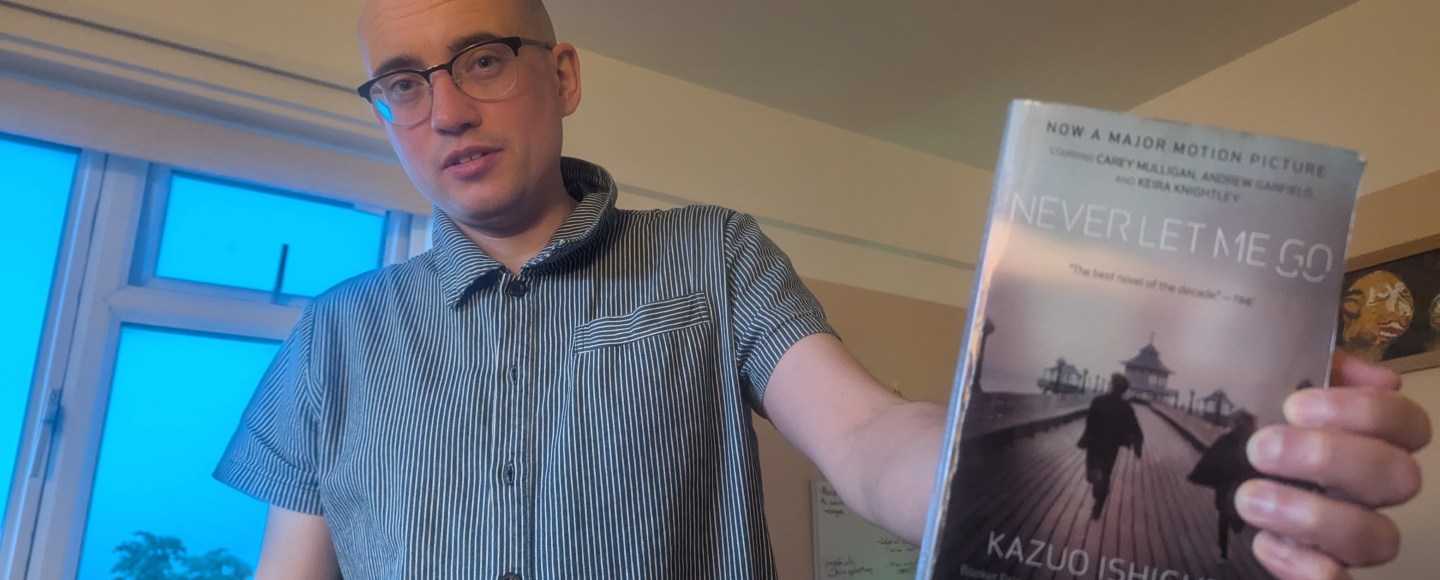

It’s my bi-monthly time to read a mainstream literary fiction book, which always tends to go one of two ways: either I read it and think “wow, I see why the tote bag and tea crowd love this crap (mainstream literary fiction) so much!” or I think the opposite, in that I understand why only the tote bag and tea crowd love that crap…
For this one, the 2005 famous book Never Let Me Go, it was the former, as in it’s very good and demonstrates why and how mainstream literature can be considered (a technical term) not shit.
Never Let Me Go was made into a reasonably acclaimed film written by Alex Garland (Civil War, other more acclaimed films) and starring notable performers like acclaimed actor Carrie Mulligan who I believe is an Oscar winner (I just checked and she isn’t but she has been nominated multiple times so I was close), popular movie guy Andrew Garfield (infamous for repeatedly flirting with that very bad vibes chicken shop dates woman) and the wine columnist Karen Knightley.
The premise, for those of you who don’t know, is that in a parallel contemporary England, human cloning has become widespread and normalised purely for the purposes of organ harvesting.
The novel takes the form of memorialising from the last surviving member of a group of three close clones and friends, as she prepares to begin her series of organ harvesting.
Most of the book takes place in their idyllic elite-seeming school known as Hailsham, which they are all incredibly proud and excited to have attended. Life after school for these clones (and the clones who didn’t go to schools as fancy as theirs) is essentially just donating organs or – the only other option – looking after their clone peers before and while they donate their organs.
Although the fate of these characters is pretty much sealed from the start, and the narrator reveals that the two friends she is mainly talking about (Ruth and Tommy) have both already died in her present as a result of their series of “donations” (as they call each operation), there is of course a glimmer of hope that she may somehow escape this, though it is very apparent for a reader that feeling this sense of hope is opening oneself up to pain.
Of course, there is no escape.
As times and politics change in the England of this novel, the boarding school style rearing of organ carriers – who are deemed by most of the population to be nothing but factories creating medical goods – become less and less tenable… The protagonists’ memories of their time at school seem to be the closest that English clones will have ever had to a type of freedom, and by the end of the novel it is implied that there will be no respite from medicine relying on the cloned and forced donated bodies of people, it will instead treat those bodies worse, more like factory farms more like factory farms more like factory farms…
(there’s also a nasty bit where the clones wonder if their bodies are kept alive and some kind of consciousness persists once their major organs have gone but while there are still things to be taken…)
–///–
Is Never Let Me Go an allegory?
Is it a bleak “What if?”?
Is it a thought experiment brought to life by exquisite, neat, Nobel-prize-winning prose?
Is it an extended metaphor for how the bodies and labours of the poor are nothing but fuel and material for the needs and desires of the rich?
Maybe? Probably? Yes?
It’s all of these things, but it’s also a bluntly and emotively humane novel about people trying and failing to rail against the status quo. Though the characters think about and talk about possibly finding ways to defer the scheduled timetabling of organ donations, they never try very hard and they never actively try to escape or get away from the spaces in which they are held…
There is, perhaps, threat preventing escape implied, but it is never seen, and it doesn’t need to be seen, much like the literal threats of violence that most of us very rarely experience – or even witness first or second hand – keep us living in our unsatisfying lanes…
Perhaps it’s just being forced to be in more conservative spaces (and by conservative I mean mainstream, I mean “normal” spaces) in my free time – which are essentially the kind of spaces I’m normally only paid to be in – but the policing of people (and especially female maternal bodies) is something I’ve been hyper aware of since my baby was born, with constant (not “literally” constant but regular and very visceral) comments made both to me and to my partner about restrictive expectations as to her body and her life now that she has given birth to a child occuring all the time. These restrictive expectations for her are bluntly contrasted with absolutely no implications of constraints put upon my horrible masculinised body (which I take no pleasure in being the possessor of).
It isn’t violence alone that causes people to restrict their lives, but it is microaggressions, microthreats… This is aggression that I have seen, this sneering and criticising a person who isn’t known… Just the world’s full of dickheads, basically, innit, y’know…
–///–
I think that’s probably the saddest thing about Never Let Me Go…
It is the fact that, though we don’t have communities of clones being kept alive just so we can harvest their organs here in England, we basically do have that level of cruelty, that level of selfishness, and it is merely lack of scientific discovery that keeps this from happening.
Dehumanisation is rife, the Conservative Party and their slightly more right-wing rival Reform littered their manifestos with language of dehumanisation, which as we all know, precedes genocides, and the Labour Party was hardly any better…
Just a week or so into power, the Labour Party has already made calls that are explicitly punitive and dangerous for trans people and made many statements with regard to privatisation of the health service that very much risks the movement towards a situation where positive health outcomes are explicitly and bluntly tied exclusively to bank balance.
Never Let Me Go didn’t leave me weeping because it felt so outlandish and sad and difficult to imagine… humans demonised and treated like this… It left me weeping and hollowed out because it all felt so – if not literally, but politically – possible.
A powerful, engaging and serious novel, about naive people often in denial of deep cruelties that they are the victims of. Much like any text coming out of England at the moment…
What future is coming here? It’s hard to believe in a good one…
(my baby is doing fine btw and I obviously don’t have no hope for its personal future otherwise I wouldn’t have had unprotected sex with an ovulating woman, I’m not a fool 🙏🙏🙏, thanks for wondering)
MY GLASGOW INTERNATIONAL COMEDY FESTIVAL WIP SHOW IS ON 12TH MARCH! TICKET LINK HERE!

Thank you so much for reading TriumphoftheNow.com! If you like what you’ve read, please subscribe, share and order one of my books. If you love what you’ve read, why not order me something frivolous and noisy from this Amazon wishlist or make a quick donation via my ko-fi page?
I’m currently focusing on parenting and creative practice, so small donations are appreciated now more than ever!
scott manley hadley aka SOLID BALD live
Here’s a video of me recently performing at the prestigious (it has a Wikipedia page) comedy night, Quantum Leopard. Listen to how much fun the crowd is having. You could have that much fun, too!
Forthcoming gigs include the following – there may/will be others:
12th March 2026: BALD PERSONALITY DISORDER 30 MIN WIP at Glasgow International Comedy Festival
26th March 2026, 7.30pm: Comedy @ Cosmic, Plymouth
Various Dates and Times, May 2026: BALD PERSONALITY DISORDER FULL LENGTH WIP at the BRIGHTON FRINGE
27th June 2026: Twinkles Cabaret, London
Discover more from Triumph Of The Now
Subscribe to get the latest posts sent to your email.

 Triumph Of The Now
0 comments on “Never Let Me Go by Kazuo Ishiguro”