
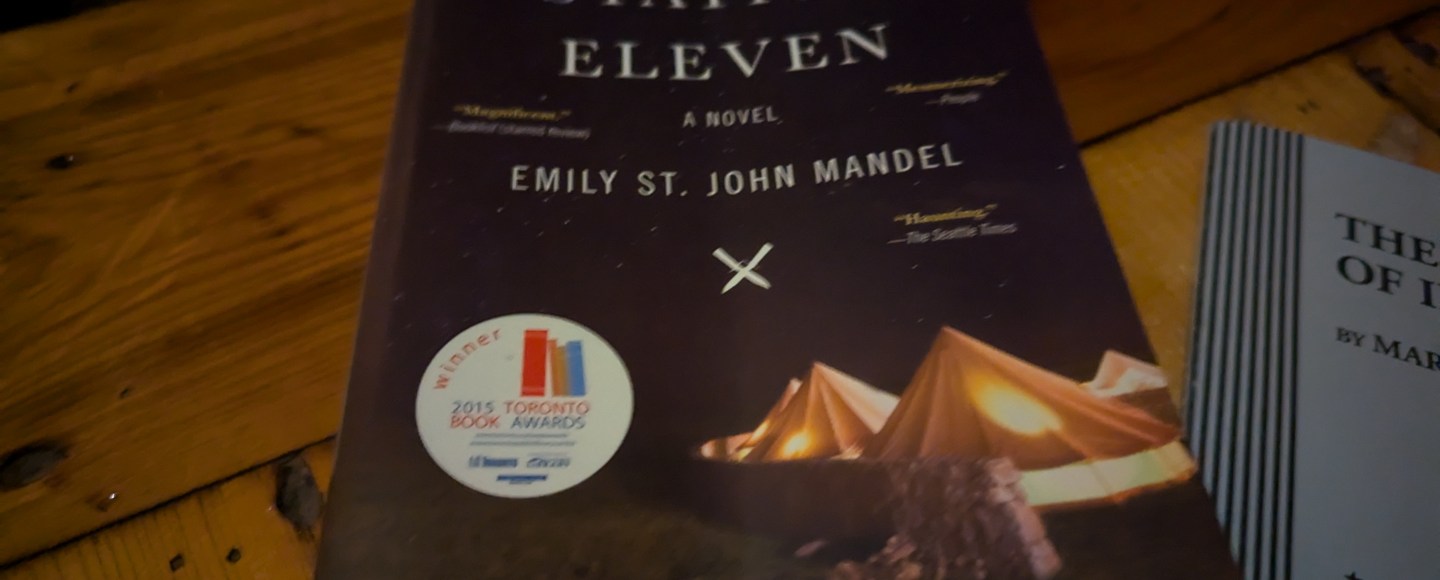

An excellent, complicated (well, not really complicated but y’know what I mean … complex) [seeming] novel from the writer of Sea Of Tranquillity that has big ambitions and manages to hit all of its promised emotional and narrative beats. It’s an absolute success.
A masterful novel, then, that is actually far more engaging and interesting than the wince-inducing secondhand elevator pitch I’d previously received (“a troupe of actors and musicians travel post-apocalyptic North America performing Shakespeare” 🤮) would have you expect…
That is there, yes, but it’s not just that, and the bit that is that is done in such a way that it feels satisfying, acceptable and meaningful thanks to both authorial AND character puncturing of a reader’s (especially mine) potential allegations of pomposity…
This is a novel that does – articulately, delicately and seriously – interrogate what it is that makes us human and what we should – and could – maintain if the vast majority of us were to die (i.e. so many dead that nothing could persist as it was)…
–///–
I’d say the only real negative of Station Eleven is that it makes Sea Of Tranquillity feel like a much less interesting novel than it did when I read it, as that later novel by this writer (Emily St John Mandel) is essentially doing the same thing as this one (i.e. a fast-paced novel with multiple interlocking narratives set in different times and locations, some in a far future, some in a dark version of the present, some (the most naturalistic sections) in the recent(ish) past), but in a way that’s not quite as interesting or daring as here. Because this one is excellent, interesting and – I’ll argue by saying it but I won’t go further – daring.
–///–
Station Eleven is a novel that bounces between multiple timelines and moments in people’s lives, centring on the incredibly rapid total collapse of 21st century society due to a pandemic known as Georgian Flu which occurs due to an airborne pathogen with an incredibly short incubation period and an incredibly high mortality rate. Within weeks, an estimated 99% of the world’s population has died. Everything collapses around the corpses…
On the night the pathogen arrives into North America – when/where the novel starts – a highly acclaimed (though past his prime) Hollywood (and gossip-mag) star is performing as King Lear in a Toronto Theatre, when he has a fatal heart attack on stage.
A young – no, not young – a sort of approaching middle-aged former paparazzo and journalist who’s now training as a paramedic jumps on stage to perform emergency CPR, to no avail.
Sad about failing to save a life but invigorated by his instinct to try his hardest to do so, the trainee paramedic is meandering through late night snowy Toronto when a doctor friend of his calls with a very serious warning and a plea to fucking get out of the city, now, a pandemic is here and it’s unstoppable…
Rather than fleeing the city, though, the trainee paramedic instead ducks into a late night convenience store, fills the rack of trolleys (“carts”) with loads of water, canned food and toilet roll and instead gets all this stuff (via a goods lift) into his wheelchair-bound brother’s condo round the corner, and then the world – and the chronological narrative of the novel – begins to splinter.
–///–
Station Eleven reminded me more of Infinite Jest than any other book I’ve ever read (other than Infinite Jest itself, which I haven’t reread, I’m not that bad, I’m not that bad, I haven’t reread Infinite Jest, so there’s still hope for me, maybe?)…
In terms of a novel being so ambitious, large and complicated w/r/t (teehee) structure…
Just like Infinite Jest, Station Eleven bounces back and forth in time…
Sometimes in the middle of chapters we will move from perspectives and timed and locations…
From paragraph to paragraph, we swing between the 1990s in Hollywood, we’re then looking at Toronto in the ’80s, then we are suddenly leapfroged forward 20 years into the post-apocalyptic future as society rebuilds or fails to rebuild (obviously, there’s never a definitive answer on that…)
It is like Infinite Jest in its ambition, it is like Infinite Jest in its scope, in its plethora of characters and the ways in which all of its plot threads – even those that seem to have been completely forgotten or discarded – resolve and always in a satisfying way…
Characters may meet their deaths, sometimes, in moments that feel disappointing and as if too early in the novel, and on a couple of early occasions I found myself thinking “what was the purpose of that chapter, that character, that voice, that story being so central, when it hasn’t come back to be fully explored or looked at in detail?”, however, all of the times this happened there were then later flashbacks (or not even flashbacks, I suppose that’s not really the right word because there isn’t a firm central linearity of that the flashbacks/flashforwards would be diverting from) that rounded that character’s narrative out…
Following the first section, the entire novel is splintered, with characters placed and located around the world (primarily around the Great Lakes, though, which is where the troupe of actors and musicians wander for decades in the future, performing Shakespeare and classical music to small towns and communities in the post-collapse world)…
It is really neatly done, and any narratives that feel incomplete or unsatisfactory when they seem to conclude in the middle or even the late second half of the novel, always reappear – sometimes briefly – yet always enough for there to be a deeply satisfying and cohesive end for all characters, evidencing the known reality that often eludes us in narrative art forms, i.e. that a person’s death is never the most important thing that happens in their life…
–///–
In the future we see actors and musicians having to fight for survival in a sometimes hostile world, but we also see the beginnings of stable trade and agriculture, we see them encounter a newspaper and hear rumours of a museum, though we also see serious peril with the seemingly growing power of a doomsday cult led by a supposedly charismatic leader who has a dog with the same name as the dog in the novel’s own Station Eleven, which is a rare comic book that one of the Shakespearean actors carries. This character is arguably the central one (certainly when the cult force her and another member of the troupe to be separated from the main group, we follow on her adventures as she travels onwards to the agreed emergency meeting point), as she was present as a child actor in the wings when the Hollywood star died playing Lear the night the pandemic began…
Everything all pulls together… What happened to the parademic, where did the rare comic book come from, what’s going on with the rumoured museum…
It all clicks into place and it’s so fucking satisfying when it does.
We see a lot of death and a lot of deaths. A lot of fear and danger, but also a lot of joy and pleasure found even within a chaotic, disintegrated world. And that, though (other than the bizarre lack of solar panels and small self-reliant off-grid electrical systems which you see all over this part of the world now and I don’t really believe were non-existent when the novel was published a decade ago but heyho that’s a minor quibble), is… I suppose… the only criticism that I’d have with the text… that (some violence aside!) it does present a rather optimistic view of the future, i.e. one in which all of the best things about humanity (art, thought, music, literature, community, performance, mutual care etc) continue and – again, some violence and cruelty aside – pretty much of the worst elements (e.g. predatory capitalism, inequality, institutionalised exploitation, heavy industry, waste, continued climate destruction etc etc etc) are comfortably left behind in all the massive open graves of the billions who died in the past…
I described Station Eleven as “relentlessly optimistic” to my baby’s other parent and they pointed out that the novel’s future does include forced marriage, sexual assault, violence, torture, untreatable injuries, death due to minor infections etc etc etc so, yes, I’m happy to roll that comment back, but I do think that the post-apocalyptic world St John Mandel evokes here would likely be a better one to live in than the late capitalistic hellhole we’re all fucking trapped within now…
Or maybe not, it’s difficult to say, but I don’t think a longer life expectancy with so much mediocre (or worse) living is really anything to brag about, personally… Society’s achievements are fragile, and of very little merit… In my opinion.
Recommended – especially if you liked Infinite Jest, structurally…

Thank you so much for reading TriumphoftheNow.com! If you like what you’ve read, please subscribe, share and order one of my books. If you love what you’ve read, why not order me something frivolous and noisy from this Amazon wishlist or make a quick donation via my ko-fi page?
I’m currently focusing on parenting and creative practice, so small donations are appreciated now more than ever!
scott manley hadley aka SOLID BALD live
Here’s a video of me recently performing at the prestigious (it has a Wikipedia page) comedy night, Quantum Leopard. Listen to how much fun the crowd is having. You could have that much fun, too!
Forthcoming gigs include the following – there may/will be others:
LATE JUNE/EARLY JULY BREAK DUE TO A BEREAVEMENT
22nd & 23rd August, 6.30pm: BALD PERSONALITY DISORDER at Aces & Eights, part of the Camden Fringe
25th September: Worcester
5th November: Isle of Wight
14th November: Welwyn
Discover more from Triumph Of The Now
Subscribe to get the latest posts sent to your email.

 Triumph Of The Now
Overpopulation is the main driver of most environmental and social issues modern society is struggling with. When in some countries the birthrate sinks, only economists are huffing about shrinking economies or aging population. Growing population, means more consumers, equals to more pollution. At the same time, modern technologies are making more and more jobs redundant, so the slew of jobless people grows. It’s just a question of time before the planet’s ecosystem will hit back.
LikeLiked by 1 person