
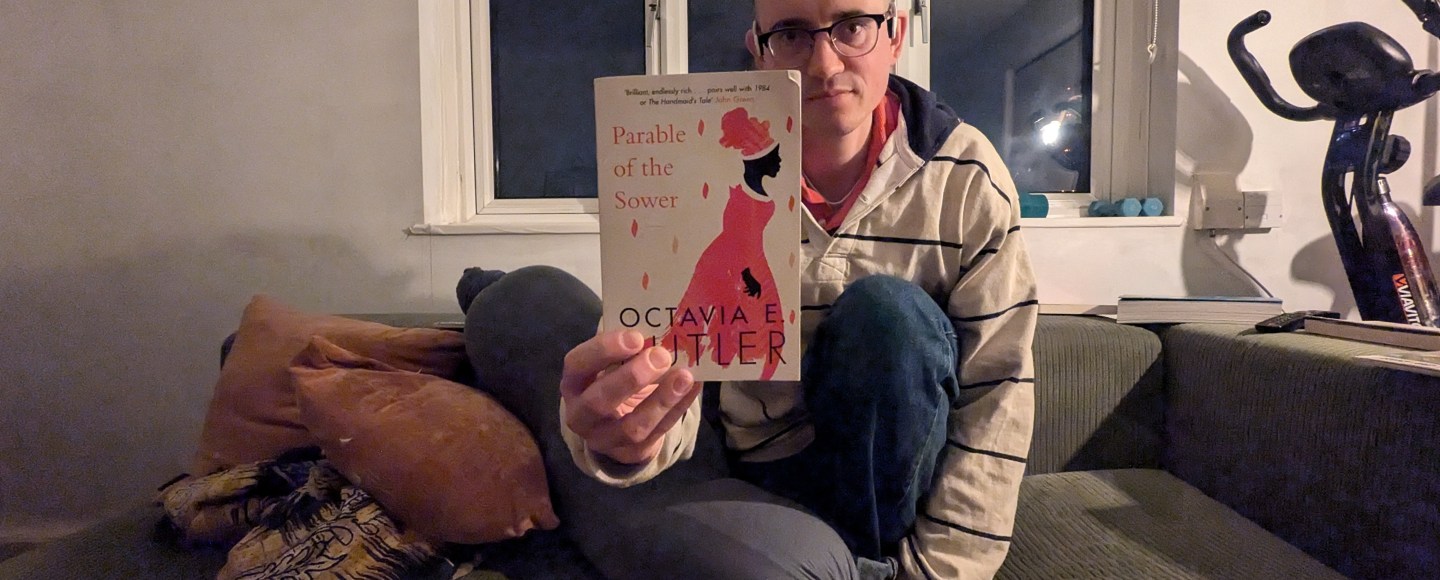

I’ve read a few of Octavia E. Butler’s books, and enjoyed them all a lot. There is an errieness to her created worlds, a lack of safety and a sinister edge that feels far more realistic than many other non-naturalistic stories, with fantasy/SF elements doing nothing to dispell the idea that the imaginings she writes are our world, though a little different, possibly only a little later…
None more so – from what I’ve read of her oeuvre – than here, in her acclaimed and (for a while) perennially zeitgeisty 199(6) novel, Parable of the Sower.
It is a dystopia, yet it is barely different from how we live today… There are people who are afflicted with a form of hyper-empathy that causes them to feel the pain others experience, but this one aspect aside (plus the existence of a popular illicit drug that causes its users to love being proximate to fire so much that constant arson becomes an even bigger problem than the forest fires that flicker and burn more frequently as a result of climate change.
This novel is set in the decade in which we now live, in California, and begins in a small walled community of lower middle class strivers, who share security and other essential utilities in their small neighborhood, as – outside – the United States of America continues to fracture and fall apart as droughts cause agricultural destruction, and the deliberately set and spontaneous fires ravage what exists further. The government has withdrawn to provide nothing other than police services (which also have to be paid for at point of use and are functionally useless at protecting and serving anyone) and over-stretched fire brigades, who also charge.
Businesses and industries have shut down, oil and gas has run out, the cost of food and water has skyrocketed and “company towns” are slowly reappearing all over America, offering a facsimile of safety from behind a private army, with scrips instead of cash and a quick easy route to formal bankruptcy and life indenture to the company store.
Backwards steps, backwards steps, with no meaningful hope.
The bleak, terrifying, thing about this novel from 30 years ago is how clearly it paints an image of a world, an America, that many people – who are right now in positions of significant power – want to exist. Butler depicts a clear idea of the “neo-feudalism” that you’ve probably read a bit about (if you’ve been paying attention recently), and there’s nothing about it that feels very far away from not only possibility, but likelihood, too.
Those who are afflicted with the hyper-empathy are most in demand for the slavery (by another name) type employment, as they are much easier to control – only one must be injured to hurt many. As a metaphor for the way in which late capitalism (and the shift into blunt oligarchism we’re experiencing now) rewards those who deny the humanity of others and treats those who feel empathy and sympathy are the lowest of the low. This is certainly the America and the Americans who have control of their government at the moment. It’s a fucking bleak time.
Within the novel, of course, there is a character who is hopeful, who unites with other people who are hopeful and finds ways to create strength through community with people who may otherwise be dismissed as weak, once she has left her walled neighbourhood and begun travelling to the less-fucked up, northern states of America and, possibly, even as far as the Canadian border.
There’s an exciting, and thrilling, and bleakly unputdownable touch to this novel – I stayed up later than I meant to reading it two nights in a row, and if I didn’t have an infant child I would have probably stayed up until I finished it that first night (I did on the second). It’s powerful, evocative, characterful and also narratively compelling writing. Butler’s world here – which is too, too, familiar, really – is dramatised over the course of a few years of continued collapse, and nothing here feels far away.
Cannibalism, when it comes, feels inevitable, and as the novel progresses, it becomes clear that the biggest threat to the individuals we, the reader, cares for are not the arson-drug addled desperate and impoverished willing to kill for water, but the growing institutions that promise safety in exchange for all meaningful freedom.
Institutionalised violence is far scarier than individualised. Everything is worse at scale.
A serious, important, harrowing, yet also breezily readable novel.
Highly recommended, though there are many people probably close to living through it, so if you wait long enough you might get the experience without having to shell out for a secondhand paperback.
Absolutely worth a read.

Thank you so much for reading TriumphoftheNow.com! If you like what you’ve read, please subscribe, share and order one of my books. If you love what you’ve read, why not order me something frivolous and noisy from this Amazon wishlist or make a quick donation via my ko-fi page?
I’m currently focusing on parenting and creative practice, so small donations are appreciated now more than ever!
scott manley hadley aka SOLID BALD live
Here’s a video of me recently performing at the prestigious (it has a Wikipedia page) comedy night, Quantum Leopard. Listen to how much fun the crowd is having. You could have that much fun, too!
Forthcoming gigs include the following – there may/will be others:
6th May 2026, 8.15pm: Prop Roulette at the Caroline of Brunswick for the Brighton Fringe
27th June 2026: Twinkles Cabaret, London
14th July 2026: Poole, Dorset
5th November: Isle of Wight
14th November: Welwyn
Discover more from Triumph Of The Now
Subscribe to get the latest posts sent to your email.

 Triumph Of The Now
will you read Parable of the Talents next?
LikeLiked by 1 person
I’ll definitely read it soon, absolutely!
LikeLike
I’m excited to read your thoughts!
LikeLiked by 1 person