

cw: discussion of child sexual abuse
Order Vantage Points direct from Arsenal Pulp Press via this link
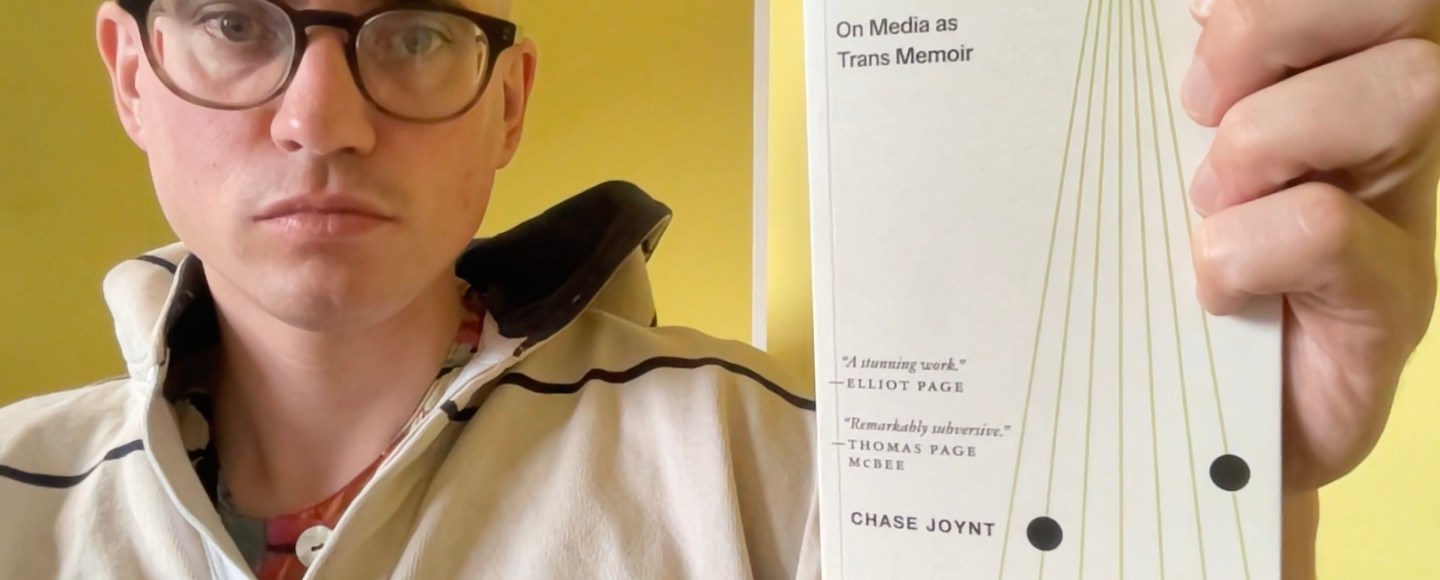
Something you have to understand about this blog – you have to, I mean it, you really have to – is that the posts don’t always pop up in the order of the books that I’ve read. And I often read a handful of books then have one afternoon or evening during which I write a selection of these screeds. So, what that means is that my decision to read this book – Vantage Points: On Media as Trans Memoir by Chase Joynt – came as a direct result of the comment I wrote at the end of my post about the spectacular Notes Made While Falling by Jenn Ashworth, despite having read that book almost a month earlier.
The comment I made there was that I need to stop reading mediocre books. And, alas, I have read a mediocre book between these books, but it wasn’t until a later point that I decided to try and eschew mediocrity. (At least for a bit, though who knows how long that will last?)
That was why I picked this up, feeling (pretty strongly) that this would be the kind of book that I’d enjoy. And figuring that even if this book wasn’t good, it would be bad in an interesting way, which – to me – is definitely better than being mediocre.
Vantage Points: On Media as Trans Memoir is a hybrid piece of media theory (or, perhaps, response to media theory – I would have to ask someone who knows more than I do if this ultimately counts as original work or mere collation/contrasting of ideas) and memoir, crafted as mixed media (within the confines of a paperback) collage – photography, graphic, letters, certifications, historic documents, quotation, and – of course – what (at least a few years ago) would have been called Creative Non-Fiction.
The book wrestles with several very hefty themes, and it is the choice to eschew any clear conclusions or epiphanies that marks it as serious and mature, yet also somewhat dissatisfying for a person with no ideas of their own like me, who yearns for the books I read (selected on purpose) to tell me what to think.
Central to the memoir elements of the text is a recounting of child sexual abuse perpetuated on Chase Joynt by his adopted uncle, referred to throughout the text as X. X was never arrested or, societally, punished for these actions, and Joynt doesn’t know to what extent these assaults – which persisted over an undisclosed period, far from an un-premeditated one-off – happened to other people, or just to him. He never reported X, and the only interaction the two have had for decades is – according to the text at least – Joynt telling an unrepentent X to never contact him again and to, if X must talk to someone else in the family, go and confess what he did to Joynt to X’s brother (Joynt’s frequently absent father), which X does. The consequences of this confession on family dynamics is never discussed, as too is the level of knowledge that Joynt’s parents had about X’s abuse by the time of his confession. (But this doesn’t matter. This isn’t what the book is about.)
This lack of consequence, though, is a key thematic and meaningful part of the text, as Joynt has – in the decades since his childhood in Ontario – not only moved to the United States and established a successful career in the Arts, but has also transitioned.
And this book is part of a reckoning with the worries/fears Joynt has about what it means, ethically, to become a man in the modern world, ruled as it still it, by corrupt patriarchy.
The world feels far more of an Old Boys’ Club now than it did twenty years ago… Though, let’s be honest, how much was that sense of progress a mere gloss on the world as it existed, rather than anything more meaningfully true? Did dickheads always run the world, but just pretend they didn’t for a couple of decades? Or did we genuinely move towards a better, more equitable, society and then step back from it? Is it even possible to have a significantly and markedly and sustainably different, better, world, without the total eradication of capitalism and capitalistic economic models and social structures? If there is a stock market, will it always demand constant growth? If there is extraction, will there always be a heavy demand, an economic incentive, to increase production/extraction to the point of systemic ecological collapse? Can we build a better world while still living in this world that has resisted calls to meaningfully improve for as long as the masses have been vocal and able to organise? They let us have the internet for a bit as a site of collation and community, but that has been stripped of meaning and access and cohesion and, tbh, it doesn’t feel like any of that is coming back. (To me.)
Sorry, big digression.
The world feels like an Old Boys’ Club.
Senior politicians across the globe are known as (and convicted for) crimes against female bodies. Indiscretions become misdemeanours become cruelties become abuse and it does all become and occur in a systemic way. Being a powerful white man is about eschewing the need for consequence. You don’t have to clean up your messes and, often, you don’t even have to remember they happened.
Joynt wonders how X feels. He doesn’t ask, but instead becomes a written correspondent with a former priest and child sexual abuser, hoping to find answers about the weight of these heinous acts. But, of course, someone who traffics with faith and religion – even in a corrupt enough manner to permit assaults against children within their own personal behavioural code – is a person whose contemplation of consequence and life itself is meaningfully different from the average person’s, as too is someone who has faced societal awareness, punishment and castigation for their actions (maybe the criminal convictions make more of a difference than the professed faith for a person like this?).
X continued to live his life – his small, smalltown life, sure – but/and, as Joynt makes clear, X’s life wouldn’t have been any materially better or any worse had he not groomed and abused a family member, and the isolation and meaninglessness of the man’s existence is no excuse for his actions, but merely signs of the ways in which this society trains men, masculine men, to behave and to think.
Selfishness, pursuit of pleasure and power and control.
These are what it means to be a man, in the world as it exists.
And Joynt writes beautifully, potently (and, as I mentioned, without any kind of fawning or mock-knowing conclusion) about this worry – is becoming a man stepping into this legacy? Must masculinity always be this toxic? Must testosterone always result in cruelties and violences and exploitations?
Masculinity as the medium, the masculine body and/or aesthetic, as the medium that shares theses aesthetics and ideologies. Or it doesn’t.
The work looks at and around the writing of Marshall McLuhan (who may – or may not, again, there is no conclusion – have been a distant relative of Joynt’s), mentioning his own bigotries and prejudices that ended up in his theories and philosophies, but also exploring the legacies and meanings of that body of work. Joynt looks too at other similar explorative and self-definitive texts, including some Canadian history books written by people he (definitely) was related to.
This is a book full of riffs and digressions, but it’s beaitifully presented with its contrasting images and texts, the blunt black and white print choice causing nothing visually to be lost that may have been found in colour. This is a book that delves into deep topics for mere pages at a time, though has something interesting to say with every mentioned theme. One definite positive about its brevity is that nothing ever outstays its welcome. There’s probably under 20,000 words in here, and Joynt successfully avoids the most infamous trap of non-fiction writing, particularly writing that edges on the academic (as this does), and it never, ever, feels like he’s chasing a word count, or writing for the sake of writing.
There’s no waste here, there are empty pages or pages with visuals upon them where a somehow less brave yet also less self-censoring writer would merely have spurged another, unneeded, 500 words.
This is a tight, controlled book, and whether the ideas and the topics feel totally concluded or not, it all feels intentional: Joynt feels absolutely in control of this book, and it’s a real joy to read.
I actually wrote a lot more about this, reflecting on my own relationship with a masculine body and societal expectations of masculinity, but I’ve pulled it out of this blog and added it to the ever-increasing pile of writing for the serious bits of my forthcoming live show, Bald Personality Disorder (WIP performance on 13th October in Waterloo, London), so it’s not here any more.
For more me on gender, book tickets to that show. For more excellent CNF on media theory, histories of abuse, trans lives and thought, definitely look up Vantage Points:
Order Vantage Points direct from Arsenal Pulp Press via this link

Thank you so much for reading TriumphoftheNow.com! If you like what you’ve read, please subscribe, share and order one of my books. If you love what you’ve read, why not order me something frivolous and noisy from this Amazon wishlist or make a quick donation via my ko-fi page?
I’m currently focusing on parenting and creative practice, so small donations are appreciated now more than ever!
scott manley hadley aka SOLID BALD live
Here’s a video of me recently performing at the prestigious (it has a Wikipedia page) comedy night, Quantum Leopard. Listen to how much fun the crowd is having. You could have that much fun, too!
Forthcoming gigs include the following – there may/will be others:
9th April 2026, 7pm: Sunset Comedy, Chalk Farm
27th June 2026: Twinkles Cabaret, London
Discover more from Triumph Of The Now
Subscribe to get the latest posts sent to your email.

 Triumph Of The Now
0 comments on “Vantage Points: On Media as Trans Memoir by Chase Joynt”