
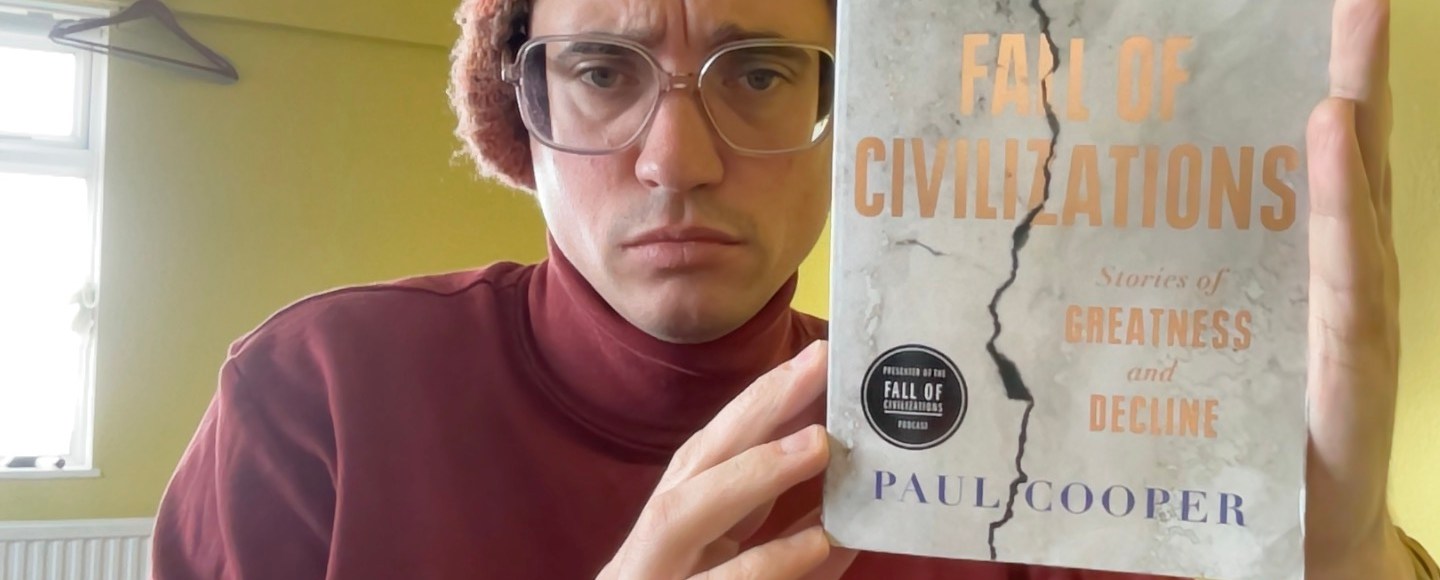

Fall of Civilizations: Stories of Greatness and Decline is published by Duckworth
This book has taken me several weeks to read (I’m busy livin’1, friends), but I’ve had a great time doing so.
For those of you who are familiar with the title (Fall of Civilizations: Stories of Greatness and Decline) and author of this book (Paul Cooper) from the podcast that spawned it, then you’ll know exactly what to expect from this.
That podcast, which ran for a few years earlier in the decade (maybe it’s technically still going but on an “indefinite hiatus”, or maybe with a book deal, Cooper drew the project to a close?) consists of (sometimes several-hours long) audio episodes in which the historian and novelist host describes the rise and fall of a different historic civilisation (or city, or state, etc.).
In the podcast, Cooper uses actors to read historical texts and, where possible, musicians to play instruments and/or melodies from the times and places he discusses, ultimately constructing a varied and complex auditory tableau /collage that is far more engaging and complex than a podcast just consisting of a [white] man narrating a historical narrative with no auditory flourishes or embellishments.
They’re not lectures, basically.
They’re more than that.
I [have] listened to them all and, like many people, enjoyed them a lot.
Of course, I was keen to read the book. Especially when a close personal friend of mine (not a euphemism for a lover) told me that he was part of the editing team. Thankfully, I enjoyed it.2
Fall of Civilizations [sic], the physical book, contains chapters that each tell a different tale, arranged here (in contrast to the podcast) in a broadly chronological order (though there is, of course, overlap, because the world is a big place (and, perhaps, used to be bigger…)).
Perhaps the vast majority of this text is the writing Cooper did for the audio scripts of his podcasts, minus the performative flourishes, or perhaps it’s a rewrite of the same material, and although re-listening to the audio while reading through the book would answer that question very quickly, there’s nothing within this book to indicate which is the case and I don’t think it really matters.
It’s not a problem.
I think that regurgitation is what I – and probably most of this book’s readers – expected and would be happy with.
It’s the podcast written down, essentially.
This is a book that is very unlikely to appeal, or ingratiate itself with, anyone who failed to enjoy the previous iteration of this project. AND THAT IS FINE.
–///–
The stories and narratives of civilisational collapse included here have similarities, yes, but they also have stark differences. During the podcast’s run, there were often many months between episodes, and each episode drop was an exciting and engaging experience. With a book (or to someone listening to the podcast now), there isn’t this forced pacing. And perhaps these are stories that work best when engaged with when you have little pauses in between.
Alas, some civilisational collapses are more interesting or complex than others, but the varying lengths of the episodes (and the chapters included here) tend to reflect a different factor to excitement: how much of a written record has survived from that society or (in the case of the latest ones) the societies that destroyed them.
As a writer, primarily, Cooper is someone whose research for these shows is mostly from the page. He’s not an archeologist, and though these things are definitively heavily researched (the bibliography takes up more pages than most chapters in the book and is printed in a very small font), that research is predominantly secondary, looking at the texts of historians who have come before. Cooper isn’t a linguist or a translator, so even when he is writing about societies with a deep written record, he’s still approaching those through a barrier: even the primary sources have a distancing…
But no one can truly be an expert storyteller as well as an expert in 14 completely different historical societies!
Cooper has produced a book here that looks in reasonable depth at a huge variety of places and organisations, and he describes not only how (and (to varying degrees of certainty) why) these civilisations collapsed, but also how they rose, how they existed at their peak and how – as much as possible – ordinary lives there felt.
Cooper aims to tell us what people ate, what people wore, how people had fun, how people farmed, who people traded with, what they traded, what people did for a living, and what people believed. He tells us the stories these societies told about themselves, as much as possible.
Fall of Civilizations [sic] functions, then, as a treasure trove of stories within stories.
There are foundation myths and historical epics within these tales, there are legends and rumours and tales of kings and paupers and victims and villains. There are tales of battles, tales of elephants, tales of infrastructure, tales of agriculture. There is detail, detail, detail, all wrapped up in neat, well formed chapters.
Most of these civilisations, concludes Cooper, ended due to a couple of recurring factors, usually exacerbated and/or finished off by invasion from the neighbours: a) unexpected climatic change causing a loss of stable food and/or water; and b) the rich-poor divide expanding so much that society ceased to function with wealth-hoarding sapping the life out of those who aren’t able to hoard…
Cooper doubles down on these with a book-conclusion here, imagining an abandoned London.
I think this is almost certainly in response to the unwelcome right-wing approval Cooper’s podcast gained, with Elon Musk at one point tweeting praise for the show. An opinion (and a person) who Cooper was very quick to distance himself from! (Thankfully, as I wouldn’t be quick to enjoy the work of someone who revelled in that kind of approval…)
It is, truly, an interesting read, with some of the most bleakly human stories ever told contained within these pages.
Here we have a catalogue of the highs we have been able to achieve as a species, and the lows that we seem to inevitably fall back into with a stark regularity.
It reminds us that everything we have will one day be dust and ruins, and Cooper even suggests that our current reliance on digitised media means that for future archeologists, a knowledge of our late capitalistic society might be as hard to pull together as some of the other civilisations who left little to no words behind.
These are tragic tales, but they’re also hopeful ones. They draw attention to the spinning of the wheel, the machinations of fate and the way that everything, eventually, must fall. And that’s the good, yes, but also the bad.
I enjoyed it. Now to read some shorter books for a bit!
More details on the publisher’s website here
- Working on Bald Personality Disorder, working and parenting, mainly. ↩︎
- Especially the editing, David, if you’re reading. ↩︎

Thank you so much for reading TriumphoftheNow.com! If you like what you’ve read, please subscribe, share and order one of my books. If you love what you’ve read, why not order me something frivolous and noisy from this Amazon wishlist or make a quick donation via my ko-fi page?
I’m currently focusing on parenting and creative practice, so small donations are appreciated now more than ever!
scott manley hadley aka SOLID BALD live
Here’s a video of me recently performing at the prestigious (it has a Wikipedia page) comedy night, Quantum Leopard. Listen to how much fun the crowd is having. You could have that much fun, too!
Forthcoming gigs include the following – there may/will be others:
LATE JUNE/EARLY JULY BREAK DUE TO A BEREAVEMENT
19th July: BALD PERSONALITY DISORDER at Pump House, Watford, part of the Watford Fringe
22nd & 23rd August, 6.30pm: BALD PERSONALITY DISORDER at Aces & Eights, part of the Camden Fringe
25th September: Worcester
5th November: Isle of Wight
14th November: Welwyn
Discover more from Triumph Of The Now
Subscribe to get the latest posts sent to your email.

 Triumph Of The Now
Infighting, regularitis, and a declining innovation capacity are clear signs that an empire is about to collapse.
LikeLiked by 1 person