
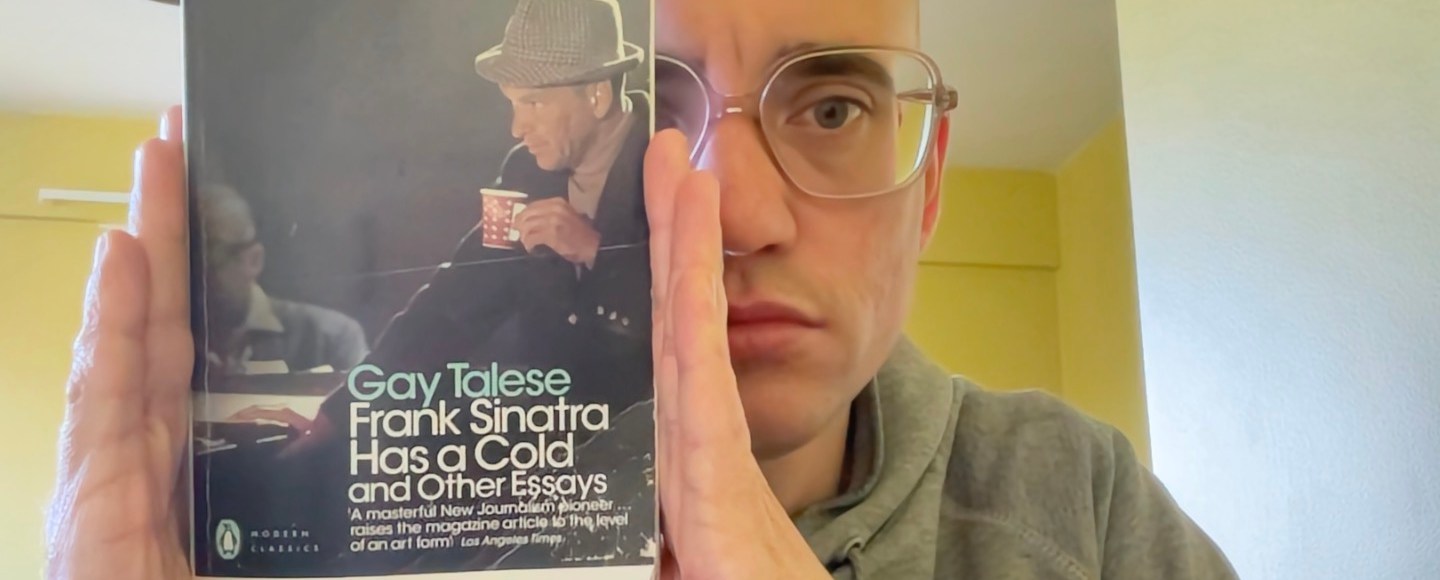

I have to be blunt and honest and tell you that I had never heard of Gay Talese, not until I saw this pleasingly titled and pleasingly decorated recent(ish) Penguin Modern Classics book sticking out of a set of battered and street-abandoned pre-loved volumes…
Something drew me to it (well, the cover did) and so I picked up Frank Sinatra Has A Cold and took it home to love.
I picked it up and packed it for a recent trip across to Toronto, Canada, for a family (in-law) wedding, as I could see it contained several small, discrete pieces I could dip in and out of as I careened from family (in-law) event to family (in-law) event, chaperoning my perfect toddler, Wham!athan, who everyone in the world is (rightly) keen to meet.
I also packed a copy of a collection of short stories and novellas, but it’s now almost a week since I got back and I’m no closer to finishing that. I read maybe 100 pages in total while I was away, including on the flights either way, and most of that took place on the one three hour solo time I had in the city, which I spent half of catching up on emails and WhatsApp messages while nursing a coffee, then dedicated 30 sweaty minutes to browsing the music stores and bookstores on Queen West between University and Spadina, before wandering into Kensington Market for a very slow single beer in the (new to me, but not that new to the city) Burdock tap-room now located there. Burdock’s first, smaller, brewery remains up on Bloor, just past Lansdowne, and it was somewhere I would often drop into (when schedules allowed) to grab a can or two for pandemic-era stroll home to Parkdale down dark Brock when I was working at Paradise Theatre. Ahhh. Local knowledge.
While I sat in Burdock, eating some olives that were described as “marinated” but served to my single table with more marinade than olive by volume (and cutlery to facilitate eating) I made my way through the second half of this slim book. And I had an absolute fucking blast, even with all the marinade.
–///–
Gay Talese was/is (he’s still alive!) a “New Yorker type writer” whose parents immigrated to the US from the South of Italy. Initially he was a sports writer, though very quickly rose in the newsrooms of the 1960s to become a New Journalist (capitalised) producing long-form celebrity and non-celebrity profile pieces and book length studies on various topics.
The work included here is long form journalism, though it’s also what would now be more generally referred to as “Creative Non-Fiction”. In the final essay in the book, ‘Origins of a Nonfiction Writer’, Talese talks about how Tom Wolfe used his writing as an example when collating his own description and idea of “New Journalism”.
In this essay, Talese talks about how what has always been important to him is trying to communicate the lives and lived experiences of “normal people”, of people who aren’t the people “at the top”, and although in some of the pieces included here he is ostensibly writing about powerful and successful, culturally significant, figures, he’s either doing so at moments when everything isn’t perfect or moments when their star and its brightness isn’t what it once was…
The first few essays are good, solid, fine but ultimately uninspiring writing of that long form New Yorker type that someone like me would associate with Janet Malcolm or Joan Didion or even, later on, David Foster Wallace. There’s nothing really distinctive in these earlier pieces, though – of course – doing this kind of writing in the early 1960s was itself doing something new.
The first piece is about the staff at Vogue magazine, the second and third about celebrities I’ve vaguely heard of but have no interest in (even after reading these profiles), while the fourth is about a man who was a total stranger to me: the boxer Floyd Patterson. All of a sudden, in this essay, Talese’s writing takes off and becomes something truly spectacular.
–///–
The fourth essay included here really drew me in and has made me certain to pick up the next Gay Talese book I find [for free or low cost]. It’s called ‘The Loser’, and it’s an almost jaw-dropping exploration of a financially stable and successful boxer who has fallen into the kind of rut that a person never gets out of, but only in terms of his fighting career.
And being a fighter who regularly loses is not something that Patterson wants to define himself by, especially when he has made so many prudent financial decisions, an act not commonly associated with sports professional with sudden bags of cash.
‘The Loser’ explores the kind of monomania and focus normally included in a profile of a sports star to explain their success and greatness, whereas here it becomes a sign of a continued failure. It isn’t necessarily Patterson’s losses in the ring that make him ‘The Loser’, it is his refusal to give up, when clearly he has passed his peak. Talese describes watching Patterson make a fool of himself at the school gates as he tries and fails to intimidate some children who are bullying his daughter… we see him cajoling his wife into driving their children a needlessly far distance for dinner with him while he flies his private jet the same route… In everything he does there is a quiet smallness, a not-quite-landing, a sense that his idea of self is rapidly separating out from how he exists in the world…
The piece is written with delicate yet precise language, regular use of reported speech and direct description of witnessed experience.
Throughout these texts (spanning almost four decades of writing), Talese allows his subjects to explain themselves in their own terms, though not necessarily in such a way that is ever totally clear how solid their logic is when they explain why they do the things they do.
In a later piece, the titular ‘Frank Sinatra Has a Cold’, Talese does a similar thing, looking at a depressed Frank Sinatra whose voice isn’t as good as he wants it to be, though not due to irreversible career decline, rather due to a minor medical ailment.
In this essay, we see Sinatra needlessly pick a fight with the then up-and-coming novelist Harlan Ellison in a nightclub because Sinatra doesn’t like the casual way he’s dressed, as well as many other snippy, but many more warm, interactions with people who rely on him for their livelihood and people he relies on for his… Talese demonstrates the hypocrisies and the inconsistencies of the ways in which Frank Sinatra engaged with the world, with a particular lean on Sinatra’s blunt disappointment that a TV documentary about him isn’t quite as explosively salacious as he would have liked it (and feared it) to be…
The piece about Talese’s own career and development – from his roots as the working class child of immigrants through to a writer on prestigious titles – is super interesting for the ways in which it looks at class and status in mid-century USA, and the essay that explores a group of journalists following Muhammad Ali on a 1990s US government-backed trip to meet Fidel Castro in Cuba, is deeply fascinating. Yes, it surprised me that this trip took place (something unimaginable (again) now: the US government sending a highly regarded celebrity on their behalf with medical aid to Cuba), but there is one further piece in Frank Sinatra Has A Cold that I may think about indefinitely…
‘The Brave Tailors of Maida’ is one of the shortest essays here and the first to quite explicitly discuss events that Talese wasn’t a first hand witness to. It narrates a fascinating tale from just over a century ago.
One morning somewhere in the 1910s (or just before) at the tailor’s where he was a literal child apprentice, Talese’s father accidentally damaged a pair of brand new totally bespoke trousers that the local mafioso was due to pick up later that morning. In a panic, the tailor decided to make an identical tear on the other leg, stitch them both up in a playful way, and then force every single tailor and apprentice present to do the same to their own trousers (or spare, unwanted, unsellable trousers in the right size that they could find in the building), with the plan to pretend that this design was the hot new style elsewhere in Europe and that only the on-the-button tailors of Maida were rocking it in the city.
It’s a beautiful period piece about power and fear, about who can wield it and how. It draws attention to many of the themes explored elsewhere in the book, with the violence of organised crime the closest to the narrative present of the story.
Talese wrote an entire book on organised crime in the United States (as well as one about the New York Times (which is mentioned a lot in this collection as a formative part of his early career), and also one on “liberated” post 1960s and pre AIDS crisis sexuality, a theme not meaningfully explored here), and as a proponent of “New Journalism”, leaning on a personal connection via his roots and stereotyping around the mafia is something that makes sense to do.
–///–
Talese was born in 1932, and hasn’t (according to Wikipedia) officially retired, and the Controversies section of his page includes updates from his mid-80s. Clearly an opinionated person, this collection embodies someone curious about people and the world and the ways in which power works, which are ideas not being expressed in his comments quoted on Wikipedia w/r/t sexual assault allegations made about a powerful man.
There’s some very special writing in Frank Sinatra Has A Cold, offering insights into people and times and places that often did, yes, get ignored. I’d absolutely be interested in reading one of his longer form books, though I’d probably need to double check how the opinions of 86 year old Gay Talese compare with those from his 30s and 40s…
But… Gay Talese, though, isn’t the star in these pieces. And, really, neither is the person he’s ostensibly writing about, even when that person is a 20th century colossus, like Muhammad Ali, like Frank Sinatra, like Fidel Castro…
It is nuances and human touches, and the people around the “big” people that are most interesting here.
The way orbits align and spin back, the way people who can make worlds around them in their own image…
It’s good stuff. It’s really good stuff.
An absolute pleasure to read…

Thank you so much for reading TriumphoftheNow.com! If you like what you’ve read, please subscribe, share and order one of my books. If you love what you’ve read, why not order me something frivolous and noisy from this Amazon wishlist or make a quick donation via my ko-fi page?
I’m currently focusing on parenting and creative practice, so small donations are appreciated now more than ever!
scott manley hadley aka SOLID BALD live
Here’s a video of me recently performing at the prestigious (it has a Wikipedia page) comedy night, Quantum Leopard. Listen to how much fun the crowd is having. You could have that much fun, too!
Forthcoming gigs include the following – there may/will be others:
15th October: The Bar VXXXII Comedy Club, Colchester
18th October: Brockley
19th October: West End New Old Act of the Year Semi-Final
26th October: Alternative Comedy Jam, Brighton
29th October: The Comedy Centre, Isleworth
21st November: Twinkles Cabaret, London
7th December: Coherent Comedy, Online
13th December: Dr Mew’s Sci-Fi Cabaret, Aces & Eights, Tufnell Park
7th January 2027: I’ve got something in the calendar for this but no details
10th March 2027: Lydford, Devon
Discover more from Triumph Of The Now
Subscribe to get the latest posts sent to your email.


0 comments on “Frank Sinatra Has A Cold by Gay Talese”