

Tw: homophobia, violence, sexual assault
I read this well over a month ago, and then life (well, a death) got in the way of me thinking about it and writing about it…
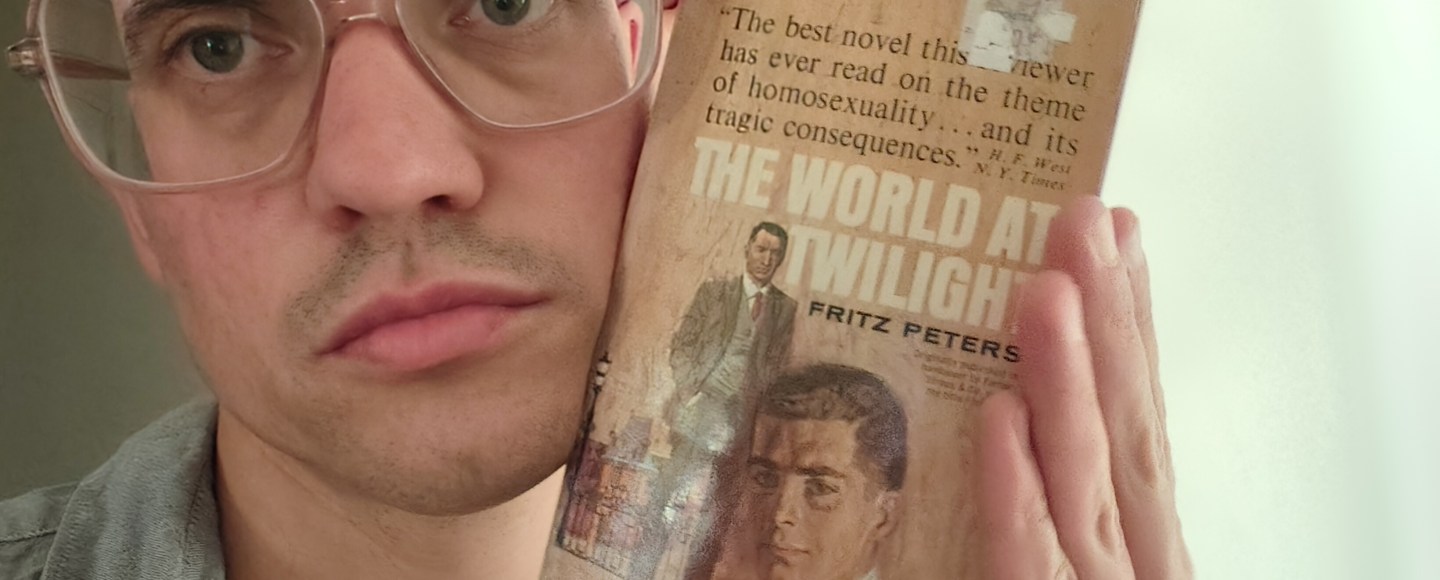
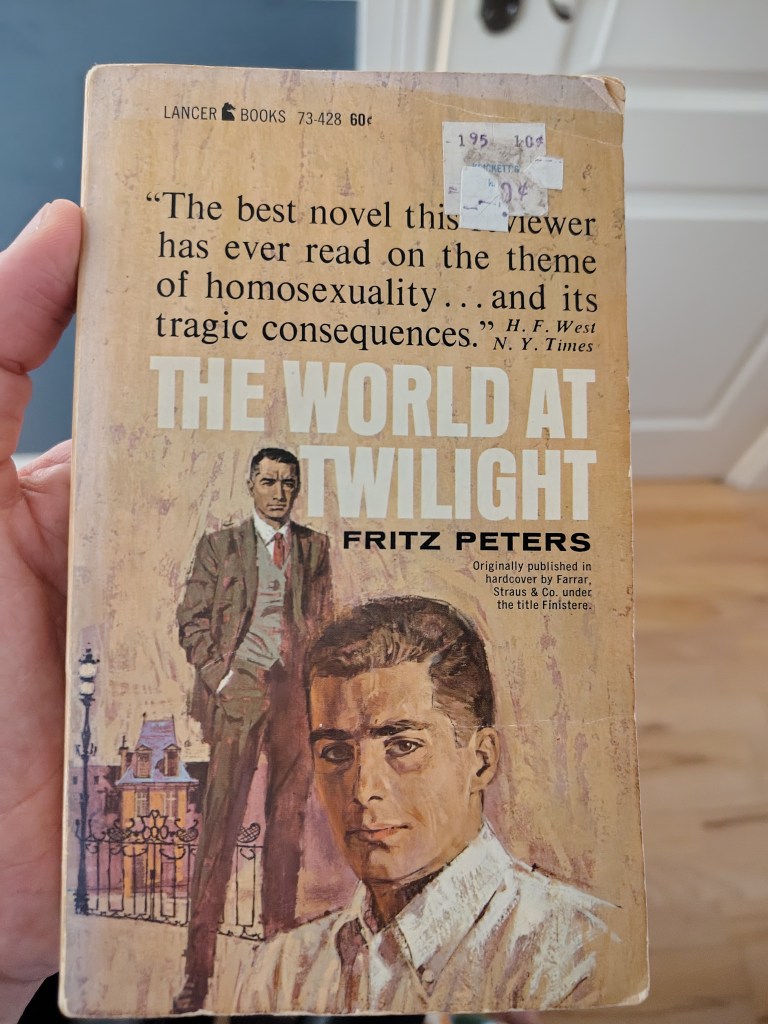
Published in this edition as The World At Twilight, though originally (and more generally known as Finistère (The end of the Earth), this is a 1951 novel written by Fritz Peters, and a piece of distinctly of-its-time mainstream American queer writing… It’s very much published in the tradition of early 20th century wiring in that the text both dramatises (and is arguably guilty of) puritanical and repressive moralising, with queerness leading inevitably and irrevocably to tragic ends. Difficult to untangle and know is the ethics and opinions of the novelist, however what happens within the novel is [a depicition of] a patronising and unrealistic amalgamation of mutual desire and romance with coercion, exploitation and taking sexual advantage of a child.
I choose to read Finistère generously and kindly, and see Fritz Peters’ writing as a statement about how policing, repressing and attempting to control sexualities by denial ultimately leads to act of violence.
If mutual desire is treated as if it’s as morally damaging as coercive or violent unwanted sexual contact, than one ends up in a situation whereby dangerous and unethical practices become normalised.
There is a passage in the Bible I often refer to when talking about dangerous conservative and repressive ethics, which is Matthew 5:28: “whosoever looketh on a woman to lust after her hath committed adultery with her already in his heart” (as per the KJV).
If a person has looked upon another with desire, you’ve already committed adultery “in your heart”. To want to do something, to feel an urge to do something, is here positioned as “the sin”, rather than action itself.
It encourages policing not what you choose to do, but what you feel, without choice.
This line and this attitude, essentially, posits that to consider doing something is the same as doing it.
As any kind of ethical understanding of anyone in the world and any person with any kind of moral existence beyond that of rigid and unwavering sainthood will know, this is only the kind of ethical reasoning the deeply – at best – amoral (though likely immoral) person would attempt to justify.
No, being a “good” person isn’t about never feeling impulses to be “bad”, it is in fact the opposite of this; everybody feels anger and frustration and desire to varying degrees, but it is by choosing not to behave badly when behaving badly is an option (or even behaving morally ambiguously when behaving in a morally ambiguous yet fun way is an option) that a person’s morality can be assessed.
Thinking about kindness is not a “good” act, just as thinking about meanness is not a “bad” one. What matters is what happens after the thought…
People are emotional beings, moved by what moves them, and equating harm with puritanical and conservative social mores, is a blunt cause of danger for the world.
You do not need anyone to more than gesture at the evidence of the historic abuse scandals of numerous organised religions in order to demonstrate the dangers of repression and silence.
Repression is a very dangerous thing.
And this novel is about that, in my opinion, rather than an example of it.
If Matthew – a young teenage boy who moves to France with his mother after her marriage disintegrates and is sent to a fancy rural boarding school – had at any point been able to talk openly to anyone other than the teacher he’s fucking and falling in love with about the fact that he’s fucking and falling in love with a teacher, then someone might have been able to intervene and point out that this is an unequal and unsafe relationship, and not just because they both have dicks.
Matthew is a young teenager, naïve and living in a foreign country; the teacher is not only at a different life stage, but much more worldly and in a position of legally and ethically being in loco parentis. He is not someone who should be having sex with Matthew, because Matthew is a boy who is in his care, not a man who knows and understands his own mind and the desires of others.
Eventually, Matthew’s mother remarries and the new – evil – stepfather quickly realises her son is fucking his teacher, so tells Matthew very bluntly that unless he also starts fucking him, then he’ll tell his mother about the teacher. He tries to force himself on Matthew, but the boy is able to escape. Then – presuming his mother isn’t awful – he tells her everything, “confesses” all, but rather than being shocked that her new husband tried to assault her son or appalled that a teacher has been having a long term affair with him, she is instead (and, ultimately, embarrassingly) far more disgusted by the fact that her child has been attracted to men than any other aspect of the story, so does the family equivalent of excommunication and then the boy – as so often happens in queer stories from this time period – kills himself.
Matthew is depicted as alone and lonely, but it is the lack of safe conversation and adult, or mature, responsibility, that leaves him in a position where he feels no way out but suicide.
Had he been able to speak about his feelings of attraction towards his teacher, a kind and non-regressive listener would have been able to suggest to him that maybe finding a boyfriend his own age was a better idea. But because all nuance and reality is combined into one single, regressively judged, idea, Matthew is left with nothing and no one.
It’s a sad novel, and though its joyful and playful moments are fun, and though there is vivid place and historic detail – some of the depictions of the inter-war Parisian queer scene are engagingly evoked, and the landscape of the area of the titular Finistère is dramatically sketched – it’s overall melancholic, for depicting, as it does, the realities of a homophobic world.
Though many of us live in places where these ignorant and destructive attitudes are less prevalent, there remain societies and countries where being queer is criminalised, and often horrifically punished. In those places, then, the realities of this novel must still be playing out; if a young or vulnerable person is unable to discuss and understand when their relationships are safe and when their relationships are not, then they are open to consequences of deep and damaging horrors.
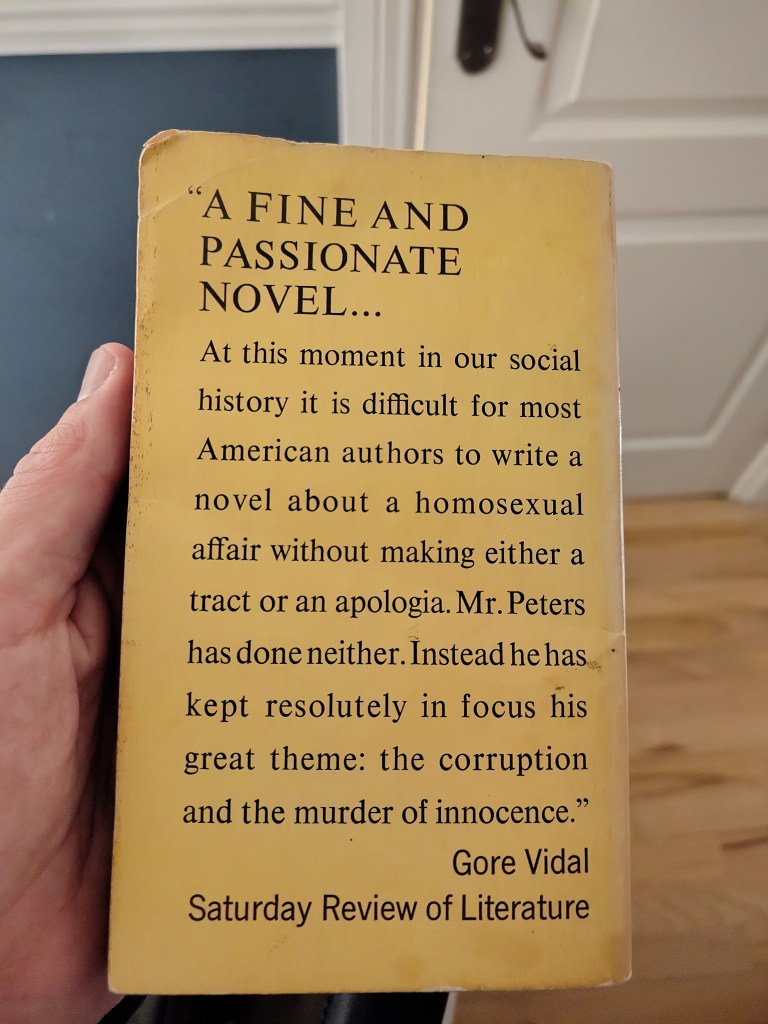
An interesting and an engaging read, with some frankly bizarre blurbs on the cover, including one from Gore Vidal:

Thank you so much for reading TriumphoftheNow.com! If you like what you’ve read, please subscribe, share and order one of my books. If you love what you’ve read, why not order me something frivolous and noisy from this Amazon wishlist or make a quick donation via my ko-fi page?
I’m currently focusing on parenting and creative practice, so small donations are appreciated now more than ever!
scott manley hadley aka SOLID BALD live
Here’s a video of me recently performing at the prestigious (it has a Wikipedia page) comedy night, Quantum Leopard. Listen to how much fun the crowd is having. You could have that much fun, too!
Forthcoming gigs include the following – there may/will be others:
15th October: The Bar VXXXII Comedy Club, Colchester
18th October: Brockley
19th October: West End New Old Act of the Year Semi-Final
26th October: Alternative Comedy Jam, Brighton
29th October: The Comedy Centre, Isleworth
21st November: Twinkles Cabaret, London
7th December: Coherent Comedy, Online
13th December: Dr Mew’s Sci-Fi Cabaret, Aces & Eights, Tufnell Park
7th January 2027: I’ve got something in the calendar for this but no details
10th March 2027: Lydford, Devon
Discover more from Triumph Of The Now
Subscribe to get the latest posts sent to your email.


0 comments on “Finistère by Fritz Peters”