
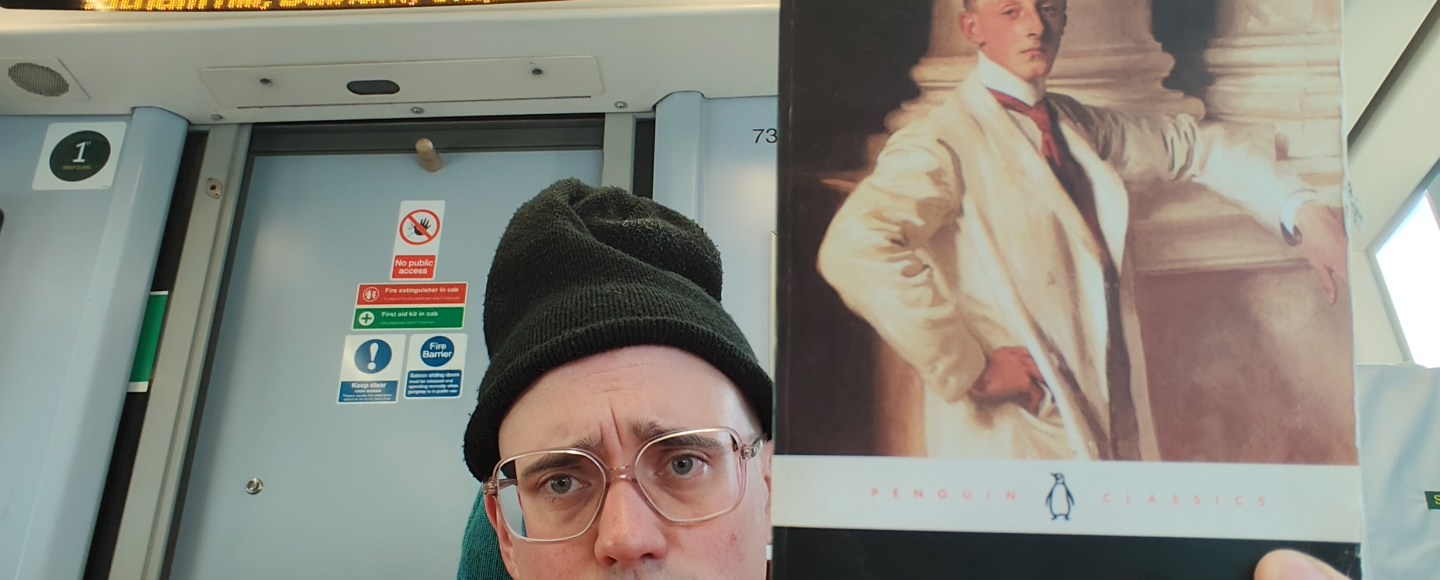

this isn’t about The Picture of Dorian Gray at all. It’s all about me. However, because a reader’s inability to separate themselves from the fiction they read is (arguably) a textual element of this novel, I fear this is a rare example of my self-centred commentary being literarily justified.
This is the kind of book that, yes, I could probably sit down and bleed about at the laptop until my own face rotted into a collapsed ball of rank flesh.
This is, perhaps, the novel that ruined my life the way that the anonymous novel (a lightly fictionalised A Rebours by Joris-Karl Huysmans, probably) gifted to young, suggestible and beautiful Dorian Gray, perhaps, ruined his.
Dorian – much like young scott manley hadley – was a thing of beauty, yet naive, a bit thick, and willing, oh-so-willing, to please.
Obviously, Dorian has bags of money and cultural capital and class privilege (if there is a whiff of familial scandal about his half-underclass roots), which I certainly didn’t, but he has a similar level of ignorance, a similar level of being open-eyed in a way that is deeply, deeply, destructive.
–///–
There’s a long section in the Introduction to this Penguin Classics Edition that argues that Dorian Gray’s inability to read the lusty French novels he gorges on while still an innocent naif without imagining – and transplanting – himself into the part of the protagonists is his real tragic flaw, his real sin; being unable to read non-autobiographically is far more soul-erasing, ignorant and unforgivable than all of the varyingly-clarified sins and misdemeanours he performs in later life.
Not being able to read a novel without seeing it through one’s own eyes is a failure of critical faculties; not being able to imagine an action without imagining how you would respond to it is solipsism, is narcissism, is self-indulgent and embarrassing and bad and shameful and equal in terms of intellectual failure to pretty much anything else Not-Good that a person could ever do (runs the argument).
That, then, is a sin I continue to do over and over and over again.
–///–
I first read this novel when I was young. Seventeen, or maybe just eighteen. Certainly, it was before I had botched the sole interview I had at an elite university and years before I had finally come to terms with how difficult it was going to be to ever feel like my life was “on track” again following that*.
–///–
I read this when I was seventeen (let’s go with that), and it consumed me.
Misreading, as I misread it all, as I misread and misunderstand almost everything I read, through my inability to, meaningfully, subtract myself from my thoughts.
I knew Wilde ended up shamed and dead and miserable; I knew, too, that at his zenith he was the leading writer of his moment. A person who hit the greatest heights and the lowest lows, punished due to bigotry and cruelty and conservative dickheadedness (sure, you might not be able to keep your wife if you decide to embrace a hedonistic secret second life outside the marital home, but there’s absolutely no reason for that to impact your career as “bitchy playwright”). Wilde’s wit and sparklingly witty dialogue was his big draw, yet his characters’ cynicism and self-indulgent and self-centred cruelty was the stuff of archetypal satire in his own time and both before and ever since**.
Wilde’s novel is not a celebration of the characters it contains, but if – like child-me – you are a fool, it is easy to read it as so. Because these people are written with intellect, with smarts, and with an access to and an enjoyment of culture that extends far beyond anything ever available to a bumpkin youth in a culturally-deprived backwater town in the West Midlands.
Gray and his peers go to concerts, to the theatre, they all read, they all go to gallery openings and look at artworks and know about literature and know about culture; they travel and they explore the world, and they also explore too the limits and extents of their own more corporeal pleasures and (thus more earthly) delights.
Although the prudence (a counter to its arguably more meaningful prurience) of the 1890s means that Wilde’s novel is able to be bizarrely blunt and bloody about violence (including self-harm) and, too, about the use of opium, the novel is discreet to the point of ridiculousness about anything Dorian Gray or any of his friends do with their (or other peoples) genitals.
We presume that all the young men and women who kill themselves or “ruin” themselves as addicts or allow themselves to be blackmailed by Dorian Gray are people who have played fast and loose with Victorian codes of conduct (and thus de-clothed Victorian bodies) with him in the middle of many nights, but we never have ever the beginning curls of a paper erection or the intimation of growing prose lust to cling to to be sure.
The notes in this edition point to locations where blunt queer love – romantic love – was excised between the first manuscript, the initially-published magazine version and the “final” book form published a little later, but these aren’t passages about quivering thighs and spewing cum and bodies panting in the heat of fuck, no, they are rather tame and always romantic passages about want, about care, about inspiration, yes, and crucially about love.
The queerness that was reduced as the novel made its way to the public was queer romance far more than it was queer sexuality… and it was this, perhaps, that scandalised; Basil Hallward is the artist who paints the portrait that becomes devilishly enchanted, and he is stabbed to death by an enraged Dorian Gray who hates him for having permitted to exist in the world this record of sin and corruption (which, of course, is self-hatred; Hallward didn’t paint the picture as a magical piece, was unaware of what it had become until the scene where he sees it (and is then killed), and when Gray does finally attempt to destroy the picture in a slightly later scene, it is he – and not the canvas – that ends up in tatters on the schoolroom*** floor).
But is Hallward’s death – in a Victorian morality kinda way – narratively justified and, even, demanded? For is Hallward’s romantic feeling towards Gray expected to be viewed as if it is as much of a corruption – to the contemporary reader – as all of the cruelty and whatever-else Gray himself does in the night? It’s the ambiguities around this, really, where the novel is unclear in its contemporaneous echoes (I think, really, Hallward is meant to be read as the “nice/good” one, rather than as sinister, but given the context it’s hard to be sure) and this is one of the reasons why the novel ended up being used as evidence in the later trials against Oscar Wilde that found him guilty of “gross indecency”.
–///–
I read this book about charming, cultured, beautiful young men, all extolling the values and the import of beauty and vacuousness and youth and felt enraptured. I felt, maybe not seen, but certainly witnessing what I wanted to be wanting from life.
To misquote a line from my own book, the pleasure of regret: “We used to call our parties ‘bacchanals’; one of us had probably misread Donna Tartt[’s The Secret History.]”
Although that book of mine looked, incredibly frankly****, back at my own misspent youth and 20s, I don’t think it mentioned the impact that Dorian Gray had had on me.
I had wanted to have a Lord Henry figure – the major corrupting personal figure in Gray’s life; I had wanted to be made art of; I had wanted to live, I had wanted to live, and I had wanted to explore the world and all it promised…
In Wilde’s novel – and in so many other novels of this type that arrived into my late teenage and then undergraduate eyes – culture is associated with corruption; to know the world is to know not only the things that make it beautiful, but the things that make it stink.
The poet is impoverished; the actor turns tricks; the artist self-harms; the musician is an addict; and those who watch and read and listen and look get to play with those defiant sins and messes without being subsumed; the audience of culture is the audience, too, of those who make it; consuming art is about consuming artists, and those with the urge to create must, by their very nature, their very soul, end up consumed, destroyed, derailed, by people like Dorian Gray. The Faustian pact of getting to have an audience is getting to be torn apart. No one can have it all; Dorian Gray and his buddies can have their fun, but all the fucking (or whatver they’re doing), all the opium and all the driving young people to suicide impacts upon a person’s soul (is the argument). And the soul – runs the novel – is displayed on the face.
Dorian Gray is a novel that’s about not wanting to age, of course, but it’s also about resisting consequence, about denying the realities of the world as depicted. And, alas, yes, it is possible to be a big bad bastard who does terrible things but doesn’t look like it; but much like the treatments available now to hide some visible signs of ageing, they rarely hide the signs of ageing that matter; I don’t mean wrinkles on the neck, I mean attitudes, openness, personality, willingness and ability to change.
Ageing and bodily change is, alas, a major part of life. As someone whose hair started falling out rapidly in my mid-20s, I’m too, too, aware of this. In hindsight, I should not have shaved my head when I did and I should have figured out ways to do something, anything, to retain the ability to not feel, constantly, physically repulsive*****, because shaving my head, very much, was – to me – an intentional punishment. I did it because I hated myself and wanted to feel bad. I wanted to feel worse. I wanted to look in a mirror and be horrified by the consequences of my life. And it worked. For well over a decade I have struggled to not weep when I look into a mirror and, truly, see.
Feeling broken and damaged and destroyed by the world and the lack of a sustainable life I had failed to find for myself, I wanted mirrors to become my very own Basil Hallward’s portrait. And they did. And I look in a mirror and see the stark, broken, consequences of my own terrible meandering (the terrible decisions have been an unwillingness to make decisions; I sit, now, fearful as I look at making active decisions to recalibrate and I don’t feel like I can, like I deserve it; and then I catch a shadow of this hideous bald skull on the wall and realise that, yes, I do I do I do not deserve anything better than the misery I have; I wouldn’t look this bad if I wasn’t bad; I wouldn’t be this broken if it wasn’t right. I would not have ended up, lifeless in a way, if that hadn’t been what was due to me, or what I deserved. Because the wages of sin is death, as Marlowe taught me******, around the same time as Wilde taught me that the partner of culture is sin, and that culture is something the poor only get to be near if they are to be, yes, its product, the fly in its web, the shit on the inside of the toilet bowl that someone like Dorian Gray is pissing off the ceramic with the gonorrhea-tinged flow of his yellow, under-hydrated, awful, piss.
“I hear you say, “Hey, the city’s alright,” but you only read about it in books” is an Elvis Costello line from a song I also first heard roughly around this time in my life*******, and that was very true for me. I knew nothing that mattered when it mattered. I learned nothing worth learning until it felt – it feels – too late to put it into practice. And I know, I know, I know, that people have turned their lives around at ages older than I am now, I know that people who haven’t had any meaningful professional experiences can find them later, can re-train (or, in my case, train) and become a useful member of society who doesn’t fucking yearn for erasure as so much of their time is pissed away in nothing, nothing, nothing (or, sometimes, being on the peripheries of the unforgivable********). But it’s hard to feel like you can exist in the world in a way that isn’t shit when the depictions of what a “fun” life looks like look like this, and the depictions in culture of pretty much anything other than the aristocracy or the bourgeoisie is grim, grimy, dirty, unlivable, too.
–///–
The Picture of Dorian Gray is a funny and exciting novel, yes, it’s playful and engaging and exciting and full of great passages of purple and purplish prose. And, yes, to a bumpkin it’s dangerous, it paints a terrifying portrait of what one can and should and could be.
Will I ever read it again? Maybe; but I’m beyond the age where the magic works; I am too old to be awed again by the promises of the power of youth and beauty.
I do wish, sometimes, that I’d never learned to read. That I’d never read. How much happier I’d be if I’d never understood anything, never misunderstood anything, never stood. The wages of sin is death, yes, but the wages of everything else are all consumed by the cost of living and the work is, often, a death-in-life.
Things need to change. Things need to change.
My next read will be something that won’t make me think about myself.
– – – – – – –
* Alas, it never has yet; I am rootless, planless, directionless, stuck in a dead-end, cavorting nowhere; unable to escape living in a place where I’ve never felt welcome, but unable to feel able to push towards or through to any satisfying and sustainable mode of living here; I’m so unhappy that I can’t even casually have a beer or a cocktail any more, or I risk spiralling into irrevocable yet deeply boring contemplations and rememberings of my own failings and my own inability to escape from a near-constant life-slap-in-the-face where the ways in which I’ve failed to, meaningfully, do anything hound me, hound me, hound me as I yearn for a way to guide myself into something that feels, yes, good, or at least good enough; and I can finally just, eventually, be.
** Basically, there’s stuff in Milton, Shakespeare, in Chaucer that’s like this; and it continues to be what comedies full of people being clever and mean are all about; Succession, Veep, lots of other examples.
*** He stores the portrait in his old schoolroom. Yes, he’s rich enough that his nice big house has a schoolroom. My flat now barely has a room, and the house I lived in when I first read this was one where a bedroom was made out of what was basically a storage room, a ”box room”, not a comfortably-sized space for living in. It was a different world I saw depicted and one that, arguably, made itself seem the only way for a person to be.
**** frank[du bois]ly
***** I’m not saying that everyone else who has no hair has no value, it’s just me
****** I encountered that in Dr Faustus without knowing it came from scripture.
******* on the same album he sings “there’s no such thing as an original sin”, which then-me thought was the cleverest vocal refrain I’d ever heard
******** I really need to start a proper career soon. I think it really is time. But what can a person like me do? Start cross-posting the blog on Substack and hope people start to pay???
Discover more from Triumph Of The Now
Subscribe to get the latest posts sent to your email.


0 comments on “Re-Reading The Picture of Dorian Gray by Oscar Wilde”