

cw: violence against animals, self-harm, suicide
Ernest Hemingway was a writer who tried to live a super-sized life, and often found horrors in the cracks where it became impossible.
His life was something that, yes, he took inspiration from to write beautiful and deeply evocative and emotive literature (and some that wasn’t), but he continually tried to model his own life and experiences on an almost-Victorian idea of the exotic, of the adventurer, of the Big Man of the World.
Ernest Hemingway loved big game hunting, deep sea fishing, war, bullfighting…
He loved big animals and watching big animals and seeing them fight humans and – almost always – bleed out dead at the end of the encounter.
His oeuvre is full of death at the hands of bulls and lions and – I’m pretty certain – of more than one extended description of a one-on-one battle of wills between a very old man and a very big fish1.
Hemingway went to and sought out warzones, as a young man driving an ambulance in the First World War and then doing whatever it was he was doing during the Spanish Civil War twenty(ish) years later, and then, again, whatever he was doing in the Second World War when he got hold of military-grade sonar equipment and started patrolling the Gulf of Mexico looking for never–located U-boats.
With a life spent chasing big, bloody, thrills, this seeped into his fictions, and Hemingway pumped out novels full of blood, strong feelings, and the attempts to blunt those strong feelings with violence, booze or the kind of repression that cuts through a person totally dead.
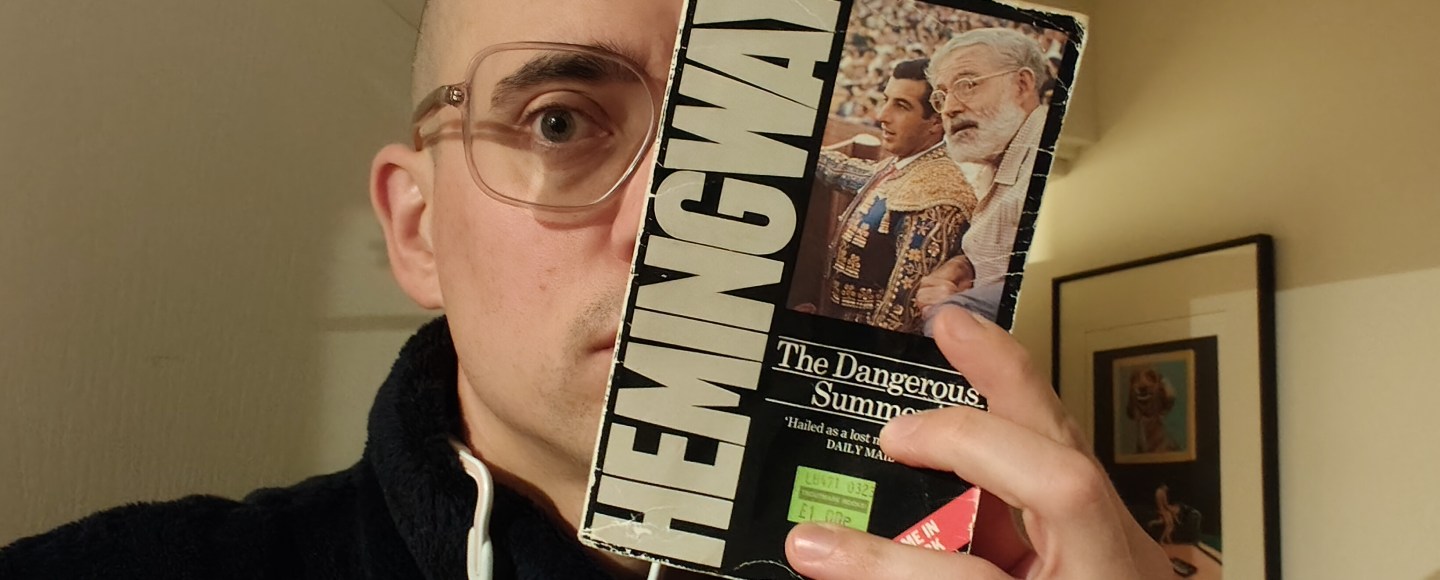
For those who don’t know, Hemingway shot himself in the head in the July of 1961, about a year after the first publication of a version of this text, which came to be known as The Dangerous Summer.
Commissioned by Life magazine but submitted in a form of somewhere between four and thirteen times the requested word length (sources I’ve consulted differ), it took a lot of cutting to get to a magazine-friendly size, and though this book doesn’t feature the entire Hemingway-submitted manuscript, it is significantly longer than the Life magazine version, even in its edited form.
Hemingway was long dead before the book-length version of the text was published (in 1985), but the realities of back and forth between writer-editor-publisher mean that what we have here may not have been his ideal version of the text, it isn’t necessarily a million miles away from what would have arrived in a reader’s hands had Papa himself stuck around for the final edits. Although Islands in the Stream – the longest of Hemingway’s posthumously published texts – does feel a bit farther from the crisp and expertly finessed brevity of his better-known works, the memoir about his Parisian years that he was working on at the time of his death – A Moveable Feast – has become a literary classic in the half-century since it was released, and that – like this – was kinda, arguably, ready to go.
Like Malcolm Lowry’s Lunar Caustic, then, this is a posthumous text that had, at some point, existed as a publishable version that the author was, ultimately, happy to sign off on. And this book-length version of The Dangerous Summer offers an expanded version of that. Which is good, yes, without being too much.
–///–
At moments this does feel teetering on the verges of self-satire (“Pamplona is no place to bring your wife” (p. 97)), but even when Hemingway recounts the moment a wolf bonded with him because it could tell he was unafraid, this doesn’t feel like a writer who has lost their sense of self, their sense of voice, the Hemingwayness that made his oeuvre and his legacy what it has been:
We inspected the animals, the poultry and the stables and the gun room and I went into the cage of a wolf which had been recently trapped on the place and played with him which pleased Antonio. The wolf looked healthy and the odds were all against his having hydrophobia so I figured all he can do is bite you, so why not go in and see if you can work with him. The wolf was very nice and recognised someone who liked wolves. (p. 20)
It’s solid, playful, engaging stuff, and though it might not necessarily be self-conscious, that isn’t what anybody goes to Hemingway for, really, and it isn’t always un-selfaware.
The melancholy that’s here exists alongside the joy; the hedonism fights with the black dog, sometimes getting it to do some beautiful twists and turns about itself in front of the baying crowd on the sand arena; but always, alas, always, in these stories, someone ends up gored, and someone ends up dead.
–///–
The Dangerous Summer is a [surprisingly?] engaging piece of non-fiction reportage about Hemingway following the bull-fighting season all over Spain in the Summer of 1959, reporting in particular on the rivalry between two toreros, both of whom seem to be (possibly) the greatest in the world.
In contains then, lots of analytical and descriptive descriptions of bullfighting, and the various ways in which a person can, theatrically, kill a bull, and the ways in which this affects an audience. For example:
Then he turned slowly with the cape wrapping itself around him spinning slowly into and out of trouble at each charge of the bull. It is very pretty to watch but basically it is a trick, not a pass. The bull starts to pass but the man spins slowly away from him as the bull comes into his territory. The crowd liked this. We liked it too. It is always pretty but it does not do anything to you inside. (p. 54)
The two bullfighters the book focuses on are Luis Miguel Dominguín and Antonio Ordóñez. They are not cruel rivals who hate each other and wish violence in either direction; their intense rivalry in any other activity may well have still led to injuries, but not as serious as the injuries one can get when doing bull-fighting with a bit too much on your mind.
The men are brothers-in-law – the one who is slightly better friends with Ernest Hemingway is married to the sister of the other, and these are all people who Hemingway has met in the previous few years, as he renewed his interest in bull-fighting. A couple of decades of Franco’s rule has dampened his opposition to it, and the passage of time made Hemingway so famous that no positive spin could be wrangled out of the Spanish state of the late 1950s taking any kind of anti-Hemingway stance. Would Franco’s regime gain anything by being unfriendly to one of the English-speaking world’s most renowned Espan-ophiles? No. So, Hemingway is warmly welcomed in as a foreign journalist and intellectual with a special interest in bull-fighting, and all of that anti-Francoist writing and living in the 1930s (see Clive Owen as Hemingway (opposite Nicole Kidman as Martha Gellhorn) in the not unenjoyable Hemingway & Gellhorn, an HBO movie about Martha Gellhorn’s doomed-ish relationship with Hemingway in the midst of this war, which features the kind of Hollywood casting half a century after his death that Ernest Hemingway would – I feel quite confident in saying – have absolutely fucking loved) is water under the bridge. (And I don’t mean water under one of those bridges they’re always blowing up in For Whom The Bell Tolls).
The bullfighter rivals have slightly different styles, but one of them – the buzzier one who earns the most money at the start of the season – is doing things that Hemingway believes to be cheating: he is predominantly fighting bulls that have had the ends of their horns sheared down slightly, meaning that to the non-expert they look normal, but to a real aficionado, they’re aware that risk has been reduced and the flashy close passes he is able to consistently achieve come not from being the best in the world, but from not challenging himself enough.
His rival – his sister’s husband – doesn’t fight with this type of animal, and is able to get similar results. Over the course of the Summer, it is the first man’s attempts to compete with his rival on an even footing (i.e. using bulls with untampered horns) and his rival’s rapidly developing ability to learn and copy everything the other does, that leads to problems, violence, injury; because one of them wins, clearly, in this dangerous Summer, and it isn’t the one who starts out on top…
–///–
Although this is, technically, a minor Hemingway work (sitting at the end of his oeuvre in the way that The Evidence of Things Not Seen sits at the end of James Baldwin’s), it is one that delivers what most readers entering a text like this would hope for.
Yes, there are lots of graphic descriptions of bulls being tortured to death as theatrical spectacle, and there is also a lot of Hemingway being self-consciously cheeky and revelling in his own fame and prestige, for example:
There was a pair of Guardia Civil at the door and another pair outside.
‘Clear all these people out,’ I said. ‘No one is to come in. Then put a pair on the door and keep the door open so there will be some air.’
I had no right to give orders but they did not know that and they were waiting for orders. They saluted and started to clear the operating room. (pp. 120-121)
and
Our public life was at the Bar Choko under the arcade outside the hotel Juanito Quintana used to own. It was at this bar that a young American journalist let me know that he would have liked to have been at Pamplona with us thirty years ago, ‘when you used to go into the country and know the people, when you used to know the Spaniards and care about them and their country and about writing and not waste your time sitting in a bar seeking adulation making wise cracks with your sycophants and signing autographs’. There was a lot more of it and it was all in a letter he had written because I had reamed him out for not picking up some tickets I had bought for him from an old scalper friend who worked all the ferias. He was in his early twenties and he would have been as square in the nineteen twenties as he was in the end of the fifties. He did not know that it is always there and you can find it and his handsome young face already showed the traced lines of bitterness around the upper lips as he tried to straighten me out on Pamplona. It was all there and he had been invited to it; but he could not see it.
‘Why do you waste your time on that creep? Hotch said.
‘He’s not a creep,’ I said. ‘He’s a future editor of the Reader’s Digest.’ (p. 101)
And there are moments where he uses his position to do things that don’t really make a lot of sense, other than continuing to exemplify the persona and the status that he has arrived at for himself, e.g.:
He cut away the big dressing and when he lifted the gauze packing he smelled it quickly and handed it to me. I smelled it and dropped it in the basin the nurse held. (p. 64)
But you get, too, smashing examples of deeply Hemingwayesque Heminwayerie, such as” “I like to think of him as he was all that summer and it is not good to think of what happened when his luck ran out” (p. 57), a particularly striking moment given that this is a passage about a bullfighter who appears nowhere else in the text. We see him young and successful and on the up; we are told this doesn’t last, and it crashes very badly, but only in this sentence, and that’s all we could have guessed at anyway, right? No one makes it forever; no one escapes with their youth unless they escape into death…
–///–
The Dangerous Summer is a narrative that has the inevitability of tragedy at its end, not just the presumption that these bullfighters are going to end up maimed, but also knowing how close to the literal authorial death this is.
Hemingway, here, is someone taking great joy from life; from travelling and travelling with friends, from being around people he likes and loves and respects, from eating and drinking and playing and spectating on others as they play…
This is an energetic life, a person having the kind of holiday, experience, life they seemed to desperately want, and one partially paid for by Life magazine (I don’t imagine they were willing to cover every single bottle of wine, but any contribution, I imagine, would have been nice). It is sad, it is important, to know how close this was to Hemingway’s life becoming unbearable to him.
Here, in this manuscript, he is confident and proud and he is not done with life. He is looking to the future, to the present, to himself, and is not overly concerned with legacy in the way someone troubled by mortality might be.
He’s aware of it, yes, but not in a way that feels like someone who has (yet) written off the possibility of their best moments being ahead of them.
I’ve written Pamplona once and for keeps. It is all there as it always was except forty thousand tourists have been added. There were not twenty tourists when I first went there nearly four decades ago. Now on some days they say there are close to a hundred thousand in the town. (pp. 97-98)
This isn’t wistful and past-focused looking back, this is being in the present, living in the now. It’s about blood sports and animal cruelty and young and youngish and not-quite-youngish men risking their lives in order to entertain others while performing their ritualised cape and sword-based animal sacrifice, yes, it’s about that, but it’s also about the joy of shared experience, the value of hobbies and interests and sharing those with people you care about. It’s about respect and the benefits any person gains when they enter the world treating others as they would wish to be treated, until they’ve been given a reason not to. It’s about openness to experience and the outside, it’s about saying “yes” to opportunities and ideas.
It’s not a depressed or a depressing book. It’s a fine piece of late Hemingway, and I thoroughly enjoyed travelling around Spain with him, one Summer three decades before I was born.
I’ll end with a quote from the text, one which – to me – is beautiful, and shows the overall tone of The Dangerous Summer. It’s a book about remembering, yes, but also about living. For me, it was worth it. It’s sad, yes, it’s very sad that life didn’t feel like this for Hemingway for much longer.
We were late in getting off from Madrid but the Lancia which we had named ‘La Barata’, the cheap one, made wonderful time and ate up the familiar road to the north. We stopped at the old tavern in Burgos so our ex-driver Mario, who had driven the Lancia down from Udine, Italy, before the mano a mano at Ciudad Real, could eat the trout from the stream in the high Castillian hills beyond the town. Shiny and spotted, they were plump and fresh and firm-fleshed and you could pick out your own trout and partridges in the kitchen. The wine was served in stone pitchers and we had the delicate Burgos cheese I used to bring back to Gertrude Stein in Paris when I’d come home from Spain in the old days third-class on the train. (p. 147)
- I’m pretty certain I have read two examples of that, though from what I remember, one was just an earlier and posthumously published draft of The Old Man and the Sea, and tbh I might be completely mis-remembering this as the bulk my my Hemingway reading was in 2008-2010. ↩︎

Thank you so much for reading TriumphoftheNow.com! If you like what you’ve read, please subscribe, share and order one of my books. If you love what you’ve read, why not order me something frivolous and noisy from this Amazon wishlist or make a quick donation via my ko-fi page?
I’m currently focusing on parenting and creative practice, so small donations are appreciated now more than ever!
scott manley hadley aka SOLID BALD live
Here’s a video of me recently performing at the prestigious (it has a Wikipedia page) comedy night, Quantum Leopard. Listen to how much fun the crowd is having. You could have that much fun, too!
Forthcoming gigs include the following – there may/will be others:
21st September: West End New Old Act of the Year HEAT, near Goodge Street
5th October: The Defectors present Scratch ‘N’ Sniff at Bread & Roses, part of the Lambeth Fringe
15th October: The Bar VXXXII Comedy Club, Colchester
26th October: Alternative Comedy Jam, Brighton
29th October: The Comedy Centre, Isleworth
5th November: Isle of Wight
21st November: Twinkles Cabaret, London
13th December: Dr Mew’s Sci-Fi Cabaret, Aces & Eights, Tufnell Park
7th January 2027: I’ve got something in the calendar for this but no details
10th March 2027: Lydford, Devon
Discover more from Triumph Of The Now
Subscribe to get the latest posts sent to your email.


0 comments on “The Dangerous Summer by Ernest Hemingway”