
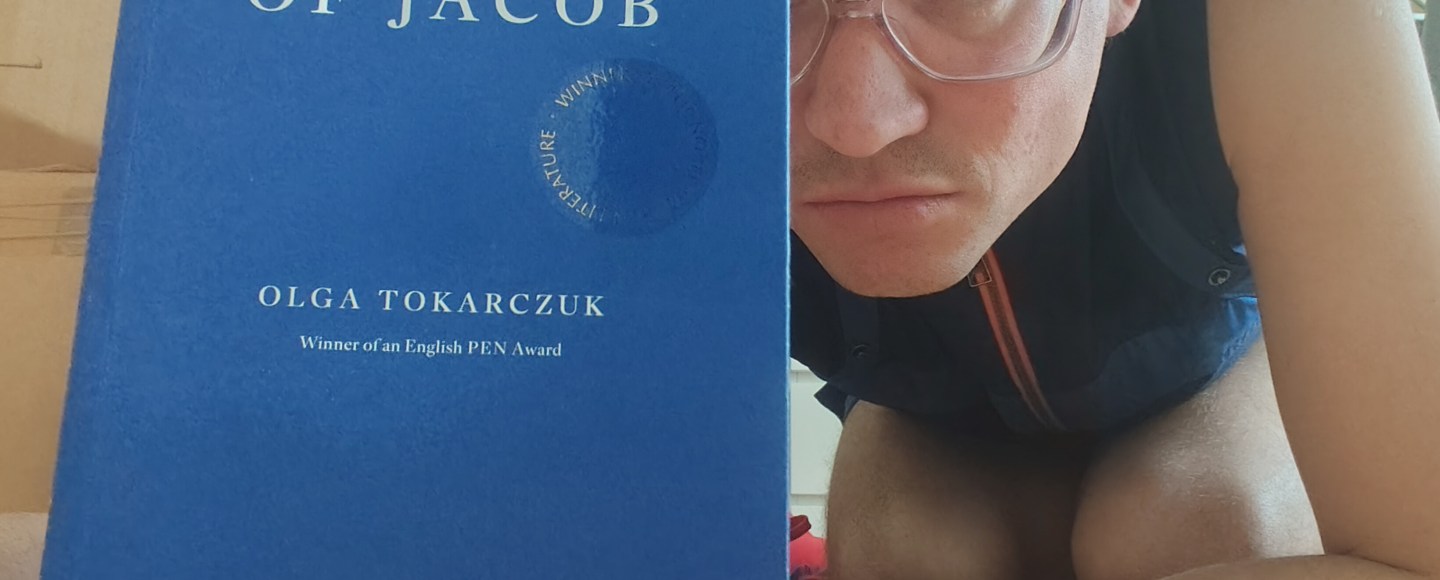

Order THE BOOKS OF JACOB direct from Fitzcarraldo Editions here
PART ONE – THE FIRST HALF OF THE BOOK IS ALL I HAVE READ
Right, well, yes. First thing to address here is why I’m giving up, pausing, halfway through what I can only, bluntly, introduce as probably the best historical novel I’ve read since Moby Dick.
Because Olga Tokarczuk’s 2014 global smash The Books of Jacob (being read by me in a glorious 2021 translation by Jennifer Croft in a gorgeous Fitzcarraldo Editions edition) is excellent, breathtaking, moving, serious, important, and great. It’s also absolutely fucking massive, and I’m about to go away for just over a week and can’t spare the luggage space.1
I’ve almost exactly half way through the novel, which is split into 7 “books” of (on average) about 150 pages, each one split into about 4/5 chapters (a total of 31) and each chapter split further into short, mostly 2-3 page sections. All of these sections are titled and all of these section titles are included in the voluminous Contents section at the start of the book. This section in itself is approaching novella length. Because the book is absolutely huge.
Physically, it’s whopping, and not just in length: the Fitzcarraldo Editions version is a French-flapped paperback that’s significantly bigger than their standard book size, with reduced internal margins and (I haven’t double checked, but it feels so) a smaller font than their books would ordinarily have.
The pages are literally bigger than standard books and there are literally more words on every page. And it’s still 900 pages long.
This is a big book. For big minds, probably, but it’s also enjoyable to sub-intellectual worms like little old scott manley hadley.
Because there’s so much going on, so much detail, so much narrative, so much history, so much textual analysis, so much description and characterisation and thought and travel and event and action, that even if I’m misunderstanding or not noticing the nuance and complexity of the novel, so much peripheral and at my level joy is available that this is a cavalcade of delights.
It’s funny, it’s serious, it’s silly, it’s cheeky, it’s prurient without being sleazy, it’s, it’s, it’s…
It’s a big and complex book that clearly took time and effort and intellect to pull together. It absolutely justifies and clarifies the 2018 awarding of the Nobel Prize for Literature to the writer. This is, absolutely, something spectacular and special.
–///–
The Books of Jacob is set in the second half of the 18th century, opening (following a few digressive and circling sections exploring the town and countryside and some of the local Catholics) around a large family gathering in 1752 when an extended Jewish family are gathering at the house of Elisha Shorr to celebrate the wedding of his daughter. However, one of the guests who has travelled the farthest – Yente, his eldest aunt – arrives unwell, comatose, and on her deathbed. A rabbi advises that the wedding must be postponed until this death has passed, however Shorr decides to ignore this and instead places a kind of magic token around her neck to keep her alive. However, Yente eats this, and the magic – which is real, though the only example of its kind that takes place (in the first half) of the novel – means she will likely now never die, but also never awaken from her coma. Her soul becomes able to wander outside of her shell, she is able to see and understand and witness events far away from her physical form, both geographically and in time. Yente is not the narrator of the novel, and her presence is not directly described as present in every moment of the text, but she floats in and out of the omniscient narrator’s peripheral vision, sometimes sharing the readerly experience as we travel across time and space as Tokarczuk weaves her exceptionally detailed and gorgeous narrative.
Jacob Frank – the titular Jacob – is the grandson of Yente, and he is one of many historic examples of people who make a claim towards being the Messiah. At the point of the novel at which I’ve reached, Jacob has begun to seriously enrage international Jewish communities and establishments because he, and most of his followers, are of Jewish origin and no longer following that faith, as Jacob has made up a new one. The existence of his cult-like meandering sect increasingly causes friction as his preachings begin to openly and self-consciously incorporate elements of Christianity and Islamic doctrines. For Christian communities – particularly anti-Semitic figures – this division within Jewish communities is something to be exploited…
Tokarczuk describes the growth and build of Jacob’s community, the history of other Jewish-Messiah cults in Eastern Europe in the second half of the second millennium, but also describes intrigues and complexities in the Catholic and the Orthodox establishments, the political, and also the familial lives of hundreds, many hundreds, of people at many social levels and in many locations across a continent. It’s a fucking masterpiece.
Jacob was a real historical figure and though I won’t be reading his Wikipedia article until I’ve read the second half of this novel (which likely won’t take place until June because of other life commitments), Tokarczuk has done a lot more than read the Wikipedia article and riff. This is a deeply-researched historical novel with (so far, gentle) magic realist touches, that explores people with power and people without it, people with ambition for power and those with no interest in it… people who yearn for knowledge – scientific, spiritual, divine – and those who see any deviance from their own conception of knowledge to be a danger and a risk and unacceptable.
It’s beautiful and serious and I’m absolutely loving it. I cannot wait to return to the text in a few weeks. Though, again, I may be reading it wrong.
One of Jacob’s most significant followers writes, in the novel, the following about reading:
…there are four types of readers. There is the reading sponge, the reading funnel, the reading colander and the reading sieve. The sponge absorbs everything it comes into contact with; and it is evident he remembers much of it later, too. But he is not able to filter out what is most important. The funnel takes in what he reads at one end, while at the other, everything he’s read pours out of him. The colander lets through the wine and keeps the sediment; he ought not to read at all – it would be infinitely better if he simply dedicated himself to some manual trade. The sieve, on the other hand, separates out the chaff to give a result of only the finest grains. (p. 737)
I think, as we all know by now, I’m a colander (maybe a funnel). But I’m having a VERY NICE TIME being that.
See “ya” soon!
Order THE BOOKS OF JACOB direct from Fitzcarraldo Editions here
- For anyone who read the previous post before this one (i.e. chronologically, the standard order to read things generally, though not necessarily re: blogs), I initially sketched this out before the trip to Toronto mentioned there. I’m not making two long trips within the same month. I wish! ↩︎

Thank you so much for reading TriumphoftheNow.com! If you like what you’ve read, please subscribe, share and order one of my books. If you love what you’ve read, why not order me something frivolous and noisy from this Amazon wishlist or make a quick donation via my ko-fi page?
I’m currently focusing on parenting and creative practice, so small donations are appreciated now more than ever!
scott manley hadley aka SOLID BALD live
Here’s a video of me recently performing at the prestigious (it has a Wikipedia page) comedy night, Quantum Leopard. Listen to how much fun the crowd is having. You could have that much fun, too!
Forthcoming gigs include the following – there may/will be others:
6th September: Bear With Me Comedy, Gravesend
21st September: West End New Old Act of the Year HEAT, near Goodge Street
5th November: Isle of Wight
21st November: Twinkles Cabaret, London
10th March 2027: Lydford, Devon
Discover more from Triumph Of The Now
Subscribe to get the latest posts sent to your email.

 Triumph Of The Now
Pingback: The Books of Jacob by Olga Tokarczuk PART TWO – Triumph Of The Now