
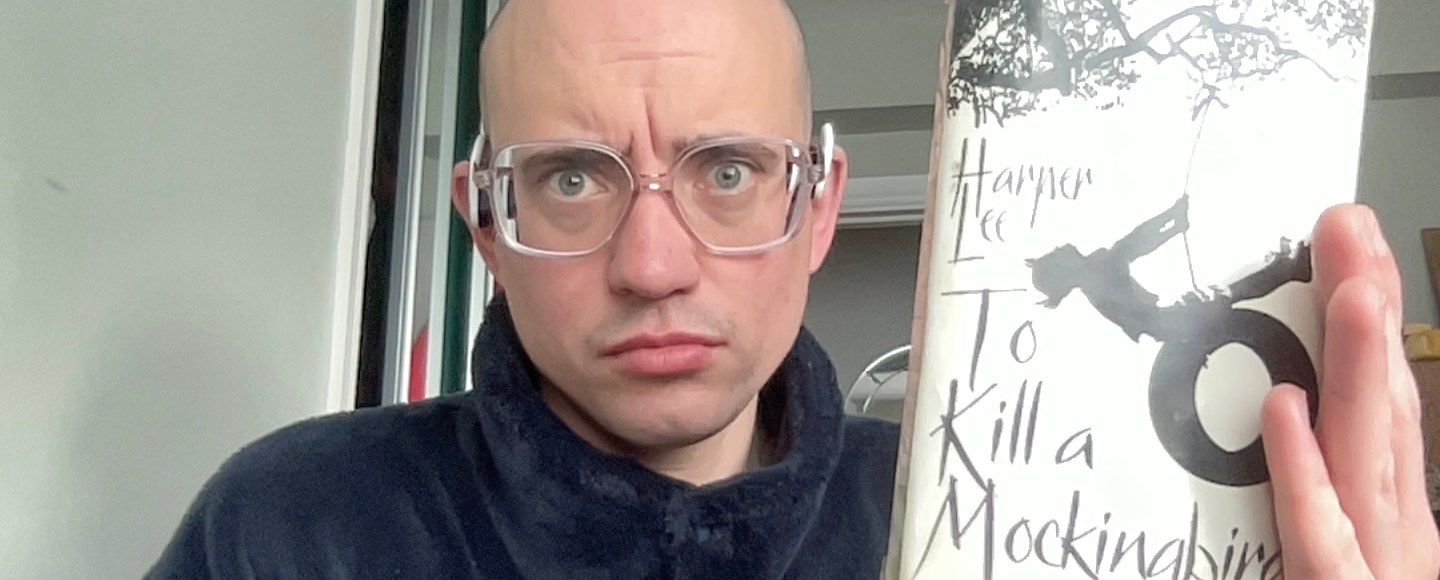

I’ve been doing some rereading recently, which is a change for me. And I think it’s genuinely been excellent for my mental health.
My mood, more than anything, seems to be tied quite directly to the quality of the book that I’m reading at the time.
It is not tied to the themes or even the mood of the book, no, as a book about sad things that is excellently written will do wonders for me in a way that a terribly written book about happy things will not.
In fact, a lot of the books that I’ve been re-reading these past couple of months have been exploring very dark and very serious themes. For example, To Kill a Mockingbird by Harper Lee.
–///–
I’d remembered this book – like I think many people do – as almost entirely consisting of the courtroom drama section, however this takes up only about a sixth, probably less, than that of the book, and the vast majority of its pages are instead filled with scene setting, or exploring the consequences of what happens in the law. A week on from reading it, as I now am when collating these thoughts (I’ve been working a bit again this month (May) and it is SQUEEZING MY BLOGGING TIME 🤬🤬🤬.)
I don’t think anybody needs me to do a “Cliff Notes”(TM) exploration of the narrative and topics of To Kill A Mockingbird, you can find that online in many places (or at least you could the last time I was minded to do that).
What I want to do, this time, is to draw attention to the delicacy of Harper Lee’s prose, the directness with which her wit shows itself. Because this is – and this I hadn’t remembered – a very very very very very witty novel. It is full of small jokes on a variety of its intricately constructed themes, topics and tones, and all of them made more palatable, more excusable, more appropriate, through the book’s choice of a child protagonist-narrator. Scout Finch is a naive person, yes, but she isn’t cruel. And this is a novel that very much is concerned with cruelty. With cruelty that has been institutionalised (unequally applied laws) and cruelty that has been socially normalised (blunt racism and the novel’s frequent allusions to widespread abuse.)
To Kill a Mockingbird is, of course, a very serious novel about some very serious things, but one of the reasons why a text like this has managed to hols its power and place within the canon for 70 years (75 years? 65 years? it doesn’t matter exactly how many years it is), is because it’s not po-faced.
This is not a book that takes itself too seriously, but it does take its themes seriously; it does take racism and bigotry and prejudice and classism and sexism deeply seriously, but it doesn’t see itself – a book that is suitable for children to read – as anything more important it is.
This is fiction, told from the perspective of a child and thus containing an apparent lack of worldliness, that is deeply worldly and deeply thought and deeply questioning. No one reads this and believes it’s written by a child. And one can maybe step away and accuse the precocious Scout Finch of maybe not being the most realistic literary child, but during the reading of the novel there is no time that suspended disbelief ever crashes down.
Nothing is in here by accident, nothing is in here that doesn’t need to be.
Harper Lee has built up something that acknowledges and states quite clearly how people quickly and directly fall apart once they begin to dehumanise others.
Can people recover from this?
The decades that followed the publication of this book could have been used as an argument that yes, society maybe can, however the decade prior to this post, including the last week of massive racist wins in British local elections, argues that maybe it can’t.
As we continue in this dead end, destructive, cycle of capitalist accumulation and exploitation, perhaps the mass uptake of individualism is the key mistake that guarantees things will get worse and worse and worse and worse.
Or maybe not. Things got better before. They can maybe get better again?
–///–
Let’s look at a handful of excerpts from the text (I would have done more but I have to leave soon and I gotta get this post done, I’ve got to, I’ve got to, I’ve got to):
Scene setting, right at the beginning, about the family of Scout and her brother, Jem:
Our mother died when I was two, so I never felt her absence. […O]ur mother died from a sudden heart attack. They said it ran in her family. I did not miss her, but I think Jem did. He remembered her clearly, and sometimes in the middle of a game he would sigh at length, then go off and play by himself behind the car-house. When he was like that, I knew better than to bother him. (p. 6)
This is right at the start of the text, just a few pages in, and demonstrates the directness and keenness of the commentary found throughout the novel. There is emotion, past and present colliding, and there is Scout Finch, sailing right through the middle as if believing she is unaffected by most things. The way that the character of Scout is able to speak without any restraint or self-consciousness is what makes the novel work so well.
–///–
On Scout’s friend and childish romantic interest, Dill:
[H]is mother worked for a photographer in Meridian [and] had entered his picture in a Beautiful Child contest and won five dollars. She gave the money to Dill, who went to the picture show twenty times on it. (p. 8)
It does later transpire that Dill is a compulsive liar, so any information we get about his life shouldn’t necessarily be read as “true” within the strictures of the novel’s own plot, but this little micro-anecdote here, I think, also does a great job in setting when, where and how the novel sits in its world. Cinema tickets cost 25c, children could win money for cuteness, children were able to exist independently in a way that no longer happens. (Dill is about 7 years old at this point and there is no motion to disregard his comments because that’s too young to go solo to the movies, because it isn’t.)
–///–
Something that I’d clocked in this reading of the text and missed before is that there is an overzealousness to Atticus Finch (the defence lawyer and father of Scout) in his faith in “The Law” as concept. His unwillingness to accept that the law itself is inherently corrupt rather than inherently fair is what makes him a compelling figure and able to work so well both narratively and analogously, but it also seems – to an older, more cynical, reader than I was the last time I flicked through this, that Harper Lee is asking us to question what he’s saying, too, to understand those ways in which – to use the arguably overused line from Audre Lorde – “The Master’s Tools Will Never Dismantle the Master’s House”.
Atticus, though, is basically the person who gets to speak progressively and bluntly, at times, though it’s definitely possible to read his character as not solely motivated by the need for equity and community, but rather through that sheer commitment to belief in law:
The one place where a man ought to get a square deal is in a court-room, be he any colour of the rainbow, but people have a way of carrying their resentments right into a jury box. As you grow older, you’ll see white men cheat black men every day of your life, but let me tell you something and don’t you forget it – whenever a white man does that to a black man, no matter who he is, how rich he is, or how fine a family he comes from, that white man is trash. (p. 243).
What matters to Atticus is fairness, and what he isn’t trying to do is change things. He is trying to live and use the law in the ways in which he believes it to be designed. The innocent man he defends is, racistly, found guilty by an all-white jury, and then, racistly, dies by all-white prison guard violence while awaiting an appeal.
–///–
To Kill A Mockingbird is a sad and a serious book, and it’s also a light one in places, too.
Childishness used to massage through a message that is far more complex than merely “evil is evil”, or that “good is good”, for there is acquiescence to then-prevalent societal norms and no promise of meaningful escape and redemption for the children involved. There’s no happy ending. There’s no change. This novel covers a set of awful, racist, things that happened, and would have happened in similar ways again, out of sight and reach of anyone even as committed to the promise of legal equality as Atticus Finch.
Well worth reading.
Now, I gotta go!!!

Thank you so much for reading TriumphoftheNow.com! If you like what you’ve read, please subscribe, share and order one of my books. If you love what you’ve read, why not order me something frivolous and noisy from this Amazon wishlist or make a quick donation via my ko-fi page?
I’m currently focusing on parenting and creative practice, so small donations are appreciated now more than ever!
scott manley hadley aka SOLID BALD live
Here’s a video of me recently performing at the prestigious (it has a Wikipedia page) comedy night, Quantum Leopard. Listen to how much fun the crowd is having. You could have that much fun, too!
Forthcoming gigs include the following – there may/will be others:
21st September: West End New Old Act of the Year HEAT, near Goodge Street
5th October: The Defectors present Scratch ‘N’ Sniff at Bread & Roses, part of the Lambeth Fringe
15th October: The Bar VXXXII Comedy Club, Colchester
26th October: Alternative Comedy Jam, Brighton
29th October: The Comedy Centre, Isleworth
5th November: Isle of Wight
21st November: Twinkles Cabaret, London
13th December: Dr Mew’s Sci-Fi Cabaret, Aces & Eights, Tufnell Park
7th January 2027: I’ve got something in the calendar for this but no details
10th March 2027: Lydford, Devon
Discover more from Triumph Of The Now
Subscribe to get the latest posts sent to your email.


0 comments on “To Kill A Mockingbird by Harper Lee”