

Dear TriumphOfTheNow.com,
I’ve been meaning to write you a letter for some time.
What I wanted to do was let you know that – in my opinion – the epistolary novel doesn’t feel like it’s been sufficiently exploited in the 21st century.
People’s lives now are inundated by and overflowing with immediate communication, mostly text-based, so it feels to me that this is a type of novel absolutely due for a resurgence.
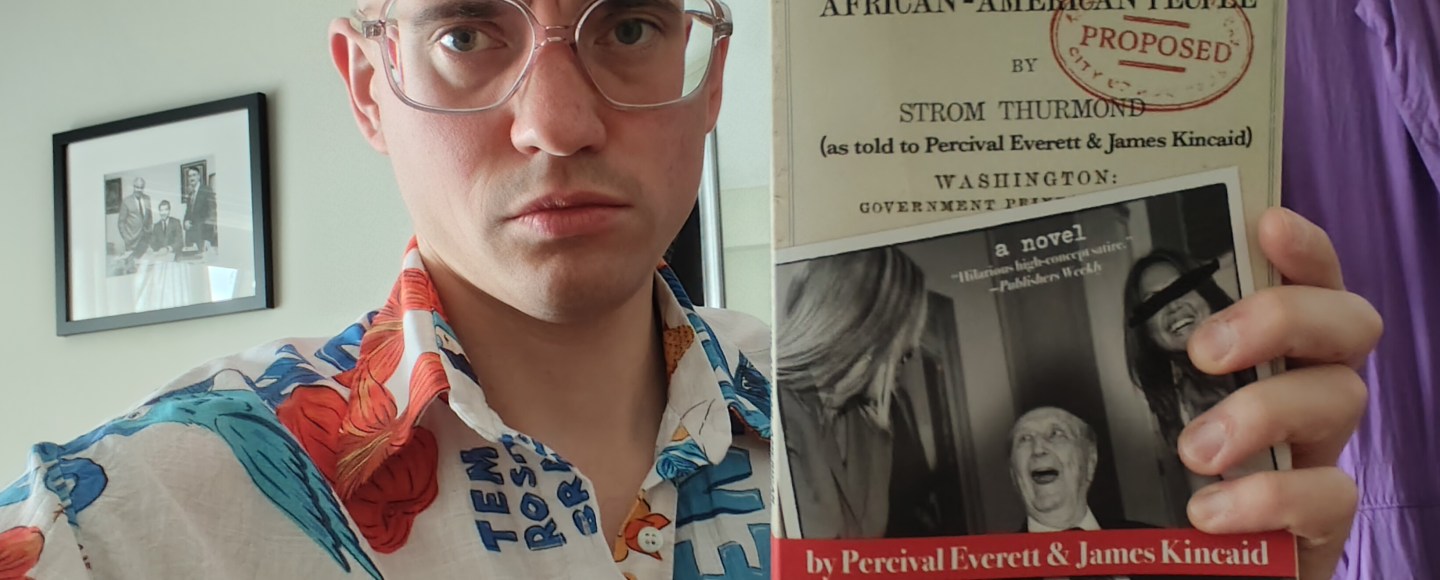
This novel – A History of the African-American People (Proposed) by Strom Thurmond: as told to Percival Everett & James Kincaid by Percival Everett and James Kincaid – is an epistolary novel, yes, but it’s isn’t an example of what I’m referring to there, as this novel – originally published in 2004 – is almost entirely composed of actual [fictional] letters sent between the novel’s characters, rather than a collage of slightly differently stylised chats from different apps. So, rather than being the first (or one of the first) epistolary novel of the 3rd millennium, it is instead one of the last ones from from the 2nd…
–///–
Percival Everett is a lauded and Pulitzer Prize-winning novelist, and also a career academic, and this novel from 2004 is a late mid career novel (you could argue very late early career, possibly) and it does hit up several of the themes of his better known works (this one is published by Akashic Books in a 2024 post-Pulitzer reissue, and was originally published by the same indie small press 20 years earlier), and – as always (in my Everett experience to date) – it does so in a playful and textually inventive way.
Much like his previous 2001 novel Erasure (the book adapted into the Oscar-winning (for adapted screenplay) American Fiction), this is a text that takes a big hard swipe at the publishing industry, as well as American cultural and social mores, the creative process and contemporary and shifting attitudes within America to race and racism.
I was somewhat surprised to discover (when I Googled about 20 pages in) that the Senator of the title – Strom Thurmond – was a real political figure, and was quite probably a well-known one to politically engaged Americans at the time of this novel’s publication (which was when I was still basically a child) and I suppose (in some ways) it’s a good thing that massive “colourful” racists like Thurmond don’t manage to have the legacy of being recogniseable to people who grew up in a different country to them most of a century after they were born.
I was surprised, because as aware as I am of the mantra “you can’t libel the dead” and the statement of deniability at the front of most American-printed novels “any real names are used fictitiously” (something like that), Strom Thurmond is presented here in such a way that I just don’t think you’d be able to publish something like this in the UK without risk of being sued. And that isn’t really a good thing, the situation here, I mean.
The text that is published here as A History of the African-American People (Proposed) by Strom Thurmond: as told to Percival Everett & James Kincaid then, is a series of letters that begin between an Editor and his assistant at the very real publishing house, Simon & Schuster (who do not appear to have ever published Percival Everett and definitely not James Kincaid, who is not a person generally associated with satirical fiction outside of this publication (and yes that is the correct Wikipedia link)) and a strange Young Republican SPAD-type, Barton Wilkes, who writes to them proposing a book (with the title and the author only), which would be the eponymous A History of the African-American People, written by the agéd Republican senator Strom Thurmond…
After much back and forth – internal between the publishers and back and forth with the political aide – it is decided that some academic ghost writers will be needed to make this questionable project bear fruit; well-regarded but not at that point “massive deal” novelist Percival Everett, who brings on his colleague James Kincaid as a second pair of hands.
The novel then adds letters (letters, I must stress, not emails, though later on there are two “transcripts” detailing in-person meetings between Kincaid, Everett and Thurmond himself) between Kincaid and Everett, between each of them and both of them together to various people working at Simon & Schuster, to Thurmond’s main aide leading on the book project (and, a handful of times, to other people working for the Senator when internal Young Republican manoeuvrings and confusions muddy already muddy waters), with family members of people and friends and friends of friends slowly being encircled in by the spiraling repercussions of this poorly-envisioned project which the academic pair fully acknowledge that any meaningful principles and scruples would have led them to turn down on first approach.
Kincaid has been promised a profit share rather than a blunt fee, so really wants to push the text in the hope that it becomes a Springtime for Hitler (see The Producers) style bestseller that somehow white supremacists can love and can also be joyfully read by people who understand that white supremacists are fucking idiots.
Everett, meanwhile, has agreed to a flat fee on publication so doesn’t want to waste any time working on A History of the African-American People until he’s actually certain the book is real and not just the ramblings of an insane Young Republican and an insane and ambitious early career publishing professional, neither of whom convey great reserves of control, poise or professionalism. (These are their fictional financial agreements with Simon and Schuster, not with the (real) Akashic, of course.)
It is for this reason that the two in-person meetings with Thurmond take place – once approximately in the middle of the book (where it is finally confirmed, yes, that he is aware of the book and, yes, that he wants it to happen (though it did start off as an idea from the kooky political aide)), and then a second time as the near-denouement of the novel.
Although a letter is used to end and punchline the novel, to me it did seem a little disappointing for this epistolary novel to drop its general form for the penultimate section, though both narratively and structurally it is coherent.
The novel is a riot – libellous of a dead racist and damning of the publishing industry, with gags throughout and some nice and fun plot manoeuvrings. It is, all said and done, a less ambitious text narratively/emotionally than So Much Blue, though certainly structurally it’s hard to fault or knock its clear ambition and complexity.
I enjoyed it a lot, I really did. Laughing laughing laughing. Though maybe not thinking, maybe not feeling, as much as in the other Everett I’ve read. But it’s smart, it’s entertaining, and it’s also nice and obscure and satisfying.
Recommended, for sure. I’ll be reading some more Percival Everett very soon, for sure for sure for sure…
Yours sincerely,
scott manley hadley

Thank you so much for reading TriumphoftheNow.com! If you like what you’ve read, please subscribe, share and order one of my books. If you love what you’ve read, why not order me something frivolous and noisy from this Amazon wishlist or make a quick donation via my ko-fi page?
I’m currently focusing on parenting and creative practice, so small donations are appreciated now more than ever!
scott manley hadley aka SOLID BALD live
Here’s a video of me recently performing at the prestigious (it has a Wikipedia page) comedy night, Quantum Leopard. Listen to how much fun the crowd is having. You could have that much fun, too!
Forthcoming gigs include the following – there may/will be others:
15th October: The Bar VXXXII Comedy Club, Colchester
18th October: Brockley
19th October: West End New Old Act of the Year Semi-Final
26th October: Alternative Comedy Jam, Brighton
29th October: The Comedy Centre, Isleworth
21st November: Twinkles Cabaret, London
7th December: Coherent Comedy, Online
13th December: Dr Mew’s Sci-Fi Cabaret, Aces & Eights, Tufnell Park
7th January 2027: I’ve got something in the calendar for this but no details
10th March 2027: Lydford, Devon
Discover more from Triumph Of The Now
Subscribe to get the latest posts sent to your email.


0 comments on “A History of the African-American People (Proposed) by Strom Thurmond: as told to Percival Everett & James Kincaid by Percival Everett and James Kincaid”