

apologies for the interruption to Triumph Of The Now.com service through June 2026 – an unexpected death occurred in my family and so I was away and unable to work on the blog for several weeks. It will not be addressed in this or the following long-form post as these were drafted but not completed prior to the loss.
–///–
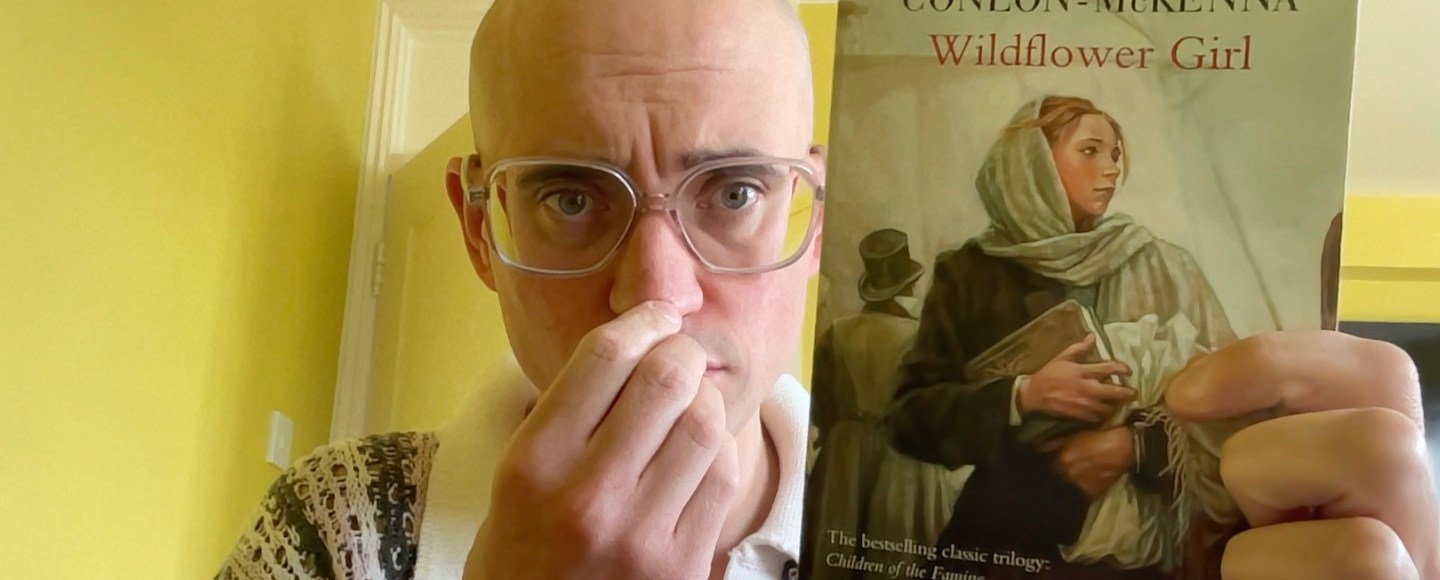
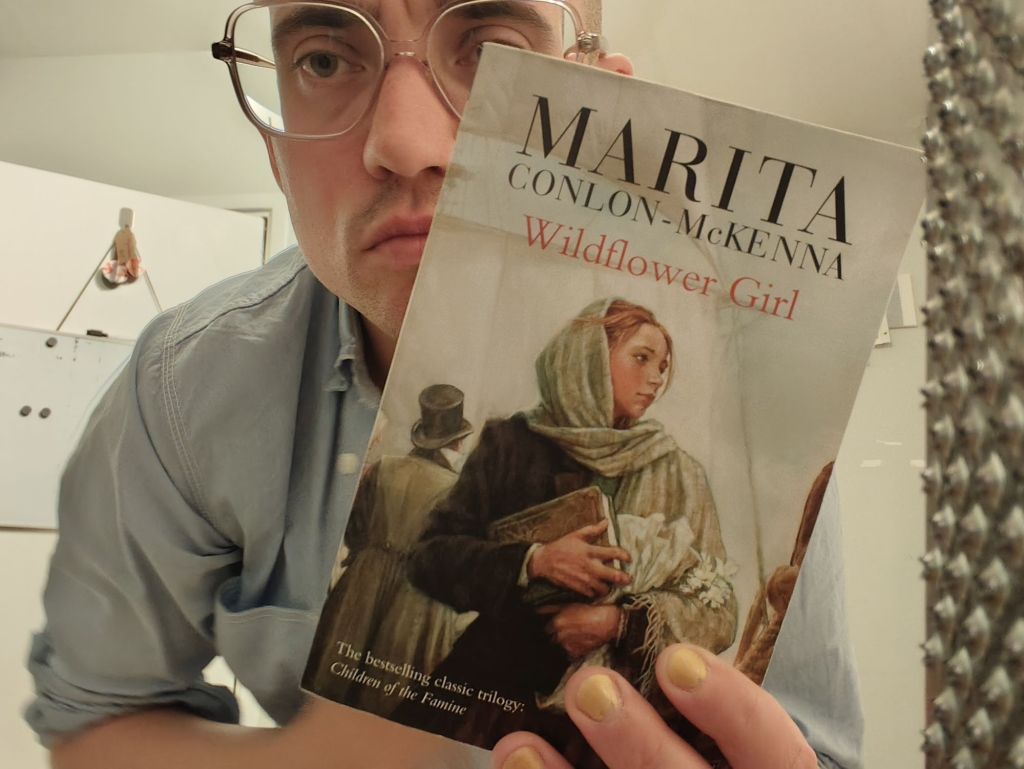
Right. I know it can make a person sound like a fool to question and assess a work of art in terms distinct from those it is asking to be considered by, but I have to say that I finished with Marita Conlon-McKenna’s Wildflower Girl feeling more than a little disappointed.
Yes, it is a novel for children, and yes it’s a historical novel that’s steeped in research and accuracy and has won several awards especially for this, but – for me – Wildflower Girl felt like a flatter, less satisfying follow up to the consistently devastating Under The Hawthorn Tree, an intense, evocative and emotionally challenging read, which is also for children. (My thoughts on that here.)
That book – which this is a direct sequel to – is essentially the same as (and not much less bleak than) Cormac McCarthy’s The Road: three children walk through famine and disease-ravaged Ireland, away from their home, in the hope of finding a safety that may not exist.
That is a novel about faith and rumour but also about adventure, and the stakes are high and are life and death from the start through until the end. In one of its first chapters, an infant dies. And that sets the tone for the whole of Under The Hawthorn Tree, which is unflinching, and often sinister (though not as sinister as the McCarthy), with the blunt intentionality and clear colonialist causes of the famine on display. Authority is not to be trusted in any form, and though one should be suspicious of strangers, one shouldn’t necessarily be presume all are evil.
That novel effortlessly, in neat, tight, simple prose, depicts the end of a world, and these three children meandering through it towards the possibility of an escape from that collapse. This novel returns to those characters half a decade later, though only one of them is in the novel the whole way through.
In the setting of Wildflower Girl, mass emigration from Ireland to the United States is taking place, often with charities and philanphropists funding trans-Atlantic travel for the poor.
The youngest of the three children from Under The Hawthorn Tree decides to go to America, as 1850s rural Ireland doesn’t have much promise for her as a teenager. Her eldest sister decides to get married to a local small farmer, and her brother (between them in age) gets a job working in some stables, so she goes alone.
The most harrowing part of this novel is the journey on the ship itself, and Marita Conlon-McKenna’s description of steerage is, again, delicately yet thunderingly put.
Here, there is illness, there is malnutrition, there is the drowning of an infant when a storm floods the inside of the ship… there’s all the bleakness and uncomplicated direct description that’s also found throughout the previous novel, and it had me worrying where this one would go… but, both narratively, characterfully and tonally, from this point onward, the rest of Wildflower Girl is an exercise in de-escalation.
Peggy (the girl’s name) arrives in Boston and, having made a friend on the ship, they find lodgings together, with a woman who seems to be kind and will find them work, “in service”, i.e. being a servant.
Peggy quickly gets a job, but it’s really shit (aren’t they all!?😜😜😜) and when her employer beats her quite badly (but not life threateningly) she runs back to the place she was staying before, asking for help.
Now, this was where I was expecting the novel to get bleak, with the housekeeper/job fixer rejecting Peggy and leaving her on the street. But, alas, this isn’t what happens; instead, the housekeeper/job fixer is revealed to he kind, and helps and supports Peggy and finds her a much better job.
And though in this second job there are some struggles – the kind middle manager there moves on and is replaced by a dickhead, but she is fired when Peggy mildly poisons the fancy family they feed while ensuring the dickhead is blamed (a risky move that has absolutely zero negative consequences for her, which is a lack of realism that wouldn’t have happened in Under The Hawthorn Tree), so the novel ends with a kinda fine outcome.
Sure, her job isn’t ideal or engaging, but it’s solid, regular and well paid enough for her to live, save some money and even send some back to her relatives in Ireland (even though they send her nothing in return except for boring letters).
Other than poor working conditions – long hours, bad food and lodging, people being rude – there’s nothing truly horrific happening in the second half of this novel, which came as a bit of surprise.
Given the violence and the body horror of Under The Hawthorn Tree, I very much was expecting some horrible [at minimum] threats to come to our teenage heroine, especially for the period in the novel where she works as a maid at a very low-rent men’s hostel.
But nothing ever does.
Things don’t get worse.
And Peggy isn’t really changed by anything that happens, because nothing that happens here is more impactful – or more interesting – than what happens to her when she was younger, as depicted in Marita Conlon-McKenna’s earlier novel.
Yes, it’s good to see beyond the “happy ending”, yes, there’s great historical detail and clear descriptions of places and moments that are often not focused on, but it all just feels less vivid, less engaging, and less impactful than in Under The Hawthorn Tree, which really hit hard.
Interesting, yes, but – to me – it simply did less.
–///–
I recently recorded an episode of The Big Bald Book Club talking in more detail about Under The Hawthorn Tree – I’ll post about it in a little more detail when I can, but here’s a link direct to YouTube for now: https://www.youtube.com/watch?v=v7VbAi57NhM&t=14s

Thank you so much for reading TriumphoftheNow.com! If you like what you’ve read, please subscribe, share and order one of my books. If you love what you’ve read, why not order me something frivolous and noisy from this Amazon wishlist or make a quick donation via my ko-fi page?
I’m currently focusing on parenting and creative practice, so small donations are appreciated now more than ever!
scott manley hadley aka SOLID BALD live
Here’s a video of me recently performing at the prestigious (it has a Wikipedia page) comedy night, Quantum Leopard. Listen to how much fun the crowd is having. You could have that much fun, too!
Forthcoming gigs include the following – there may/will be others:
21st September: West End New Old Act of the Year HEAT, near Goodge Street
5th October: The Defectors present Scratch ‘N’ Sniff at Bread & Roses, part of the Lambeth Fringe
15th October: The Bar VXXXII Comedy Club, Colchester
18th October: Brockley
19th October: West End New Old Act of the Year Semi-Final
26th October: Alternative Comedy Jam, Brighton
29th October: The Comedy Centre, Isleworth
21st November: Twinkles Cabaret, London
13th December: Dr Mew’s Sci-Fi Cabaret, Aces & Eights, Tufnell Park
7th January 2027: I’ve got something in the calendar for this but no details
10th March 2027: Lydford, Devon
Discover more from Triumph Of The Now
Subscribe to get the latest posts sent to your email.


0 comments on “Wildflower Girl by Marita Conlon-McKenna”