
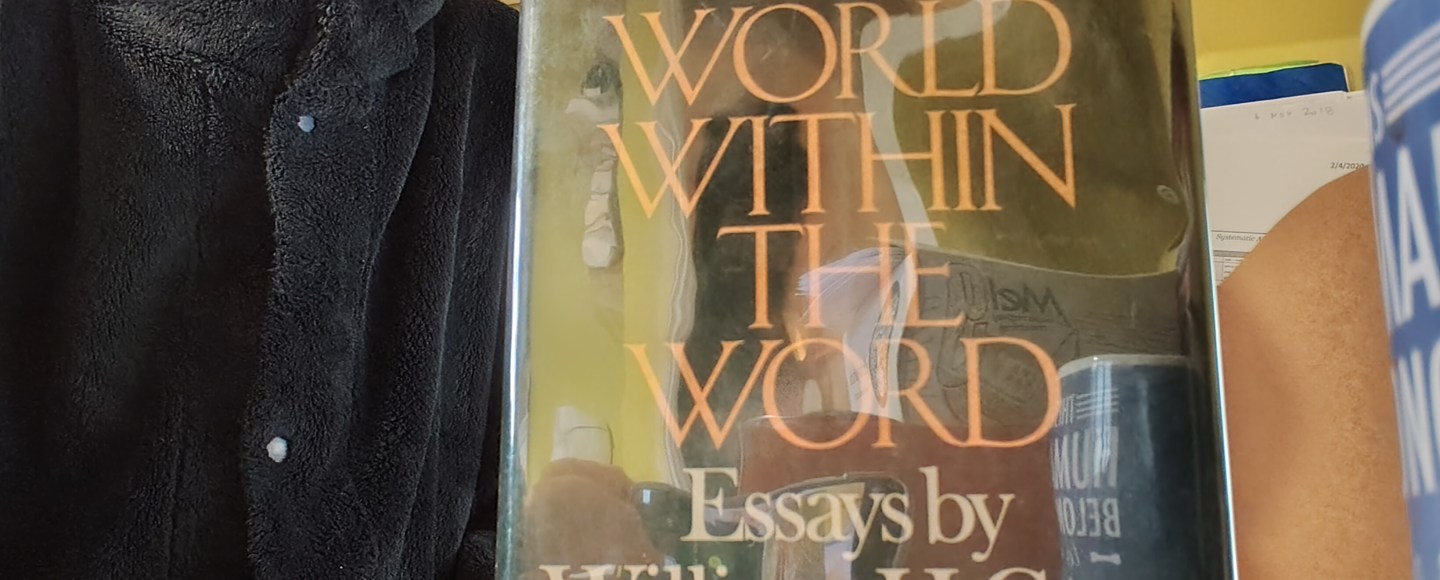

The World Within The Word by William H. Gass (1978)
One of the most challenging colleagues I’ve ever had’s surname was Gass. The person who isn’t Jack Black in Tenacious D – a comedy rock band from my youth whose work I have continued to periodically enjoy throughout adulthood -’s surname is also Gass.
So it’s fair to say that prior to reading this, I had both positive and negative associations with the name “Gass”.
Having read this book of collected essays by the famously great William H. Gass, I would have to say that I still have mixed feelings about the name.
–///–
William H. Gass is one of those writers who people with slightly off vibes often recommend [to me].
The kind of people who talk about David Foster Wallace without caveat, the kind of people who listen to Bret Easton Ellis’ podcast, the kind of people who love literature but “don’t think it’s a place for politics”.
All that told, I don’t think William H. Gass is necessarily “a bad guy” or “a bad guy but just to women” (call me mid-2010s, but I think that makes you a bad guy, David Foster Wallace), he’s the kind of writer who is a male writer’s kind of writer.
And I think what that basically means is that his writing is quite self-indulgent, and so when he’s writing on a topic or imagining a novel about something that the reader is invested in or interested in, it is an absolute delight. Given that some of the essays in this book are about some of my favorite authors, this means there were sections of this book that were genuinely thrilling and I enjoyed them from page to page to paragraph to sentence.
However, when Gass began drilling down into linguistics, into philosophy, and into the history of both of those disciplines – leaving my prior knowledge miles behind – very much I was not with him.
Gass is not writing about the various topics of these essays with any expectation of an unshared intellectual background, or with any pandering to anyone who has not got an identical experience to him within the worlds of thought and books. And that is something that, obviously, has its pros and its cons, and in different contexts makes different amounts of sense…
–///–
There is an essay in here about Malcolm Lowry, who is one of my favourite authors and whose entire published oeuvre I’ve read almost every page of, and the only reason I haven’t read all of it is because the vast majority of Lowry’s published output is what has been published posthumously with varying levels of editorial insight and there is now, alas, shitloads.
I’ve read all two of the books published during his lifetime, of course (Ultramarine and Under The Volcano), I’ve read all of the books that were published by mainstream publishers in the decade or two after his death, basically the things that were [closest to] finished (Dark as the grave wherein my friend is laid, October Ferry to Gabriola, Lunar Caustic and Hear us O lord from heaven thy dwelling place), and I’ve read also most of the things published in the decades more recently (La Mordida, the botched screenplay of Tender Is The Night, In Ballast To The White Sea), when academics have really dived down through and read in detail the leftover papers of everyone who ever knew Lowry as they too died, and then their children died, as caches of writing from the 1940s have been found and given to the University of British Columbia, which holds his archive, and then published in varying “scholarly” forms.
So it’s fair to say, then, that I know far more than the average person does about Malcolm Lowry, so for me reading an intellectual yet witty, engaged and explorative essay about Malcolm Lowry and Malcolm Lowry’s work is an opportunity that I very rarely get.
Something like this, combining clear and in-depth intellect as well as knowledge of the texts and accompanied by an expectation of shared knowledge is a real pleasure, a real privilege.
The essay in The World Within The Word on Proust, whose major works I’ve read in translation, gave me similar pleasant enjoyable feelings, the essay on Gertrude Stein a similar, if less intense, response, too.
There were other pieces in here too, particularly those that were published in more mainstream publications in their original form (by mainstream publications I do mean, like, The New York Review of Books, mainstream literary publications, not tabloids) that were really enjoyable too, but the final third of the book suddenly skews towards more philosophical writing, and writing that was published in philosophical journals, or delivered to academic conferences of philosophers. This sudden change – with the expectation that the reader of the book is someone who defines themselves as a thinker or someone who knows about thinkers or thinks about thinkers and thinks about thinking – suddenly left me intellectually exposed…
I’m someone who reads a lot, yes, and I’m someone who does kind of think about the things they read, though mainly (self-indulgently? narcissistically? immaturely?) in relation to how the things that I read make me feel about myself about the world and what they cause me to remember.
I also think a lot when I read about what’s happening to me while I read…
I’ve been reading The World Within The Word over the course of multiple (two plus) months and though I read the first two thirds of it very rapidly over a few days, enjoying the literary depth-ful analysis, I just couldn’t get into any of the pieces in its final chunk, as all of them were, for me, a struggle.
If I was someone more comfortable with my own intellectual level and failings or successes, I would have given up the book without any shame that I had tried yet failed to “read” it. But I am unable to do that, so instead I ended up carrying this very heavy hardback book around for literally months, only reading a page or ten every week in the majority of that period.
And I’m sure, I’m sure, that were I a philosopher, or a student of philosophy or an amateur aficionado of that intellectual game or whatever it is (I don’t even really know what philosophy is to be honest with you), then maybe I would have enjoyed those last few essays to the same degree that I enjoyed the ones earlier in the book that were just, like, about reading novels. But for me, they were hard without reward; they were clearly informed and informative but yet they taught me nothing, because I did not have the basic building blocks presumed by the writer that would have permitted me to understand what was going on.
And it’s not like I was trying to read this while tired or overwhelmed or distracted by other things (though I have been those things during this period), because once I realised the book was “difficult” [for me], I made sure to only read it when able to concentrate, which made it all the more frustrating that I still couldn’t really grab on and jive with it. The loss, yes, is mine.
Because Gass’ writing is undeniably, on a sentence level, really fucking slick.
He’s witty, he’s very funny, he’s very droll, he’s very dry, and though I didn’t quite understand any of the jokes he was making at the end, it was very clear that the wit and the verbosity was still there…
I could understand why this is a writer that people love, why this is a writer that people talk about, think about and evangelise about.
I think if I had read the first half of the book packaged on its own, I would have gushed about this as one of the best books I’ve read in a very long time, because ultimately what I enjoy reading the most is books that are about reading, that are about engaging with and reading literature as if it’s all that matters, because, yes, that is, actually, the main thing that I really enjoy in my life, even though it takes ever a smaller part of my existence.
So, I have to say, that maybe combining these threads (literature, philosophy, linguistics), these focuses, of Gass’s work at that time (the 1970s) in one book might have been a mistake. I don’t imagine I’m the only person in the world who likes good novels, but knows nothing (next to nothing? no, nothing) about philosophy and the history of the study of linguistics.
Maybe that isn’t true, though, maybe I am literally the dumbest person of the world who has read all of Proust (in translation) and enjoyed it, but though I don’t really believe that’s true, it’s not impossible that it is. I don’t know anyone dumber than me who’s done that, though (these days) I don’t really know anyone, so who am I to guess?
The World Within The World, then, was an engaging read, an interesting read, and what it does mean, yes, is that I do need to try to read something else by William H. Gass, other than On Being Blue which I definitely read a long time ago and I do remember enjoying and understanding, though from my blog post on that it seems I was also in a pretty shit work sitation at the time. Maybe one day I’ll read Gass when things are well?
–///–
I bought my copy of this book from Biblioasis in Windsor, Ontario when I was there at the start of the summer for my mother-in-law’s funeral (for more about that, see this linked post), and had nearly bought it the previous time to that when I’d been in Windsor, back in 2024. (No one got to the copy in the 18 month window, alas, unless it had been sold and re-acquired by the bookstore in that gap.)
It’s interesting, as well as difficult and often sad, of course, to live with someone who’s going through grief.
It’s interesting to see the ways in which intellect and emotion collide.
As those who read this blog regularly will know, my life partner is an intellectual, a real one, as in an academic and artist whose work has been exhibited and published internationally, so very much is someone who probably would have understood this book a lot better than I did.
Lots of the writing I enjoy the most sits where smarts and personhood not necessarily collide, but intersect and align.
Over the past few months, my partner has been reading a lot about grief, reading a lot of works by other people who are intellectuals writing about thinking about grief, which means there is now a stack of beautifully written books by philosophers and cultural critics (Barthes! Zambreno! Others!) exploring death dotted around our messy apartment, so maybe I will try to read some of these and maybe those – unlike the Gass book which, by the end, I just found difficult – will push me towards reading backwards towards the texts that are foundational to this kind of writing or thinking or understanding of this kind of philosophical and digressive life writing, as I’m pretty certain that if I understood it better I would take a lot of joy from it.
Anyway, yes, this post is getting out of hand, and I’ve actually done the initial draft of this post using voice to text (unlike most of the recent ones), which means that editing this is going to be a nightmare because the voice to text function on my phone isn’t as good as it should be, because I keep turning off all the AI permissions because I don’t want the AI permissions turned on, which means that the functionality of my phone is getting worse and worse and worse to punish me. Thank you, silicone valley…
For anyone who’s reading this blog to know about my life – which I don’t think is anyone except possibly my life partner during mutually busy work weeks – I have no updates on my working situation, no final date for this job that I’ve had and not enjoyed the last few months, no solid plan or meaningful plans for any kind of work beyond that, which is all very exciting and worrying and means that this remains a GREAT time to send me £1 – 25,000 as a tip for your appreciation of this literary lifestyle blog.
Fingers crossed things work out, or ideally work BETTER than out, but who knows? I just don’t really enjoy very much of my day-to-day life in the place I live, but I see no way to change location any time soon at all 🤷and have little hope of meaningfully changing my working life in the short term either. Oh well!
The next blog post will be on a recently republished 1970s Canadian feminist novel, part of the Faber Finds series, and I’ve really really really enjoyed it a lot and can’t wait to talk and think about that at some point in the next few days.
That’s something!
Oh well!

Thank you so much for reading TriumphoftheNow.com! If you like what you’ve read, please subscribe, share and order one of my books. If you love what you’ve read, why not order me something frivolous and noisy from this Amazon wishlist or make a quick donation via my ko-fi page?
I’m currently focusing on parenting and creative practice, so small donations are appreciated now more than ever!
scott manley hadley aka SOLID BALD live
Here’s a video of me performing at the prestigious (it has a Wikipedia page) comedy night, Quantum Leopard. Listen to how much fun the crowd is having. You could have that much fun, too!
Forthcoming gigs include the following – there may/will be others:
22nd November: Comedy at Brockley Brewery
7th December: Coherent Comedy, Online
13th December: Dr Mew’s Sci-Fi Cabaret, Aces & Eights, Tufnell Park
16th December: Low Stakes Comedy, Streatham
29th December: Secret Comedy Club, Brighton
30th December: Low Stakes Comedy Club, Streatham
7th January 2027: I’ve got something in the calendar for this but no details
6th February: Seventeen Songs About Lonely Vampires (WIP) at Leicester’s Independent Comedy Festival
10th February: Laughing Belly, Christchurch
24th February: Laughing Belly, Christchurch
10th March 2027: Lydford, Devon
Discover more from Triumph Of The Now
Subscribe to get the latest posts sent to your email.


0 comments on “reading The World Within The Word by William H. Gass (1978)”