
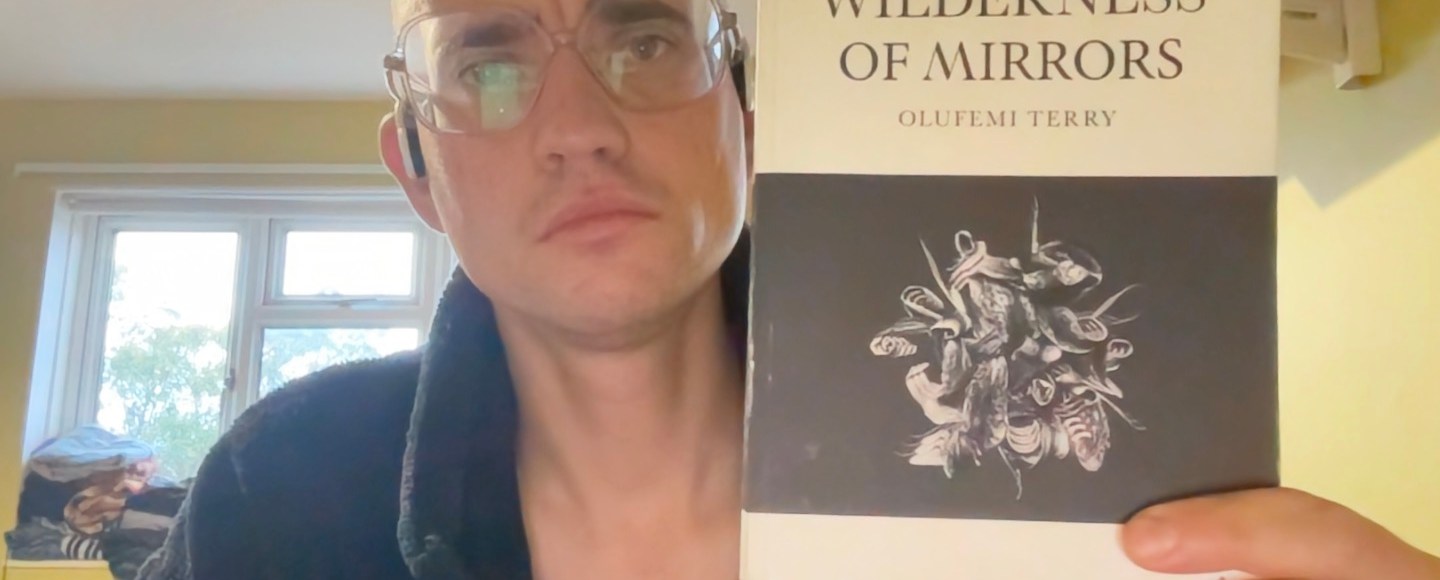

Published in the UK by Les Fugitives
South Africa is an interesting place. Piggy-backing on a work trip my partner was sent on by a university in the Summer of 2023, it is somewhere I have been lucky enough to visit not just in the pages of books. There for about a week and a half, I was able to enjoy some incredible gastronomic treats – including possibly the best meal of my life at Sanza Sandile’s Yeoville Dinner Club – and I was able to see wild penguins (something I struggle to imagine ever seeing again) and sea lions as well as all the other more obvious wild animals one goes to South Africa to see. I also spent quite a bit of time browsing small bookshops and came home with a lovely stack of small press South African contemporary fiction, which offered some real delights.
Two that I think about often are In The Shadow of the Springs I Saw by Barbara Adair, and Mermaid Fillet by Mia Arderne; both very different texts, but both books looking at and towards the contemporary country that the writers lived within; reflective, explorative, discursive; engaged and engaging.
While on my trip to SA, I also visited lots of museums, including the cavernous and deeply important Apartheid Museum, a place I would recommend any [white, in particular] international tourists visiting that country with plans to safari and tour wine farms makes time for, as the creeping sense of national hangover is often palpable, and understanding it a little better helps with the very necessary sense of perspective one needs when treating like a playground a country still riven by massive economic divides due to historic racist politics.
Wilderness of Mirrors by Olufemi Terry is not a South African novel I bought on that trip three years ago which has only very slowly made its way into my hands, but is both not a South African novel at all, and is also a newly released text published by UK indie press, Les Fugitives (though it was published in the USA by Restless Books in 2025). This is part of the imprint of that publisher that looks to release English-language literary fiction, rather than the newly-translated Francophone texts it was initially focused on. This is the series that released the engaging undergraduate-set bildungsroman To Rest Our Minds And Bodies by Harriet Armstrong (which I may have misread – see my response here) and the breath and breathe-taking mid-life crisis/mortality/cancer/doctoral novel The Surviving Cells by Brian Willems, one of the best things I’ve read this year*.
In terms of protagonist age, Wilderness of Mirrors is (like To Rest Our Minds and Bodies) again about youth, and about learning and gaining a better sense of self, though set within a fictionalised version of not-quite contemporary South Africa. A “parallel, contemporary southern part of Africa still reeling from the effects of racial Partition” says the blurb, and though I think we all know which part of southern Africa most famously had itself torn apart racistly in the same mode, and also has a tourist-loved coastal region hosting a major international city whose landscape is dominated by a massive mountain, with plenty of wine farms a short journey in-land, this very much isn’t a novel that is a simple pseudonymising of real places and real situations, it is one that, yes, parallels situations that exist.
Emil is the protagonist, the son of a successful if post-peak politician, and he is taking a break from his medical degree (planning to specialise as a neurosurgeon, though one doesn’t get the impression he’s particularly interested in doing that, or – possibly worse – that the writer wasn’t particularly interested in learning enough about studying neuroscience to effectively write much about the experience of training in it), and travels down to the South of the country to stay with his aunt (his father’s sister) and his cousins, who are all still recovering from the very recent death by suicide of their husband/father.
Emil crashes into their lives with minimal interest; one of his cousins has moved out (meaning he’s ended up with far more room to himself than he’d expected) and is now living with a lover while working full time and studying most evenings; his other cousin seems to be floundering much more, and he is in some kind of unhealthy relationship-friendship-dominant transactional engagement with a local drug dealer; his aunt is having an office romance, the first since her husband died, and there is something a little “off” with the man she’s seeing, though the kind of thing that often seems a little “off” with most middle aged men you meet, so it’s never really clear whether this is something Emil should be trying to influence his family member to extricate herself from or if is just is, alas, a case of what will be will be… (One of the few moments of decisive action in the novel is when Emil physically ejects his cousin’s drug dealer lover-friend-employer from the family home).
What Emil spends most of his time doing, though, isn’t hanging out with his grieving family, but is instead hanging out with an affluent German-Haitian artist and philosopher who is cosying up to a somewhat nationalist somewhat left-wing pro-Creole independence/reparations political firebrand who was recently deported from the United States where he (accidentally?) violated his student visa (studying law) by becoming involved in campus protests. Bolling, the German-Haitian, writes extensive philosophical diaries in his notebooks, which Emil reads and re-reads and memorises, despite lacking the prior knowledge of German and Austrian philosophy to – initially – understand a lot of Bolling’s references.
Emil and Bolling have an ambiguously sexualised relationship – it’s never quite clear if they hook up the one time that is described, or if it has become a recurring part of Emil’s routine – while Emil has an unambiguously sexualised relationship with the older sister of an old schoolmate of his, a white woman who is the daughter of an incredibly successful crime novelist, who is working on a PhD about Freud while becoming increasingly addicted to the readily-available cocaine that is flooding into the city as it becomes more and more popular with international tourists.
While having a day trip swimming in a reservoir, Emil accidentally catches his friend taking a shit in some bushes, after which he is overwhelmed by desire and the two of them become sexually interlinked until, eventually, they end up in a safe house with the political leader who is in hiding following a protest that turned into a riot, where over the course of a week, the woman shifts from one shiftless man who is taking a break from his medical studies to one who is taking a break from his legal ones.
The novel, then, is full of contemplation of politics, and philosophy; philosophical thought, and political thought; ideas are debated and discussed, and Emil is open to and amenable to all sorts of ideas and ideals; the ones inherited from his now uninspiring politician father (he was a member of the now-unloved party that ran the country in its recovery from Partition), the ones from the younger peers he meets down in the South, and the ones that flow around and across this fictionalised version of this famously politically-interesting country.
What does Emil want to be? What does Emil want to learn, to know, to believe? The novel doesn’t really give any straight answers; this doesn’t feel like writing about philosophy and politics that firmly wants to push forward a particular ideology, and maybe that is me having not understood its purpose, but it felt more to me like a book about someone understanding the plethora and variety of opinions that are available to be imbued and understood and believed. Contradictions run riot in the body politic, in the hearts and minds of many people; Emil doesn’t gain any kind of blind faith or blunt faith; he sees and discusses options, choices, possibilities…
As a piece of philosophical and political fiction, the ways in which it played with recent and contemporary politics – as I am aware of them – in South Africa in particular was intriguing, though I did certainly feel far more ignorant about the gaps in my knowledge between realities and Terry’s renamed and/or reconfigured politics than I ever did when conscious of the gaps between my very limited knowledge of philosophy and the use of it here. Perhaps, then, that is due to being at a very different level of ignorance; when it comes to Austrian and German philosophers, I honestly don’t know what I don’t know, whereas as someone who read almost every single plaque in the Apartheid Museum, I’m very much aware of the limits of my knowledge of racist and post-racist politics in southern Africa. I know I know very little; but I know what seems like slightly more than, yes, I know about the philosophers…
Wilderness of Mirrors is, then, an intellectually playful novel; there is a blunt poetry to Terry’s work and a jumping between perspective that permits a fluidity and play with voice (though I did wonder if maybe in earlier edits there had been significantly more of the voices of those other than Emil, as the amount that is here did sometimes feel a little unsatisfying.
It is, then, about a person studying their experience of the world, and having their sense of self expanded by sexuality and thought and drug use, rather than being expanded through study.
It is not about medicine, and is a real contrast to Brian Willems’ The Surviving Cells, which is a novel written by someone who is not an oncologist that very much felt written by someone who had learned, and was interested in, learning what that life might be like; but, that, then, is kinda the point of this novel; Emil is a privileged young man on a school to university to career pipeline, and he doesn’t seem remotely interested in that; he wants philosophy and physicality (or at least is interested in being around people who do), and at the end of the novel when he leaves the city he has been in, it is not clarified exactly where (or why) he is travelling to… Is he taking a brief recreational trip before returning to his less Bohemian home city, possibly to settle, possibly as a stop-off on further adventures? How many of the experiences he has had that he will take on board; will his travels take him to Europe to catch up with Bolling and the opportunities and excitement he offers? Will he never return to his father’s home and his medical degree or is this a planned break before a re-commitment to normalcy and an expectation of never veering again? Will he be a slightly more rounded and interesting version of himself? Or will he never make it anywhere for long at all? Will he not actually have been changed by any of this?
It’s an engaging, serious, novel that is nevertheless very playful. Would it be better enjoyed with slightly more or slightly less knowledge of southern African politics, particularly from outside of South Africa itself, which my irritating brain kept trying to incorrectly apply to this fictionalised and not real version of the world? Maybe. Would it be better enjoyed with a wider reading of philosophy than I have? Probably, but so too would many, many, things.
An enjoyable read.
Read more and order direct from Les Fugitives via this link
– – – – – – – – – – – – – –
* Unfortunately for Willems, though, having started a full time job for the first time in two years recently, one of the first things I did when I first got paid was buy both of the two Mathias Enard novels released in English since I last had first-hand book-buying money, so I’ll be reading those before the year is out, and given the raw potency of all of the other Enards I’ve read, I imagine I’ll enjoy them more, even if they’re not technically “better” (though they might be).
Discover more from Triumph Of The Now
Subscribe to get the latest posts sent to your email.


0 comments on “Wilderness of Mirrors by Olufemi Terry”