
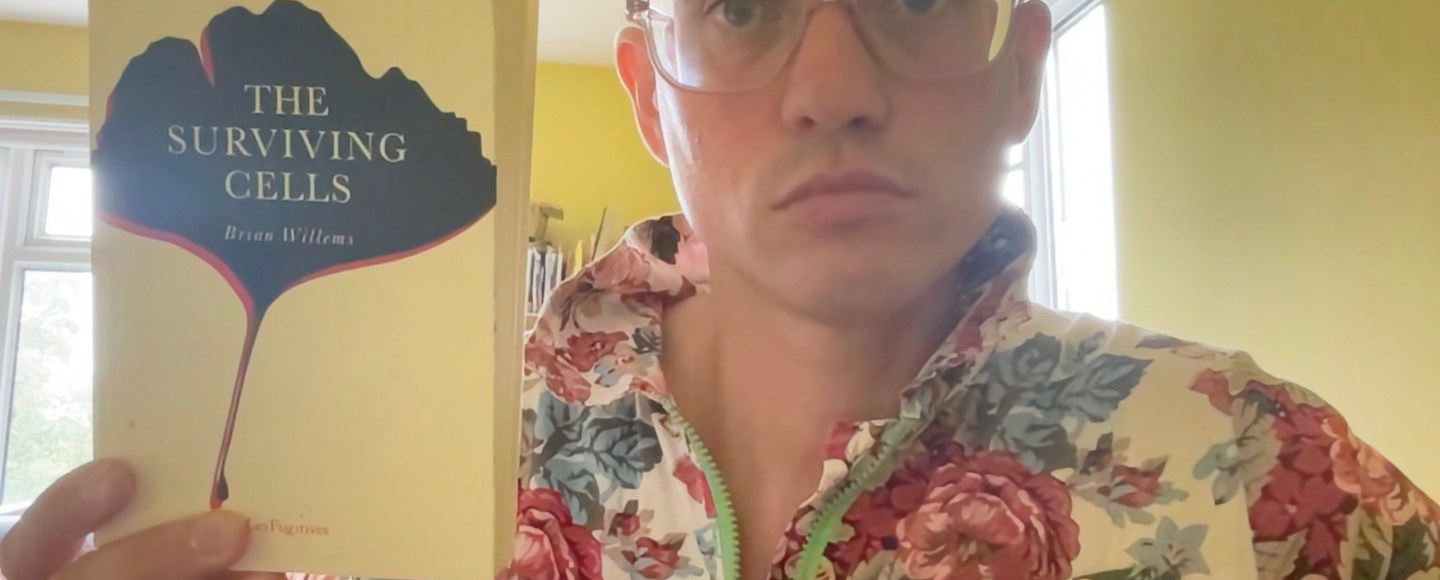

The Surviving Cells by Brian Willems is published September 2026 by Les Fugitives
Les Fugitives seems to be one of the few British indie presses that has survived the past few years without either losing sight of its purpose (i.e. publishing great works of literature), or deciding that quality literature needs to be increasingly formally challenging to have validity.
This latter notion is something I’ve encountered a few times in the past couple of years1, and is a strange return to the forms and styles of modernism a century after this was the mode de jour. It speaks, of course, of a literary scene that is trying, rather like the first time around, to grapple with the unknowable and shifting contemporary sands of existence, but is unable to find an original way to do this.
Back then, writers and artists were overwhelmed by the advent of mechanised war, normalised civilian bombing campaigns and the mass re-introduction to society of an entire generation of irrevocably physically and/or psychologically damaged men. While stream-of-consciousness was a new attempt to evoke this moment of colossal flux, now, though, it doesn’t feel [to me] like a good way to question modern mores, rather instead like an increasingly prevalent ostrich-in-the-sand type gesture.
“Well,” say the writers, “I can’t figure out how to evoke the digitised, internet age on paper, so I will instead emphasise the fact that I read and enjoyed The Waves in a better way than you did and at a younger age.”
As creative careers and the idea that a creative practice is an acceptable and normal thing to have in your life alongside less rewarding – often demeaning and always unstimulating – paid work fades as an option for anyone who isn’t born to wealth and/or willing to sacrifice their soul and wellbeing in order to pretend that they are, the breadth of voices who are able to – and expected to – tell their narratives and personhood in music, in literature, in film, atrophies, collapses, falls apart.
When literature isn’t a part of a wider life, rather what a person does as a leisure activity masquerading as a career, the need for understanding, and the normalisation of dick-swinging intellectual posturing (you don’t need to possess a dick to do dick-swinging, you just need to be one) rises.
And so many smaller presses and so many readers seem to equate quality with complexity.
Needing to concentrate with all of your soul on a book to parse its meaning is all well and good when the reading you are able to do takes place in a library (probably private) with no distractions, but if you are a person who reads on a commute and/or reads in the moments at the start and end of the day when their chores and childcare is done, then something that takes pages and pages to complete a thought (or even a paragraph) simply doesn’t match. Simply doesn’t work.
And it’s not true that big words, big sentences, big paragraphs, mean big ideas. They certainly don’t equate to big characters, big stories, big literature.
The Surviving Cells is a novel that is accessible and immediate from the first page.
It is written with crisp and engaging prose, but just because it is legible in scattered moments around a busy life, doesn’t mean it’s of any less value than something that takes more of a strain.
This is hefty, weighty, serious, fiction that knocks around ideas about, essentially, every important topic known to humanity, and it does so with poise, with wisdom, with heart and with a searing emotionality and complex construction of a wide cast of characters, many of whom float, sketched, in the background yet fade into focus and back out again with moments of punishing, articulate, detail.
The Surviving Cells starts off as a very good example of a slightly (and wrongly, I think!) out of fashion literary genre: the mid-life crisis novel.
Dr Ana Jovanovic is an oncologist, a cancer doctor, living in Minneapolis and in her 40s, reeling from a messy divorce (which turns out to have happened much less recently than she would like to pretend), who ends up on a forced sabbatical due to overruling a decision by the medical board and performing exploratory surgery on a young cancer patient that the procedures in place recommended she treat as a low-risk patient.
She had a hunch – and an awareness that the patient’s father recently died of a similar cancer while under her care and treatment – that the situation might be worse than the scans indicated, and she was proved correct. However, once treatment had begun and the prognosis very much moved from an unknown problem to a problem that is not unsurvivable, the young patient killed himself. An enquiry is scheduled to begin at some point, but off work for a bit, Dr Jovanovic heads off to a medical conference and has a little affair with a much younger Korean medical student on an American placement, who asks her to look into some medical research malpractice that he has stumbled upon in his workplace.
The novel, then, is set up to give us a peripatetic, picaresquely playful journey in the life of this doctor who has stepped away from doing what she is told and expected to do; she both breaks and bends the rules in pursuit of what she believes to be the best medical outcomes for her patients, but then acts with swift and direct contempt against others who are (possibly) doing the same. Dr J continues to sneer at the unethical practices of others, at the choices of her colleagues that she believes are not the best for their patients; and then, alas, she herself is diagnosed with a terminal cancer and the overall tone and reach of the novel changes.
This story, then, becomes not only about the ultimate powerlessness of medicine in face of mortality, but becomes a beautiful and deeply moving piece about the ways in which people see themselves and are seen by others. As Dr J slowly fades over the second half of the novel, we see the people she has sneeringly, partially, described suddenly in detail; her brother who has lived a very different life to her, that she has judged a failure, is seen to be far more content than she has ever been; her daughter becomes more than just the sum of her projections; and her ex-husband and his new family, her colleagues and former lovers are all seen as more than just foils for her own opinions and interactions; as she passed out of her own life over the course of the text, the novel and its prose passes out of confinement within her consciousness.
This isn’t a novel that seeks to mock or belittle its life-saving (and sometimes not) doctor-protagonist, it rather looks at the ways in which we cloud our own perceptions with our experiences and our desires, though sometimes we read true while others see us as misreading…
It’s a beautiful and a wise novel, full of deeply moving meditations on loss and grief, but also on hope and regret and the ways in which even the most selfish-seeming behaviours can be motivated and underlined by motives that absolutely fail to create any satisfaction or joy in life…
just because someone does what they want, doesn’t mean that they are happy…
…fulfilling want doesn’t translate into satisfaction…
…that what offers hope and solace to one person doesn’t necessarily offer hope and solace to another…
…that how one person wants to die isn’t the same as others…
… that no one should be forced to, or expected to, spend their final days and hours in any particular manner, proscribed by others…
It’s also about how propriety overrides desire, the biggest desire a person can have…
…That holding on for the sake of others even while in immense pain becomes a repeated behaviour even when nothing is gained by an extra day, an extra week, or dying, when being dead would be easier for all…
Is a quick death preferable to a slow one?
Is a late diagnosis where there is no hope better than the horrors – as described here – of cancer cures?
Chemotherapy, the oncologist believes, is a delaying tactic only, whose side effects and repercussions mean it’s not worthwhile for many cases and is only chosen in order to, hopefully, provide extra unpleasant time for the benefit of the soon to be grieiving, rather than the patient herself. Yet, when the doctor herself is terminally ill, she continues undergoing treatment against her own prior wishes and opinions, but not because she wants to live, but because she wants her daughter to not think that she wants to die.
This is a serious novel about medical ethics, yes, about the ways in which we live and the ways in which we die. It is emotionally potent, full of rich characterisation and beautiful descriptions of personhood and thought. Clear, crisp writing that is never ambiguous with what and how it is describing the viewpoints and the events it is looking at.
This is powerful, engaging, engaged writing that deserves a wide readership. I wept several times, mostly on the Northern line (though in the recent Summer heat the Northern line has been tearjerkingly hot around the clock) as I travelled to and from my brief run of live shows as part of the Camden Fringe. It was a pleasure to travel with this piece of heartfelt, emotionally and intellectually sharp fiction.
Highly recommended.
Order The Surviving Cells direct from Les Fugitives via this link
- Or is it just my own mind atrophying since having a child and what was once simple has become complex? (No, it’s not this, but if you need to pretend this is it, then by all means go ahead!) ↩︎

Thank you so much for reading TriumphoftheNow.com! If you like what you’ve read, please subscribe, share and order one of my books. If you love what you’ve read, why not order me something frivolous and noisy from this Amazon wishlist or make a quick donation via my ko-fi page?
I’m currently focusing on parenting and creative practice, so small donations are appreciated now more than ever!
scott manley hadley aka SOLID BALD live
Here’s a video of me recently performing at the prestigious (it has a Wikipedia page) comedy night, Quantum Leopard. Listen to how much fun the crowd is having. You could have that much fun, too!
Forthcoming gigs include the following – there may/will be others:
15th October: The Bar VXXXII Comedy Club, Colchester
18th October: Brockley
19th October: West End New Old Act of the Year Semi-Final
26th October: Alternative Comedy Jam, Brighton
29th October: The Comedy Centre, Isleworth
21st November: Twinkles Cabaret, London
7th December: Coherent Comedy, Online
13th December: Dr Mew’s Sci-Fi Cabaret, Aces & Eights, Tufnell Park
7th January 2027: I’ve got something in the calendar for this but no details
10th March 2027: Lydford, Devon
Discover more from Triumph Of The Now
Subscribe to get the latest posts sent to your email.


0 comments on “The Surviving Cells by Brian Willems”