
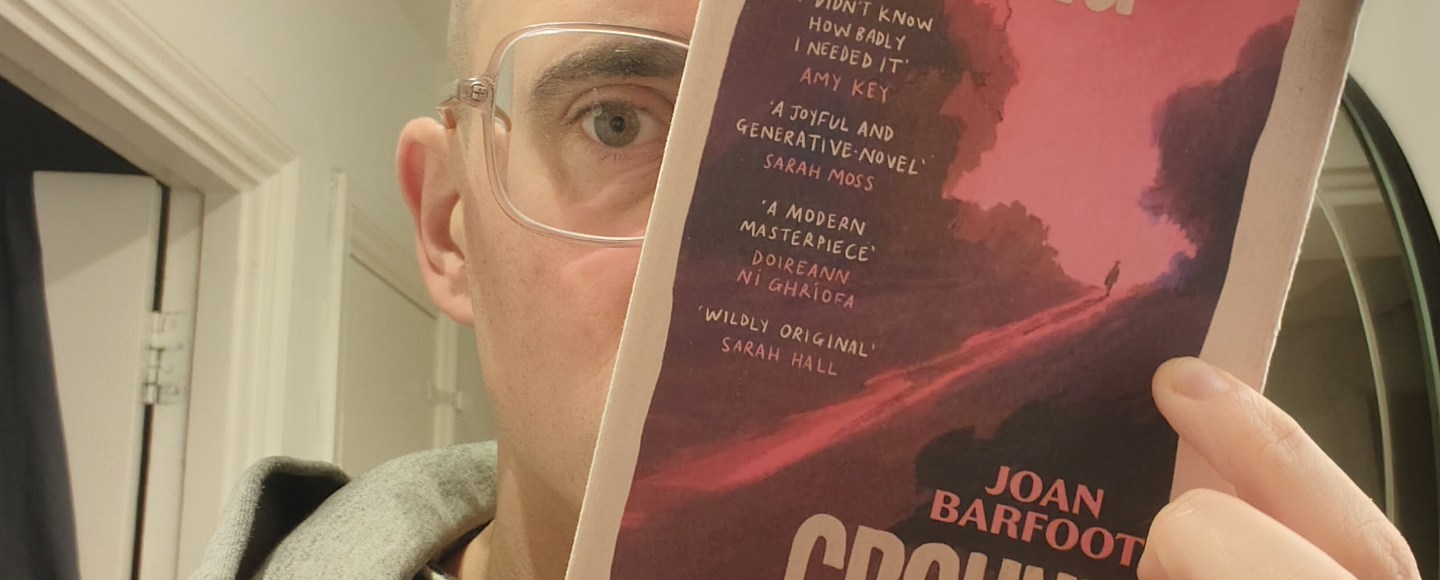

A beautifully written novel about escape; fantasy, yes, for most of us
Once again, Faber has found and re-published another neglected masterpiece.
This one, Gaining Ground by Joan Barfoot, is a 1978 Canadian novel about what could alternately be viewed as mid-life crisis or self-realisation, as its protagonist finds happiness, stability and a deep sense of purpose in running away from her responsibilities as a parent and, instead, moves solo to the countryside to tend to her garden and live off only the food she can grow herself.
After living in this solo situation for almost a decade, her now (barely!) adult daughter shows up and forces her to do something she hasn’t done for years: chat.
Can her happy stability survive the encounter with a ghost from a previous, much less happy, life? Or is she doomed to being pulled back to the city, back to “reality” or “normality”, as there doesn’t seem to be a way forward, at this point in time, where she can be an outsider, a recluse, a borderline ascetic (like – major scott manley hadley callback – John the Baptist?) while still receiving occasional visits from a person who lives back in the “real” world?
–///–
It’s a joyful text, then, about joy.
Written in the 1970s, Gaining Ground was perhaps even starker and more groundbreaking at that time in its depiction of a woman – a wife, a mother – walking away from family and home than this might be now. That said, this remains an act that would broadly be considered taboo, though I suppose the major change since publication would be that this act would no longer be acceptable if done by a non-birthing parent now, too, as even awful men are expected to remain present to any children they’ve conceived.
Abra, the woman this novel is about, is an “Abandoner”, she is someone who leaves two children (both close to (one either side of) ten years old) in their nice big house with their nice, “fair”, stockbroker father, who – of course – replaces her pretty quickly with a younger, second, wife once it becomes clear that Abra won’t be lured back by the promise of high-end therapy and enough additional domestic employees to remove all burdens of domestic labour. She doesn’t want, and doesn’t need, either of these things.
–///–
Gaining Ground is a novel that looks at the ways in which material circumstances can influence and destroy a person, how living a life that lacks any kind of personal meaning erodes a self deeply.
When your life doesn’t matter to you, it doesn’t matter to anyone else, it doesn’t matter at all.
Abra’s life with Stephen was childcare and managing a household, occasionally cooking and occasionally hosting dinner parties for Stephen and his colleagues and their life partners, too.
It is a life of tedium, which she finds increasingly claustrophobic and vapid over the course of years, yet there is nothing better or more meaningful that she can realistically envision herself doing.
Until, that is, during her daily cover-to-cover reading of the unnamed newspaper that Stephen subscribes to, she spots a property listing two days in a row that piques, irrevocably, her interest.
And she leaves.
Abra uses some inherited money from a grandparent that her husband had been too macho and proud to permit them to amalgamate into their family finances to make the purchase of the rural home and land, and she goes and lives there, growing her own food, self-sufficiently. Well, self-sufficiently by way of the big inheritance from her dead grandmother.
It’s beautiful.
–///–
Gaining Ground is described as a feminist classic, due to its depiction – its unjudgmental depiction – of a woman who chooses her own sanity and happiness over the patriarchal roles of mother and wife, and it really is beautifully done.
As the daughter reappears and their relationship rebuilds over the course of a few weeks during the summer before the daughter begins university, there is a real tension in the risk of Abra being returned to “mainstream” society, being lured in and pulled in by this connection with her previously abandoned child…
The novel depicts this as if the potential return, though, is a potential tragedy…
Again, unless I’ve just completely misread the book, as often happens, and instead Abra’s opportunity to remain in a bucolic, pastoral, self-sufficient life at the end is meant to be seen as the tragic option, rather than a return to Toronto and her daughter and awful-sounding adult son (who is only described beyond childhood in the reported comments of his sister).
–///–
I loved it, I also found it deeply aspirational in some ways.
Like Abra, I too feel no solid sense of big meaning in my life. I do genuinely, very much like my small little family, and the interior domestic life that I have isn’t a part of my life I have an unresolveable problem with.
The idea of going and living in the middle of nowhere, growing vegetables and not having to go and do demeaning, depressing and ethically dubious work in exchange for blunt money, is something I would love to realise.
I do spend slightly more time than is healthy (i.e. any) browsing property listings for rural small holdings in beautiful parts of the world. It doesn’t take a lot to set yourself up in one of these spaces (or at least it doesn’t seem to)… Enough solar panels to recharge your phone and keep a fridge-freezer functioning seems to be only around a grand second hand and not a huge lot more if you’re buying it new… And a small plot of land and a house on it… you can get that for under 30K if you’re not too squeamish about where you live and how isolated you are, and for 100 grand you can get something nice somewhere with relatively easy access back to “society”, for when you want it. (Though, of course, the costs of visa applications and other necessities would pile up beyond that.)
It’s not an amount of money that a person couldn’t acquire without attaining levels of inhuman affluence, but at this point in time I don’t have enough spare cash to buy those secondhand solar panels, and so this kind of route to escape the horrors of tedium and misery is just something that isn’t open to me.
Sure, at this moment I have enough of a regular income to probably trick a bank into giving me a medium term loan to maybe cover a 15/25k grand shack in some woods a six hour drive from an airport, but that wouldn’t be ideal or practical at all. There’d be no point in doing this kind of thing unless – like Abra – you can do it properly and irrevocably.
I think where this novel is open to critique, in its lack of interrogation as to the mode in which Abra finds her freedom. Although, yes, it is the fact that her husband refused to accept her grandmother’s inheritance as “family money” that gave Abra the later freedom to use it to escape his boring, conventional, affluent life, but this simply isn’t something the vast majority of people in the world have access to.
Most people in the world do not have a grandparent whose death gives them enough cash to buy property and live off it forever… The last time I lost a grandparent, I got a couple of coffee table books and a few framed images clipped out of magazines. Though the one before that did leave me enough money to cover the tuition fees for my master’s degree (which was a fun year, though it was not an investment in any way at all).
–///–
In her rural home, Abra cannot be lazy, she cannot be disengaged, she has to maintain the work required to keep her vegetable garden growing throughout the year.
There is harvesting, there is weeding, there is watering, and of course there is all of the maintenance required to keep her house safe and livable, too, as well as chopping wood for her winter fires.
Abra hasn’t given up on work, and in many ways the life she has now is considerably harder, certainly physically, than the life she had before as the housewife of a stockbroker in a major world city.
What she doesn’t have to do, though, is the emotional labour did that require, and that’s the thing that (in my experience) really grinds you down.
The days when I get home after having spent several hours doing meaningless manual labour I sleep far better from the days when I spend several hours doing meaningless admin.
I don’t get anxious about how I’m going to carry a table, but I do get anxious – so anxious that I can’t sleep – about how I’m going to interact with people who I think are [censored] that might be mean to me.
That kind of labour, for many people – I don’t think just Abra and I – feels so much harder than lifting things.
I do not have a garden, I do not have an allotment, I do not grow my own food, and I do not see any likely scenario where that happens.
If I had the kind of money that Abra in this novel has, would I move to a remote house with big enough, fertile enough, fecund enough land to set up a life-supporting vegetable patch and live there? Yes, I absolutely would. That’s exactly the kind of thing that I’d like to do. What will I do instead? Because nothing I’m doing now works.
It is interesting, yes, to accidentally pick up a book that so dramatically chimes with one’s own experience of the world, and the yearnings one has to leave the scenarios and situations in which ones feels deeply unsatisfied and deeply out of place.
Abra is uncomfortable, deeply uncomfortable and deeply unable to feel like herself, until she finds this isolated rural home, where she is able to begin to build a life that feels like it is hers.
She gets to have a life she has chosen, rather than one she has fallen into by dint of class origins and normalised expectations.
It’s a beautifully written novel, with its nature descriptions and its emotional descriptions, and its descriptions of middle class Toronto and Schitt’s Creek type middle-of-nowhere Southern Canada in the 1970s…
The prose is stripped back but still poetic, it is clear without being unemotional; it’s a gorgeous novel about someone who chooses authenticity, and never feels inauthentic.
It’s beautiful stuff. Highly recommended.

Thank you so much for reading TriumphoftheNow.com! If you like what you’ve read, please subscribe, share and order one of my books. If you love what you’ve read, why not order me something frivolous and noisy from this Amazon wishlist or make a quick donation via my ko-fi page?
I’m currently focusing on parenting and creative practice, so small donations are appreciated now more than ever!
scott manley hadley aka SOLID BALD live
Here’s a video of me performing at the prestigious (it has a Wikipedia page) comedy night, Quantum Leopard. Listen to how much fun the crowd is having. You could have that much fun, too!
Forthcoming gigs include the following – there may/will be others:
22nd November: Comedy at Brockley Brewery
7th December: Coherent Comedy, Online
13th December: Dr Mew’s Sci-Fi Cabaret, Aces & Eights, Tufnell Park
16th December: Low Stakes Comedy, Streatham
29th December: Secret Comedy Club, Brighton
30th December: Low Stakes Comedy Club, Streatham
7th January 2027: I’ve got something in the calendar for this but no details
6th February: Seventeen Songs About Lonely Vampires (WIP) at Leicester’s Independent Comedy Festival
10th February: Laughing Belly, Christchurch
24th February: Laughing Belly, Christchurch
10th March 2027: Lydford, Devon
Discover more from Triumph Of The Now
Subscribe to get the latest posts sent to your email.


0 comments on “Gaining Ground by Joan Barfoot”